Table of Contents
Free case qualifier
In a car or vehicle accident?
Answer a few quick questions about the crash and your injuries — we route your details straight to intake.
Start the qualifierMost riders searching for an attorney after a motorcycle accident have already noticed that the claim feels different from a car crash. The adjuster's first questions are about speed, lane position, and whether you were wearing a helmet. The bills are bigger, because a rider has no steel cage, and the coverage on a motorcycle policy is usually thinner than anyone realized when they bought it.
This guide shows what a motorcycle accident attorney in Colorado actually does differently: the coverage map that is unique to riders, the fault and helmet arguments insurers raise, and one clearly labeled hypothetical worked through to the dollar so you can see where the money comes from and what a rider keeps.
If you want settlement ranges by injury type, our guide to motorcycle accident settlements in Colorado covers them. This page is about the lawyer's work and why it starts somewhere most riders do not expect.
Why a Motorcycle Claim Is Not a Car Claim on Two Wheels
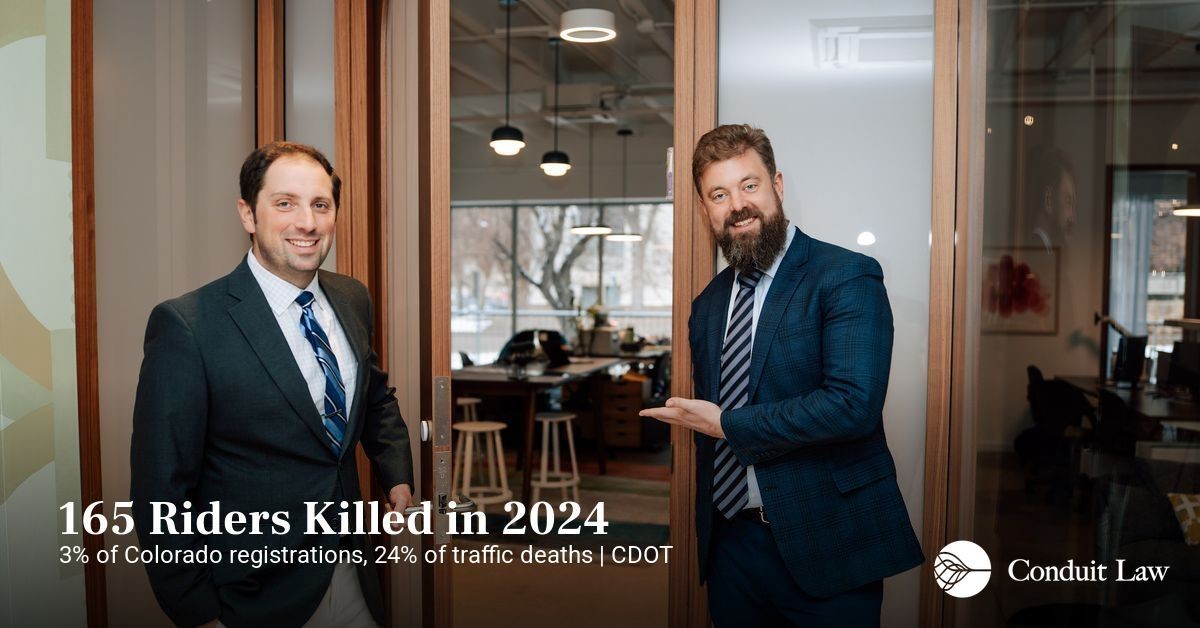
Colorado riders make up a small share of the vehicles on the road and a large share of the people who die on it. According to the Colorado Department of Transportation, 165 motorcyclists were killed in 2024, a state record, and motorcycle deaths were nearly 24% of all Colorado traffic fatalities while motorcycles were only 3% of vehicle registrations. CDOT also counted 774 serious bodily injury crashes involving motorcycles that year. Those numbers shape every motorcycle file a lawyer opens. Injuries tend to be fractures, surgeries, and road rash rather than soft-tissue strains, which means damages climb past the at-fault driver's policy limits faster than in a typical car crash. And insurers know juries sometimes carry assumptions about riders, so they test fault harder. Our Colorado motorcycle accident statistics hub tracks the numbers by year, helmet use, and season, with every figure dated and linked to its source.
Where we start: on a serious motorcycle case, the first fight is usually not the bias against riders. It is the coverage map. A rider with $180,000 in losses and $25,000 of available insurance has a coverage problem first and a fault problem second, and solving them in the wrong order costs real money.
The Bias Problem Is Real, but It Is Not the First Problem
Every motorcycle lawyer has heard the adjuster's version of the crash before reading the police report: the rider must have been going too fast, weaving, or hard to see. That framing matters, and Colorado's modified comparative negligence rule under C.R.S. § 13-21-111 gives it teeth, because a rider found 50% or more at fault against a single defendant recovers nothing, and any lower share reduces the award proportionally. But in a serious crash, fault is often not where the money is won or lost. If a driver with a 25/50 policy turns left across a rider's lane and the rider needs surgery, the at-fault driver's insurer will usually pay its $25,000 limit even while arguing about fault, because exposure above the limit is the driver's personal risk. The question that decides the outcome is what sits behind that $25,000. Our guide to motorcycle vs. car accident fault in Colorado covers the fault side in depth; the sections below cover the coverage side.
The Coverage Gap Most Colorado Riders Do Not Know They Have
Colorado's auto insurance statutes were written with cars in mind, and riders fall through two of their gaps. The first is medical payments coverage. Under C.R.S. § 10-4-635, an auto policy must include $5,000 in MedPay unless the named insured rejects it in writing, and that money pays medical bills regardless of fault. But subsection (4)(a) of the same statute says the rule does not apply to motorcycle policies. A motorcycle policy can therefore lack MedPay entirely, which means nothing pays the ambulance and emergency room bills quickly while the liability claim is pending. The second gap is uninsured and underinsured motorist (UM/UIM) coverage. Under C.R.S. § 10-4-609, UM/UIM must be included on a policy for a motor vehicle licensed for highway use unless the named insured rejects it in writing, and motorcycles count. Riders who bought the cheapest legal policy often signed that rejection without a second thought.
Reading the Motorcycle Declarations Page
The first document a motorcycle accident attorney asks for is not the police report. It is the declarations page for every policy in the rider's household: the bike policy, each car policy, and any umbrella. On the motorcycle policy, the lawyer reads three lines in order. Liability limits, shown as three numbers like 25/50/15, matter only if someone sues the rider. The UM/UIM line either shows a limit or shows that the coverage was rejected; if it was rejected, the lawyer asks for the signed rejection form, because C.R.S. § 10-4-609(1)(a)(II) requires the rejection to be in writing. The MedPay line on a bike policy is often blank, and on a motorcycle that is legal under C.R.S. § 10-4-635(4)(a). Then the lawyer turns to the car policies, because a rider who lives with a spouse, parent, or adult child may be an insured under that household auto policy, and its UM/UIM coverage is the most overlooked money in Colorado motorcycle cases.
| Coverage source | Whose policy | When it pays a rider | Colorado rule |
|---|---|---|---|
| Bodily injury liability | At-fault driver | Up to the per-person limit if the driver is legally at fault | C.R.S. § 10-4-620 (25/50/15 minimum) |
| UM/UIM on the bike | Rider | Damages above the at-fault driver's limits, up to the UM/UIM limit | C.R.S. § 10-4-609, unless rejected in writing |
| UM/UIM on a household auto policy | Rider or resident relative | May apply even though the rider was on a motorcycle | DeHerrera v. Sentry Ins. Co. (Colo. 2001) |
| MedPay | Rider | Only if the bike policy actually includes it | C.R.S. § 10-4-635(4)(a) exempts motorcycles from the offer rule |
| Health insurance | Rider | Pays bills at contracted rates, then claims reimbursement | Plan terms and lien law |
The Household Auto Policy: DeHerrera v. Sentry
In DeHerrera v. Sentry Insurance Co., 30 P.3d 167 (Colo. 2001), a mother's auto policy defined covered vehicles as four-wheeled cars, and Sentry denied UM/UIM benefits to her son because he was hurt on his off-road motorcycle in a crash with an underinsured pickup. The Colorado Supreme Court held that the UM/UIM statute requires that coverage apply to an insured person irrespective of the vehicle the injured insured occupies at the time of injury, and that a policy restriction to the contrary violates public policy and is void. For riders, the practical lesson is simple: a household car policy with UIM may cover you on the bike, even when the bike policy has none. Policies differ, insurers still raise exclusions, and later cases and policy language have to be read against the specific facts, so this is a place to look rather than a promise. A lawyer who never asks whether the rider lives with someone who carries UIM has not finished the coverage investigation.
A Hypothetical Worked Through: $180,000 in Losses, $25,000 in Coverage
Numbers make the coverage map concrete, so here is a hypothetical, not a client case and not a prediction of what any claim is worth. A rider heading north on South Colorado Boulevard in Denver is hit by a driver turning left across his lane. He suffers a tibial plateau fracture that needs surgery, plus road rash on his forearm and hip. Over ten months he incurs $68,400 in medical bills (ambulance, trauma care, surgery, two hospital nights, and 30 physical therapy visits) and $14,600 in lost wages. His noneconomic losses, including pain, a visible scar, and a riding season lost, are valued at about $97,000. Total damages: roughly $180,000. The driver carries Colorado's 25/50/15 minimum. The rider's motorcycle policy has no MedPay, and he rejected UM/UIM on the bike in writing. But he lives with his wife, whose auto policy carries $100,000 in UIM and lists him as a resident relative. The table below shows what each path produces.
| Path | Bodily injury (driver) | UIM | Gross recovery |
|---|---|---|---|
| Bike policy only | $25,000 | $0 (rejected on the bike) | $25,000 |
| Bike policy plus household auto UIM | $25,000 | $100,000 (limit; damages above BI are $155,000) | $125,000 |
| Same, with insurer claiming 20% rider fault | $25,000 | $100,000 (reduced damages of $144,000 still exceed $125,000) | $125,000 |
The third row is the point of the blockquote above. When losses dwarf the available coverage, a 20% fault argument can change nothing about the final number, while the household UIM question changes the recovery fivefold.
Why the UIM Limit Is Not Reduced by the Driver's Payment
The $100,000 UIM figure in the hypothetical depends on a Colorado rule that surprises many riders. Under C.R.S. § 10-4-609(1)(c), UM/UIM coverage is in addition to any legal liability coverage and pays the difference between the at-fault driver's limits and the damages actually sustained, up to the UIM limit purchased. The same subsection says the coverage may not be reduced by a setoff from liability insurance, medical payments coverage, health insurance, or other UM/UIM coverage. So the UIM insurer cannot subtract the driver's $25,000 from its $100,000 limit. One wrinkle matters for households with several vehicles: the statute lets a single UM/UIM policy covering multiple vehicles for a single premium apply once per accident, so stacking the same household policy across two cars is usually not available. The UIM insurer still evaluates the claim like an adversary, and its consent should be obtained before the driver's release is signed. Our guide to underinsured motorist claims in Colorado covers consent and timing.
What the Rider Keeps: The Same Hypothetical, Line by Line
Gross recovery is not take-home pay, and an honest motorcycle accident attorney shows the disbursement math before the case starts. Conduit Law's standard fee is 33.33% of the gross recovery if the case resolves before a lawsuit is filed and 40% once suit is filed; if there is no recovery, there is no fee and nothing owed for case costs the firm advanced. In the hypothetical, both claims resolve before suit for $125,000. Assume $1,900 in case costs for records, bills, and an accident-scene inspection, and a health plan that paid $41,300 of the medical bills and asserts a reimbursement lien for the full amount, which is negotiated down to $27,500. That negotiation is real work, because every dollar removed from the lien stays with the rider, and plans are not always required to reduce. Our breakdown of how much of a personal injury settlement you keep walks through a larger case the same way.
- Gross recovery: $125,000 ($25,000 BI + $100,000 household UIM)
- Attorney fee at 33.33%: $41,662.50
- Case costs reimbursed: $1,900
- Negotiated health-plan lien: $27,500
- Net to the rider: $53,937.50
Now run the same case on the bike policy alone: $25,000 gross, an $8,332.50 fee, $900 in costs, and the health-plan lien still waiting. Even if that lien is negotiated down to $12,000, the rider nets $3,767.50 on a surgery case. That gap, not the fee, is why the coverage investigation comes first.
Fault Arguments Insurers Raise Against Riders, and the Colorado Answers
Once coverage is mapped, the lawyer turns to the arguments the insurers will use to shrink the claim, and motorcycle cases draw a predictable set. The rider was speeding. The rider was in the driver's blind spot. The rider was not wearing a helmet. The rider was splitting lanes. Each argument has a Colorado-specific answer, and most of the answers are in the statute books or the case law rather than in rhetoric. Colorado gives every motorcycle the full use of a traffic lane under C.R.S. § 42-4-1503(1), which says no motor vehicle shall be driven so as to deprive a motorcycle of that use, so a driver who drifts into a rider's lane position has no claim that the rider was in the way. In left-turn crashes, which our guide to left-turn motorcycle accidents in Colorado covers, the turning driver's duty to yield is the starting point. The two arguments that most often need specific legal answers are the helmet and lane filtering.
The Helmet Argument and Dare v. Sobule
Colorado does not require adult riders to wear helmets. Under C.R.S. § 42-4-1502(4.5), the helmet requirement applies to drivers and passengers under eighteen, and the helmet must meet federal motor vehicle safety standard 218. Insurers still try to argue that an unhelmeted adult's injuries were partly self-inflicted. The Colorado Supreme Court rejected that move in Dare v. Sobule, 674 P.2d 960 (Colo. 1984), a case that arose from a driver turning left in front of a motorcycle on Mississippi Avenue in Jefferson County. The court held that under the Colorado comparative negligence statute, evidence of a plaintiff's failure to wear a protective helmet is inadmissible to show negligence on the part of the injured party or to mitigate damages. That ruling keeps helmet arguments out of the fault split, though an adjuster may still raise helmet use informally during negotiation. A lawyer's answer is the case citation. Our post on Colorado motorcycle helmet laws and injury claims covers the statute in more detail.
Lane Filtering After SB 24-079
Since August 7, 2024, Colorado has allowed a limited form of lane filtering under C.R.S. § 42-4-1503(3)(b), added by Senate Bill 24-079. A two-wheeled motorcycle may pass another vehicle in the same lane only when the passed vehicle is stopped, vehicles in adjacent same-direction lanes are stopped, the lanes are wide enough to pass safely, the motorcycle is going 15 mph or less, and conditions permit prudent operation. The rider must stop filtering when traffic starts moving, and may not pass on the right shoulder, to the right of the far-right lane on a road that is not limited access, or in an oncoming lane. Lane splitting between moving vehicles is still prohibited by subsection (3)(a), and the filtering exception is scheduled to repeal on September 1, 2027. When an insurer says the rider was lane splitting, the lawyer's first question is whether traffic was actually stopped, because a lawful filter is not negligence. Our Colorado lane splitting guide covers the details.
The Bike, the Gear, and the Property Damage Claim
A rider's property damage claim is often larger and messier than a driver's, and it runs on a separate track from the injury claim. The at-fault driver's policy must carry at least $15,000 in property damage liability under C.R.S. § 10-4-620, and that limit has to cover the motorcycle, any aftermarket parts, and the riding gear destroyed in the crash. Helmets, jackets, gloves, boots, and helmet communicators are property, and many helmet manufacturers recommend replacing a helmet after any significant impact, even without visible damage. Custom pipes, seats, and luggage are worth documenting with receipts before the bike is moved to a salvage yard. If the rider's own policy has no collision coverage, C.R.S. § 10-4-610 lets the rider request uninsured motorist property damage coverage, which pays the lesser of actual cash value or repair cost and requires physical contact with the other vehicle. Settling the property claim does not settle the injury claim, but read every release before signing it.
- Photograph the gear where it lies, including scuffs on the helmet shell and torn armor.
- Keep the damaged helmet; it is evidence of impact location and force.
- Gather receipts for aftermarket parts and gear, or screenshots of online orders.
- Request the total-loss valuation in writing and check the comparable bikes the insurer used.
The Motorcycle Claim, Step by Step, and the Deadlines
A Colorado motorcycle injury claim follows a predictable sequence, and the order matters because several steps cannot be undone. A recorded statement stays in the adjuster's file, a release ends the claim against whoever it names, and a missed deadline ends the case. Under C.R.S. § 13-80-101(1)(n), most lawsuits arising from the use or operation of a motor vehicle must be filed within three years, and motorcycles fall within that rule. Claims against a government driver or about a road defect, such as an unmarked pothole or debris left by a public works crew, require written notice within 182 days under the Colorado Governmental Immunity Act; our guide to Colorado notice of claim rules explains the process. UIM claims carry their own contract and statutory timing rules, so confirm them early. Most serious motorcycle claims that resolve without a lawsuit take a year or more, and the biggest variable is how long the rider's medical treatment runs.
- Coverage investigation: declarations pages for every household policy, signed UM/UIM rejection forms, and a C.R.S. § 10-3-1117 limits request to the at-fault driver's insurer.
- Evidence preservation: the bike and helmet held before salvage, scene photos, intersection video, and witness contacts.
- Treatment and records: the rider focuses on recovery while records and itemized bills are collected.
- Demand package: sent when treatment stabilizes, with records, wage proof, scarring photos, and a reasoned valuation.
- Negotiation and consent: BI and UIM resolved in the right order, with the UIM insurer's consent before any BI release.
- Suit, if needed: filed in Colorado district court before the limitation period runs.
Frequently Asked Questions
What does a motorcycle accident attorney do that a general injury lawyer might not?
A motorcycle accident attorney starts with the rider's coverage map, because motorcycle policies in Colorado are exempt from the MedPay offer rule and riders often reject UM/UIM on the bike. The lawyer then answers the fault and helmet arguments insurers raise against riders with evidence and Colorado case law.
Can the insurer reduce my claim because I was not wearing a helmet?
Colorado law only requires helmets for riders and passengers under 18 under C.R.S. § 42-4-1502(4.5). In Dare v. Sobule (1984), the Colorado Supreme Court held that a rider's failure to wear a helmet is inadmissible to show the rider's negligence or to reduce damages.
Does my car insurance cover me when I am on my motorcycle?
Sometimes, and it is worth checking. In DeHerrera v. Sentry Insurance (2001), the Colorado Supreme Court held that UM/UIM coverage applies to an insured person irrespective of the vehicle they occupy, so a household auto policy's UIM can matter even when the bike policy has none.
Is lane filtering legal in Colorado?
Yes, within limits. Since August 7, 2024, C.R.S. § 42-4-1503(3)(b) lets a two-wheeled motorcycle pass stopped vehicles at 15 mph or less on lanes wide enough to pass safely; lane splitting through moving traffic is still prohibited, and the filtering exception is set to repeal September 1, 2027.
How long do I have to file a motorcycle accident lawsuit in Colorado?
Most motorcycle crash lawsuits must be filed within three years under C.R.S. § 13-80-101(1)(n). Claims involving a government vehicle or road condition require written notice within 182 days, so those files need to move much faster.
This article is general information about Colorado law, not legal advice, and reading it does not create an attorney-client relationship. The dollar figures above are a hypothetical illustration, not a client case or a prediction of any claim's value. Every case depends on its own facts, coverage, and deadlines.
If you were hurt riding in Colorado and an insurer is already calling, talk with our Denver motorcycle accident attorneys before you give a statement or sign a release. The consultation is free, and there is no fee unless we recover for you.
Sources: C.R.S. § 10-4-609 (UM/UIM coverage); C.R.S. § 10-4-635 (MedPay, motorcycle exemption); C.R.S. § 10-4-620 (minimum liability limits); C.R.S. § 10-4-610 (UM property damage); C.R.S. § 42-4-1502 (helmets); C.R.S. § 42-4-1503 (lane use and filtering); C.R.S. § 13-21-111 (comparative negligence); C.R.S. § 13-80-101 (three-year limitation); Dare v. Sobule, 674 P.2d 960 (Colo. 1984); DeHerrera v. Sentry Ins. Co., 30 P.3d 167 (Colo. 2001); CDOT, 2024 motorcycle fatalities and serious injury crashes; CDOT motorcycle safety.

Written by
Elliot Singer, Esq.
Personal injury attorney at Conduit Law, dedicated to helping Colorado accident victims get the compensation they deserve.
Learn more about our team