
Updated September 2026.
Colorado motorcyclists are a small slice of registered vehicles and a large slice of the people who do not come home. The 2024 death count was a state record. Preliminary 2025 figures came down, then jumped again in an unusually warm November and December. Those two facts can both be true. They measure different windows.
This hub is a crash-and-injury census, not a case-value page. CDOT early notifications, FARS motorcyclist fatalities, officer-coded serious bodily injury crashes, and hospital discharge coding are different books. Mixing them invents a fourth definition. National NHTSA motorcycle tables are here for comparison only. Every figure below is dated, linked to the origin document, and labeled when it is preliminary.
Key Takeaways
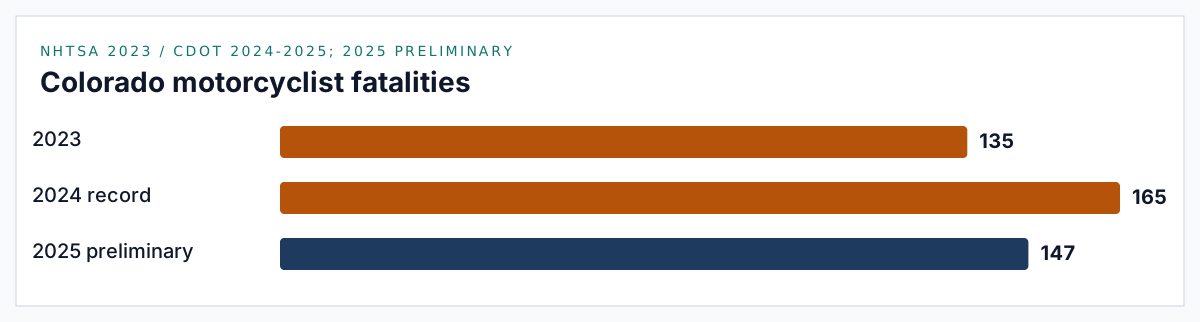
- Preliminary CDOT data: 147 motorcyclists were killed on Colorado roadways in 2025, down 11% from a record 165 in 2024 (CDOT, Jan 2026).
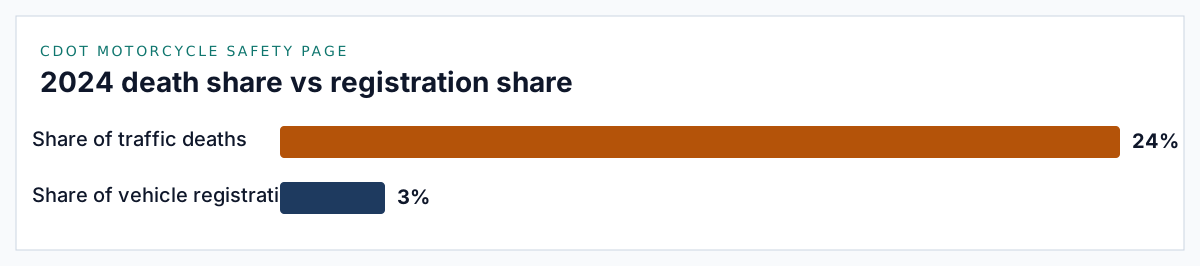
- In 2024, motorcycle fatalities accounted for nearly one-quarter (24%) of Colorado traffic deaths, while motorcycles were 3% of vehicle registrations (CDOT, Sep 2026).
- In 2024, 44% of motorcyclists killed in Colorado traffic crashes were not wearing a helmet (CDOT, Sep 2025).
- Almost half (49%) of motorcyclists killed in Colorado over the last five years were not wearing a helmet (CDOT, Sep 2026).
- September 2024 claimed 33 motorcyclist lives in Colorado, the highest month in CDOT's published monthly series for that year (CDOT, Sep 2025).
- Unusually warm November and December 2025 saw motorcyclist fatalities increase 167% versus the same period in 2024 (CDOT, Jan 2026).
- Motorcycles were involved in 774 serious bodily injury crashes in Colorado in 2024 (CDOT, Sep 2025).
- NHTSA FARS ARF Table 7 lists 165 Colorado motorcyclist fatalities in 2024, matching CDOT's record count (NHTSA NCSA, Jul 2026).
- Nationally, 6,228 motorcyclists were killed in 2024, 16% of all U.S. traffic fatalities (NHTSA NCSA, Jul 2026).
- Per 100 million VMT in 2024, the U.S. motorcyclist fatality rate was 28.00, almost 27 times the passenger-car occupant rate of 1.05 (NHTSA NCSA, Jul 2026).
- An estimated 86,887 U.S. motorcyclists were injured in 2024, up 5.2% from 82,567 in 2023 (NHTSA NCSA, Jul 2026).
- Colorado HSO's FY2024 table lists 164 motorcyclist fatalities and 73 unhelmeted motorcyclist fatalities for calendar 2024 (State, preliminary through 31 Dec 2024) (Colorado HSO, Jan 2026).
- FHWA counted 176,484 motorcycles registered in Colorado in 2024, of 5,276,703 motor vehicles statewide (FHWA, Jan 2026).
- Motorcycle deaths on Colorado roads have risen 57% since 2015 (CDOT, Sep 2025).
How many motorcyclists die on Colorado roads each year?
A record year and a down year can sit next to each other without canceling. 2024 is the peak in the published Colorado series. 2025 is labeled preliminary. The late-year weather spike is part of the 2025 story, not a reason to throw the annual count out.
Statewide traffic deaths are the denominator. Read the motorcycle line against that census, and against the Colorado car accident statistics hub when you need the all-mode picture.
What were Colorado motorcycle fatalities in 2024 and preliminary 2025?
CDOT's January 2026 release is the current official statewide story. The 2025 motorcycle line is marked preliminary pending edit checks. The 2024 record also appears on CDOT's motorcycle safety page and in NHTSA's state helmet table. Those three books should be close. They are.
- CDOT's motorcycle safety page states 2024 was a record-high year for motorcycle fatalities on Colorado roads (CDOT, Sep 2026).
- The same safety page reports motorcycle fatalities decreased 11% in 2025 compared with the previous record-breaking year (CDOT, Sep 2026).
- CDOT's January 2026 statewide release lists motorcycle deaths among the 2025 mode lines, down from 2024 on that same preliminary file (CDOT, Jan 2026).
- Preliminary statewide traffic deaths in Colorado were 701 in 2025, up 2% from 689 in 2024 (CDOT, Jan 2026).
- Passenger-vehicle deaths in 2025 were 392, up 5% from 2024 on that preliminary release (CDOT, Jan 2026).
- Colorado HSO's C-7 motorcyclist-fatality target for FY2024 was maintain at 148; the State actual missed it (Colorado HSO, Jan 2026).
- HSO recorded that C-7 measure as not on track for FY2024 (Colorado HSO, Jan 2026).
- NHTSA's 2023 motorcycle fact sheet Table 7 lists 135 Colorado motorcyclist fatalities for 2023 (62 helmeted, 72 unhelmeted, 1 unknown) (NHTSA NCSA, Jul 2025).
- CDOT's fatal-crash dashboard is the current count; suspected impairment on an early notification is not a FARS toxicology result (CDOT, Sep 2026).
- CDOT's FARS program is a nationwide census of fatal injuries in motor vehicle traffic crashes, partially funded by NHTSA (CDOT, Sep 2026).
If the crash involved a serious injury on a Front Range road, the next useful step is a free consult with a Denver motorcycle accident attorney who will read the report before anyone writes a narrative for you.
How has the multi-year trend moved since the mid-2010s?
The Problem Identification series is slower than a January news release and more stable. Use it for the 2016–2022 run. Do not splice a 2025 preliminary count onto a 2020 FARS row and call it one trend.
- Motorcyclist fatalities in Colorado were 125 (2016), 103 (2017), 103 (2018), 103 (2019), and 140 (2020) (CDPHE, Jun 2022).
- That 2020 count was a 36% one-year increase from 2019 and a 12% increase over five years (CDPHE, Jun 2022).
- Motorcycle fatalities increased from 137 in 2021 to 149 in 2022 (CDPHE, Aug 2024).
- In 2022, 24% of fatally injured occupants in Colorado were riding motorcycles, the same share as 2021 and still above pre-pandemic levels (CDPHE, Aug 2024).
- Among people fatally injured in Colorado motor-vehicle crashes in the 2022 Problem ID charts, 27% were riding a motorcycle and 68% were in a passenger vehicle (car, van, SUV, or pickup) (CDPHE, Jun 2022).
- In 2020, El Paso County led C-7 motorcyclist fatalities with 26, followed by Jefferson (15), Adams (12), Denver (11), and Pueblo (9) (CDPHE, Jun 2022).
- Colorado traffic deaths peaked at 764 in 2022 in CDOT's published all-mode trend line (CDOT, Jan 2026).
- That all-mode trend starts at 547 deaths in 2015 (CDOT, Jan 2026).
- HSO reported 720 traffic fatalities in Colorado in 2023 (Colorado HSO, Jan 2026).
- The same HSO table lists 681 2024 fatalities (State, preliminary through 31 Dec 2024), which later moved in CDOT's January 2026 comparison line (Colorado HSO, Jan 2026).
How do motorcycle deaths compare with overall Colorado traffic deaths?
Three percent of the fleet is not three percent of the risk. Registration share is an exposure proxy, not VMT. NHTSA's national VMT rates are a different metric. Do not treat them as interchangeable.
What share of Colorado traffic deaths involve motorcyclists vs vehicle registrations?
- CDOT's motorcycle safety page repeats the 2024 death-share versus registration-share mismatch in the same paragraph as the record fatality count (CDOT, Sep 2026).
- The September 2025 caution release uses the same 24% / 3% framing for "last year" (CDOT, Sep 2025).
- Problem ID 2024 notes that motorcycles represent a small percentage of vehicles on the road (2–3% nationally) but motorcycle occupants make up around 25% of motor vehicle fatalities annually in Colorado (CDPHE, Aug 2024).
- Of those seriously injured in Colorado in that 2020 hospital/crash series, 2% were riding a motorcycle, versus 45% in a car/van and 29% in an SUV (CDPHE, Jun 2022).
- Most people seriously injured from a Colorado motor vehicle crash in 2020 were riding in a vehicle (96%); pedestrians were almost 3% (CDPHE, Jun 2022).
- Nationally, motorcycles made up 3% of all registered vehicles in the United States in 2024 and accounted for only 0.7% of all VMT (NHTSA NCSA, Jul 2026).
- Per 100,000 registered vehicles in 2024, the U.S. motorcyclist fatality rate (67.25) was over 6 times the passenger-car occupant rate (10.81) (NHTSA NCSA, Jul 2026).
- That same registered-vehicle rate was over 10 times the light-truck occupant fatality rate (6.54) (NHTSA NCSA, Jul 2026).
- Per 100 million VMT in 2024, the U.S. motorcyclist fatality rate was over 44 times the light-truck occupant rate (0.63) (NHTSA NCSA, Jul 2026).
- FHWA's Colorado 2024 automobile total was 1,356,526 (FHWA, Jan 2026).
- FHWA recorded 0 publicly owned motorcycles in Colorado's 2024 motorcycle registration line; the 176,484 figure is private and commercial (FHWA, Jan 2026).
- U.S. motorcyclist deaths in the FARS Encyclopedia national table were 6,228 in 2024 and 6,366 in 2023 (NHTSA FARS, Apr 2026).
- FARS national motorcyclist deaths were 6,251 in 2022 and 6,144 in 2021 (NHTSA FARS, Apr 2026).
How often were motorcyclists killed in Colorado not wearing a helmet?
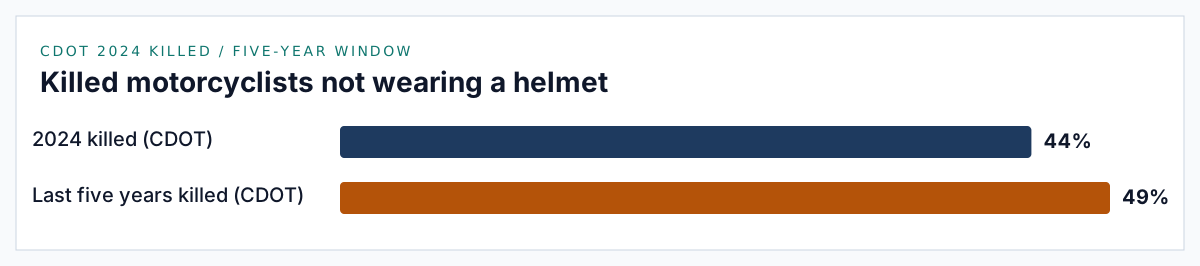
Colorado does not have a universal adult helmet law. CDOT still publishes two helmet-nonuse windows that people flatten into one rate. They are not the same number. 2024 killed-and-unhelmeted is not the five-year killed-and-unhelmeted share, and neither is NHTSA's known-use state table.
If helmet use, the police diagram, and coverage are already in dispute, a Denver motorcycle accident attorney can walk the record with you in a free consultation. That is education about the file, not a promise about value.
What does CDOT report for a single year vs a multi-year window?
- CDOT states Colorado law requires riders younger than 18 to wear a helmet (CDOT, Sep 2026).
- GHSA records Colorado's rule as helmets required for all riders and passengers under 18, with the universal helmet law repealed in 1977 (GHSA, May 2024).
- GHSA counts 17 states plus D.C. and several territories with a universal helmet law requiring helmets for all riders (GHSA, May 2024).
- Illinois, Iowa, and New Hampshire are the only states with no motorcycle helmet law (GHSA, May 2024).
- 47 states, D.C., and several territories have some form of motorcycle helmet law (GHSA, May 2024).
- NHTSA Table 7 for 2024 shows Colorado 81 helmeted, 80 unhelmeted, and 4 unknown among 165 motorcyclist fatalities (NHTSA NCSA, Jul 2026).
- Based on known helmet use, NHTSA's Colorado 2024 split is 50% helmeted and 50% unhelmeted (NHTSA NCSA, Jul 2026).
- NHTSA's 2023 Table 7 known-use split for Colorado was 46% helmeted and 54% unhelmeted (NHTSA NCSA, Jul 2025).
- Unhelmeted motorcyclist fatalities in Colorado were 82 (2016), 72 (2017), 58 (2018), 54 (2019), and 74 (2020) (CDPHE, Jun 2022).
- Unhelmeted motorcyclist fatalities represented 53% of all motorcyclist fatalities in Colorado in 2020 (CDPHE, Jun 2022).
- In 2019, 54 of 103 Colorado motorcyclist fatalities (52.4%) were unhelmeted (CDPHE, Jun 2022).
- In 2020, 74 of 140 Colorado motorcyclist fatalities (52.8%) were unhelmeted (CDPHE, Jun 2022).
- In 2020, 127 of 140 Colorado motorcyclist fatalities were male (CDPHE, Jun 2022).
- The 25–34 age group had the most Colorado motorcyclist fatalities in 2020 (33) (CDPHE, Jun 2022).
- In 2020, 16 of 19 Colorado motorcyclist fatalities ages 21–24 (84.2%) were unhelmeted (CDPHE, Jun 2022).
- The 25–34 age group accounted for 23 Colorado motorcyclist fatalities in 2019 (CDPHE, Jun 2022).
- In 2019, 16 of 23 Colorado motorcyclist fatalities ages 35–44 (69.6%) were unhelmeted (CDPHE, Jun 2022).
- In 2019, 12 of 17 Colorado motorcyclist fatalities ages 45–54 (70.6%) were unhelmeted (CDPHE, Jun 2022).
- In 2020, the 35–44 and 45–54 age groups each recorded 27 Colorado motorcyclist fatalities (CDPHE, Jun 2022).
- In 2020, 12 of 16 Colorado motorcyclist fatalities ages 55–64 (75%) were unhelmeted (CDPHE, Jun 2022).
- In 2020, 9 of 14 Colorado motorcyclist fatalities ages 65–74 (64.3%) were unhelmeted (CDPHE, Jun 2022).
- Female motorcyclist fatalities in Colorado numbered 12 in 2019 and 13 in 2020 (CDPHE, Jun 2022).
- The share of fatally injured Colorado motorcycle occupants who were unhelmeted decreased to 52% in 2022 even as the fatality count rose (CDPHE, Aug 2024).
- HSO's C-8 unhelmeted-motorcyclist target for FY2024 was reduce to 71; the State actual was above that target (Colorado HSO, Jan 2026).
- HSO recorded C-8 as not on track for FY2024 (Colorado HSO, Jan 2026).
- In 2020, El Paso County led C-8 unhelmeted motorcyclist fatalities with 15, followed by Denver (8) (CDPHE, Jun 2022).
- Jefferson and Pueblo each recorded 7 unhelmeted motorcyclist fatalities in that 2020 C-8 county list (CDPHE, Jun 2022).
- Nationally, 34% of the 6,228 motorcyclists killed in 2024 were not helmeted, based on known helmet use (NHTSA NCSA, Jul 2026).
- In States without universal helmet laws, 48% of motorcyclists killed in 2024 were not wearing helmets, compared with 11% in States with universal helmet laws (known use) (NHTSA NCSA, Jul 2026).
- Reported helmet use rates for U.S. motorcyclists killed in 2024 were 67% for riders and 48% for passengers (NHTSA NCSA, Jul 2026).
- NOPUS estimated overall DOT-compliant motorcycle helmet use in the United States at 73.8% in 2023, the highest recorded in that series (NHTSA NCSA, Sep 2024).
- That 2023 NOPUS rate was not statistically different from 66.5% in 2022 (NHTSA NCSA, Sep 2024).
- NOPUS observed 945 motorcyclists in 2023, up 1% from 934 in 2022 (NHTSA NCSA, Sep 2024).
- In 2023, DOT-compliant helmet use was 82.7% in States requiring all motorcyclists to be helmeted, versus 65.9% in other States (NHTSA NCSA, Sep 2024).
- HSO's Motorcycle Safety Rider campaign reached 958,659 unique devices and served 6,740,634 impressions about helmets and protective gear in FY2024 (Colorado HSO, Jan 2026).
When during the year are Colorado motorcycle fatalities concentrated?
Warm months are when people ride. CDOT says the deaths follow that exposure. That is a seasonality statement, not a claim that weather "causes" a crash. The monthly 2024 series is the cleanest published Colorado motorcycle calendar we have.
Which month was deadliest in the latest full year with monthly data?
CDOT's September 2025 release published 2024 motorcycle fatalities by month, reported as of August 19, 2025, from the Colorado Traffic Fatalities Dashboard. January through December:
- January 2024: 0 motorcyclist fatalities (CDOT, Sep 2025).
- February 2024: 3 (CDOT, Sep 2025).
- March 2024: 9 (CDOT, Sep 2025).
- April 2024: 8 (CDOT, Sep 2025).
- May 2024: 17 (CDOT, Sep 2025).
- June 2024: 20 (CDOT, Sep 2025).
- July 2024: 26 (CDOT, Sep 2025).
- August 2024: 23 (CDOT, Sep 2025).
- October 2024: 17 (CDOT, Sep 2025).
- November 2024: 3 (CDOT, Sep 2025).
- December 2024: 6 (CDOT, Sep 2025).
- The monthly graph in that release is sourced to the Colorado Traffic Fatalities Dashboard, with data reported as of August 19, 2025 (CDOT, Sep 2025).
- As of that September 2025 release, CDOT said motorcycle deaths were down 15% so far in 2025 compared with the same period in 2024 (CDOT, Sep 2025).
What happened in the warm late-2025 months?
Until November and December, 2025 statewide deaths were on track to fall. Then the last two months moved. Motorcycle fatalities moved more than the all-mode line.
- Until the unseasonably warm months of November and December, Colorado traffic deaths were on track for a 7% decline in 2025 (CDOT, Jan 2026).
- During those final two months, statewide deaths jumped 70% compared with the same period in 2024 (CDOT, Jan 2026).
- CDOT said the late-year surge was most visible along the Front Range, where the warm weather was most predominant (CDOT, Jan 2026).
- CDOT's motorcycle safety page attributes the 2025 death count in part to warmer weather and the same November–December spike (CDOT, Sep 2026).
- Nationally, 66% of 2024 motorcyclist fatalities occurred in urban areas versus 34% in rural areas (known values) (NHTSA NCSA, Jul 2026).
- 56% of 2024 U.S. motorcyclist fatalities occurred during daylight, 38% in the dark, 4% at dusk, and 1% at dawn (known values) (NHTSA NCSA, Jul 2026).
- 97% occurred in clear/cloudy weather versus 2% in rain and 1% in snow, sleet, fog, or other conditions (NHTSA NCSA, Jul 2026).
- 91% occurred on non-interstate roads versus 9% on interstates (NHTSA NCSA, Jul 2026).
- 62% occurred at non-intersection locations versus 38% at intersections (NHTSA NCSA, Jul 2026).
- 47% of U.S. motorcyclists were killed during the weekend in 2023 versus 46% in 2024 (NHTSA NCSA, Jul 2026).
- Urban U.S. traffic deaths had a larger motorcyclist share (18%) than rural deaths (13%) in 2024 (NHTSA NCSA, Apr 2026).
How many serious-injury motorcycle crashes does Colorado report?
"Serious bodily injury crash involvement" is an officer-coded crash count. It is not a count of injured people, not a FARS fatality, and not a hospital discharge. HSO's statewide serious-injury total is a different series again.
How many serious bodily injury crashes involved motorcycles in the latest cited year?
- CDOT's September 2025 release is the source for the 2024 motorcycle SBI-crash involvement figure (CDOT, Sep 2025).
- Colorado HSO reported 3,067 serious injuries in traffic crashes for calendar 2024 (State, preliminary through 31 Dec 2024) (Colorado HSO, Jan 2026).
- HSO's FY2024 serious-injury target was 3,356; the State actual beat that target (Colorado HSO, Jan 2026).
- Crash-report serious injuries in Colorado were 2,956 (2016), 2,884 (2017), 3,112 (2018), 3,190 (2019), and 3,164 (2020) (CDPHE, Jun 2022).
- CDOT publishes statewide crash-data listings for 2007 through 2026; 2026 is labeled preliminary and rough, and 2021–2026 remain subject to revision (CDOT, Sep 2026).
- Those listings, reports, and dashboards are protected under 23 U.S.C. § 407 (CDOT, Sep 2026).
- After an officer completes form DR3447, the Department of Revenue enters the legal record in DRIVES; CDOT receives that feed excluding private-property and counter reports (CDOT, Sep 2026).
- CDPHE's motor-vehicle data-linkage project joins crash reports to ED, hospital discharge, death, and trauma-registry files with CDOT, CDOR, STRAC, CHA, and the State Trauma Registry (CDPHE, Sep 2026).
- HSO's Motorcycle Safety Driver Awareness campaign reached 437,318 unique devices and served 5,464,167 impressions in FY2024 (Colorado HSO, Jan 2026).
- HSO rally outreach generated 114,408 impressions and 4,030 engagements against targets of 12,000 impressions and 1,200 engagements (Colorado HSO, Jan 2026).
- According to CDOT's 2025 Driver Behavior Report, 78% of motorcycle riders were aware of Colorado's lane-filtering law (CDOT, Sep 2026).
- Senate Bill 24-079 took effect August 7, 2024, legalizing lane filtering under listed conditions; the law is set to expire in September 2027 (CDOT, Sep 2026).
- Lane filtering is not lane splitting. Filtering is passing between vehicles that are stopped, at 15 mph or less, on the left, without entering oncoming traffic; splitting remains illegal (CDOT, Sep 2026).
How does the U.S. motorcyclist fatality picture compare?
National FARS is context, not a local diagnosis. Use it to see whether Colorado's 2024 record sits inside a national motorcycle year, then return to CDOT for the state count. Do not present national totals as Colorado figures.
How many motorcyclists died nationally in the latest NHTSA Traffic Safety Facts year?
- Motorcyclists accounted for 16% of all U.S. traffic fatalities and 20% of all motor vehicle occupant (driver and passenger) fatalities in 2024 (NHTSA NCSA, Jul 2026).
- Of the 6,228 U.S. motorcyclists killed in 2024, 96% (5,950) were riders and 4% (278) were passengers (NHTSA NCSA, Jul 2026).
- The 2024 national motorcyclist death count was a 2.2% decrease from 2023 (NHTSA NCSA, Jul 2026).
- The 2023 Final File updated motorcycle fatalities to 6,366 from an earlier ARF figure of 6,335 (NHTSA NCSA, Jul 2026).
- U.S. motorcyclist fatalities by year in Table 1 include 5,029 (2015), 5,337 (2016), 5,226 (2017), 5,038 (2018), and 5,044 (2019) (NHTSA NCSA, Jul 2026).
- U.S. motorcyclist fatalities were 5,620 in 2020 and 6,144 in 2021 in that same Table 1 (NHTSA NCSA, Jul 2026).
- Registered U.S. motorcycles numbered 9,261,249 in 2024, with 22,241 million motorcycle VMT (NHTSA NCSA, Jul 2026).
- The 2024 U.S. motorcyclist injury rate was 938 per 100,000 registered vehicles and 391 per 100 million VMT (NHTSA NCSA, Jul 2026).
- The most harmful event for 3,790 (60%) of 6,366 motorcycles in 2024 fatal crashes was a collision with a motor vehicle in transport (NHTSA NCSA, Jul 2026).
- In two-vehicle fatal crashes, 78% of the motorcycles were impacted on the front and 6% on the rear (NHTSA NCSA, Jul 2026).
- 24% of motorcycles in 2024 fatal crashes collided with fixed objects, compared with 16% of passenger cars, 12% of light trucks, and 5% of large trucks (NHTSA NCSA, Jul 2026).
- There were 3,396 two-vehicle fatal crashes in 2024 each involving a motorcycle and another vehicle type; in 45% (1,532) the other vehicle was turning left while the motorcycle was going straight, passing, or overtaking (NHTSA NCSA, Jul 2026).
- Both vehicles were going straight in 689 (20%) of those two-vehicle fatal motorcycle crashes (NHTSA NCSA, Jul 2026).
- 35% of motorcycle riders in U.S. fatal crashes in 2024 had no valid motorcycle license, versus 14% of passenger-vehicle drivers in fatal crashes (NHTSA NCSA, Jul 2026).
- 37% of all motorcycle riders in fatal crashes in 2024 were speeding, compared with 22% of passenger-car drivers, 15% of light-truck drivers, and 8% of large-truck drivers (NHTSA NCSA, Jul 2026).
- Motorcycle riders 15 to 20 years old in fatal crashes had the highest speeding involvement at 56% in 2024 (NHTSA NCSA, Jul 2026).
- The average age of motorcycle riders killed in U.S. traffic crashes was 40 in 2024 (NHTSA NCSA, Jul 2026).
- Motorcyclist fatalities ages 15–20 increased 20% from 508 in 2023 to 609 in 2024 (NHTSA NCSA, Jul 2026).
- Motorcyclist fatalities ages 21–24 increased 15% from 613 in 2023 to 705 in 2024 (NHTSA NCSA, Jul 2026).
- Of motorcyclists killed in 2024, 37% were on 501–1,000 cc motorcycles, 26% on 1,501 cc or higher, 19% on 1,001–1,500 cc, and 12% on engines up to 500 cc (NHTSA NCSA, Jul 2026).
- Of 5,950 motorcycle riders killed in 2024, 1,529 (26%) were alcohol-impaired (BAC ≥ .08 g/dL) (NHTSA NCSA, Jul 2026).
- 40% of motorcycle riders who died in single-vehicle crashes in 2024 were alcohol-impaired, versus 18% in multivehicle crashes (NHTSA NCSA, Jul 2026).
- Motorcycle riders killed at night were 2.6 times more frequently alcohol-impaired than those killed during the day (37% versus 14%) in 2024 (NHTSA NCSA, Jul 2026).
- NHTSA's 2024 overview counts 1,606 alcohol-impaired motorcycle riders in fatal crashes (25%), down 3.0% from 1,656 (26%) in 2023 (NHTSA NCSA, Apr 2026).
- NHTSA Table 8 lists 164 Colorado motorcycle rider fatalities in 2024 (riders, not all motorcyclists) (NHTSA NCSA, Jul 2026).
- Among those Colorado riders, 32% had BAC ≥ .01, 25% had BAC ≥ .08, and 13% had BAC ≥ .15 (NHTSA NCSA, Jul 2026).
- NHTSA's 2023 rider-BAC table lists 131 Colorado motorcycle rider fatalities (NHTSA NCSA, Jul 2025).
- Among those 2023 Colorado riders, 35% had BAC ≥ .01, 29% had BAC ≥ .08, and 18% had BAC ≥ .15 (NHTSA NCSA, Jul 2025).
- FARS national motorcyclist deaths were 4,594 in 2014 and 2,897 in 2000 (NHTSA FARS, Apr 2026).
- FARS national motorcyclist deaths were 4,518 in 2010 and 5,312 in 2008 (NHTSA FARS, Apr 2026).
- Neighboring-state 2024 motorcyclist fatality totals in Table 7 include Arizona 219, New Mexico 50, Utah 52, Wyoming 23, and Kansas 56 (NHTSA NCSA, Jul 2026).
- California recorded 522 motorcyclist fatalities in 2024 in that table, with 8% unhelmeted on known use (NHTSA NCSA, Jul 2026).
- HSO recorded 97 fatalities involving a driver or motorcycle operator testing at or above 5 ng of Delta-9 THC (FARS 2023), against a C-14 target of 90 (Colorado HSO, Jan 2026).
- HSO recorded 178 alcohol-impaired driving fatalities for FARS 2023 (C-5) (Colorado HSO, Jan 2026).
- Starting in 2022, FARS classifies people on motorized bicycles as pedalcyclists instead of motorcyclists; in 2021 there were 43 such fatalities, 0.7% of motorcyclist deaths that year (NHTSA NCSA, Jul 2026).
- In 2024 only 17 States, the District of Columbia, and Puerto Rico required helmet use for all motorcyclists (NHTSA NCSA, Jul 2026).
- GHSA notes 2024's 6,228 U.S. motorcyclist deaths were down from a 2023 count that was the most since federal recordkeeping began in 1975 (GHSA, Jun 2026).
- U.S. traffic deaths overall were 39,254 in 2024 in the FARS Encyclopedia (NHTSA FARS, Apr 2026).
- The U.S. fatality rate was 1.19 deaths per 100 million VMT in 2024 (NHTSA FARS, Apr 2026).
Methodology and Sources
Stats on this page come only from origin publishers: CDOT motorcycle-safety and news pages, CDOT/CDPHE Problem Identification PDFs, the Colorado HSO FY2024 Annual Report, NHTSA NCSA Traffic Safety Facts (Motorcycles 2023 and 2024, Overview 2024, NOPUS helmet use 2023), NHTSA FARS, FHWA Highway Statistics Table MV-1, and GHSA's motorcyclist state-law compilation. Aggregator listicles are not sources. National NHTSA motorcycle series are comparison only. The page is refreshed monthly; preliminary 2025 CDOT fatality totals will move.
Data risks, in the order they actually break pages:
- 23 U.S.C. § 407. CDOT crash listings and dashboards are protected. Use them for safety analysis, not as a discovery exhibit.
- Preliminary vs final. 2025 CDOT motorcycle and statewide deaths are preliminary. 2024 motorcycle deaths appear as 165 (CDOT / NHTSA Table 7) and 164 (HSO C-7 State; NHTSA Table 8 riders). Those are different definitions, not a rounding error to hide.
- Definition conflicts. FARS motorcyclist fatality is not CDOT early fatal notification, not SBI crash involvement, and not a hospital discharge. Helmet "percent not wearing" depends on the window: 44% (CDOT 2024 killed), 49% (CDOT five-year killed), 50% known-use (NHTSA Table 7 Colorado 2024).
- Registration share vs VMT. Colorado's "3% of registrations" is not a VMT exposure measure. NHTSA's 28.00 per 100 million VMT is national.
- Seasonality is not causation. Warm weather increases riding exposure. CDOT frames the late-2025 spike that way. This page does not claim weather caused individual crashes.
- Lane filtering vs lane splitting. Colorado legalized filtering in stopped traffic (SB 24-079, Aug. 7, 2024). Splitting remains illegal. No primary crash-series for filtering outcomes is cited here; CDOT's evaluation is due to the legislature by early 2027.
- Source lag. Problem ID PDFs lag fatality news releases. This page prefers the newest stable URL and keeps the older table when it is still the last published annual total for that series.
- No case outcomes. This hub is crash, fatality, injury, and hospital statistics. It does not publish settlements, verdicts, or case-value averages.
Glossary
- FARS: Fatality Analysis Reporting System (NHTSA census of fatal crashes)
- ARF: Annual Report File (FARS year still subject to Final File revision)
- NCSA: National Center for Statistics and Analysis (NHTSA statistical unit)
- CRSS: Crash Report Sampling System (national injury estimates)
- VMT: vehicle miles traveled
- HSO: Colorado Highway Safety Office
- CDOT: Colorado Department of Transportation
- CDPHE: Colorado Department of Public Health and Environment
- SBI: serious bodily injury (officer-coded crash involvement in the CDOT release)
- NOPUS: National Occupant Protection Use Survey
- GHSA: Governors Highway Safety Association
- FHWA: Federal Highway Administration
- BAC: blood alcohol concentration
- FMVSS 218: federal motorcycle helmet performance standard
Sources
- CDOT Motorcycle Safety
- CDOT, Warm weather coincides with increase in traffic deaths in 2025
- CDOT, CDOT urges motorcyclists to use caution this September
- CDOT Fatal Crash Data
- CDOT Crash Data
- CDOT Motorcycle Lane Filtering
- CDOT 2024 Problem Identification Executive Summary (prepared by CDPHE)
- CDOT/CDPHE 2022 Problem Identification Statewide Report
- Colorado HSO Fiscal Year 2024 Annual Report
- CDPHE motor vehicle data linkage briefs
- NHTSA NCSA, Motorcycles: 2024 Data (DOT HS 813 824)
- NHTSA NCSA, Motorcycles: 2023 Data (DOT HS 813 732)
- NHTSA NCSA, Overview of Motor Vehicle Traffic Crashes in 2024 (DOT HS 813 791)
- NHTSA NCSA, Motorcycle Helmet Use in 2023 – Overall Results (DOT HS 813 634)
- NHTSA FARS Encyclopedia
- FHWA Highway Statistics 2024, Table MV-1
- GHSA, Motorcyclists state laws
- Colorado car accident statistics (parallel hub)