Table of Contents
After an accident, one of the first practical questions is who pays: for the ambulance, the ER, the missed shifts, the car. In Colorado the answer depends less on how badly you were hurt than on how you got hurt. A car crash, a fall in a store, a dog bite, an injury at work, and a collision with a city vehicle each run through different insurance, different statutes, and different deadlines. Two people with identical injuries can have very different claims because one was hurt in a car and the other was hurt on the job. This guide maps who pays by accident type, shows you the five lines on your own declarations page that matter most, explains which payers expect to be repaid from a settlement, and covers the Colorado rules that apply whatever the accident was.
The accident type is not a label for the file folder. It is the map of where the money is, and it is usually decided in the first ten minutes of a phone call, not the last ten days of a negotiation.
Who Pays Depends on How You Got Hurt
Every Colorado accident claim runs through a short list of possible payers: the at-fault person's liability insurance, your own first-party coverage, an employer's workers' compensation carrier, a property owner's commercial or homeowner policy, or a public entity under the Colorado Governmental Immunity Act. Which of those apply turns on the accident type, and each comes with its own rules. A car crash usually puts the at-fault driver's bodily injury coverage first, with your own medical payments and underinsured motorist coverage behind it. A fall in a grocery store runs through the Premises Liability Act, C.R.S. § 13-21-115, and the store's commercial general liability policy. A serious dog bite can trigger strict liability under C.R.S. § 13-21-124. An on-the-job injury starts in workers' compensation, which generally bars a negligence suit against your own employer. The table summarizes the map before the subsections work through each branch.
| Accident type | Usual first payer | Often-missed second payer | Governing Colorado rule |
|---|---|---|---|
| Car crash | At-fault driver's bodily injury liability (minimum 25/50) | Your own UM/UIM and MedPay | C.R.S. § 10-4-609; 50% fault bar in § 13-21-111 |
| Truck or rideshare crash | Motor carrier or rideshare company policy | Driver's personal policy; your UIM | Federal carrier minimums (49 C.F.R. § 387.9) for interstate trucks |
| Fall on someone's property | Owner's or tenant's commercial or homeowner policy | Property manager, snow-removal contractor | Premises Liability Act, C.R.S. § 13-21-115 |
| Dog bite | Owner's homeowner or renter policy | Landlord, in limited situations | C.R.S. § 13-21-124 (strict liability for serious bodily injury) |
| Workplace injury | Employer's workers' compensation carrier | Third parties: other drivers, contractors | C.R.S. § 8-41-203 (third-party claims and carrier repayment) |
| Government vehicle or property | The public entity, if immunity is waived | Your UM/UIM if the government claim is capped or barred | CGIA, C.R.S. § 24-10-109 notice; § 24-10-114 limits |
Car, Truck, and Rideshare Crashes
Motor vehicle claims have the most layers, which is why they reward a careful coverage review. Colorado requires drivers to carry minimum bodily injury liability coverage of 25/50 (per person / per accident, in thousands) plus property damage coverage, under C.R.S. § 10-4-620. Those minimums can run out fast after a hospital admission; our guide to bodily injury liability coverage explains how that coverage works. Behind it sits your own coverage. Colorado auto policies must include at least $5,000 of MedPay under C.R.S. § 10-4-635 unless the named insured rejected it in writing, and it pays medical bills without waiting on a fault decision. Uninsured and underinsured motorist coverage under C.R.S. § 10-4-609 fills the gap between the other driver's limits and your damages, and Colorado UIM is not reduced by what the at-fault driver's insurer paid. For-hire interstate trucking companies hauling general freight must carry at least $750,000 in liability coverage under 49 C.F.R. § 387.9, with higher minimums for some hazardous loads, and rideshare companies such as Uber and Lyft carry their own policies during active trips. More on those layers: our underinsured motorist guide.
Falls, Dog Bites, and Other Property Injuries
Injuries on someone else's property run through rules that look nothing like a car claim. Under the Premises Liability Act, C.R.S. § 13-21-115, what a landowner owed you depends on why you were there. An invitee, such as a shopper in a grocery aisle, is owed reasonable care against dangers the owner knew or should have known about. A licensee, such as a social guest, is owed protection against known dangers the owner created or failed to warn about. A trespasser is owed far less. Dog bites are different again. C.R.S. § 13-21-124 makes an owner strictly liable for economic damages when a dog causes serious bodily injury to someone lawfully present, without proof the owner knew the dog was dangerous. That statute covers economic losses like medical bills and lost wages, not pain and suffering, so noneconomic damages still require a negligence theory. Details: Colorado's dog bite strict liability law.
Workplace Accidents and Government Defendants
Two accident types come with special gates. If you were hurt on the job, workers' compensation is generally your exclusive remedy against your employer. It pays medical care and, under C.R.S. § 8-42-105, temporary total disability at two-thirds of your average weekly wage up to a state maximum, but it pays nothing for pain and suffering. The door that stays open is a third-party claim against someone other than your employer, like the driver who hit your work truck or a subcontractor whose crew left a hazard on the site. Under C.R.S. § 8-41-203, the comp carrier is generally repaid from that recovery for what it paid. If a city bus, a CDOT plow, or a public school's property was involved, the Colorado Governmental Immunity Act requires written notice within 182 days under C.R.S. § 24-10-109, and damages are capped under § 24-10-114. Miss the notice and the claim against the government is usually gone. Related: the government notice of claim.
Reading Your Declarations Page Before Anyone Calls You
The declarations page, usually page one or two of your auto policy, is one of the most useful documents in a Colorado accident claim, and almost nobody reads it until something goes wrong. It lists every coverage you bought, the limits, the vehicles, and the drivers. Your insurer can send a copy if you ask, and many carriers post it in their app. We ask for it on the first call because it answers questions the other driver's adjuster will never raise: how much of your own coverage can pay your medical bills right now, how much stands behind a minimum-limits driver, and whether anything on the page conflicts with what you remember buying. Colorado law generally requires a rejection of UM/UIM or MedPay to be in writing, so a missing coverage line is worth a second look, not an assumption.
The Five Lines That Matter
A typical Colorado declarations page has a dozen or more lines, but five drive almost every injury claim, and each answers a different question about where money can come from. Read them in this order, and write down the number next to each before you talk to any adjuster, including your own. The first three lines most often change what a claim can recover. The last two most often get forgotten entirely, because they do not sound like injury coverage. If a line is blank or reads "rejected," ask for the signed rejection form before assuming the coverage is truly gone. The Colorado auto insurance requirements guide explains the statutory minimums behind each line.
- Bodily Injury Liability (shown as two numbers, such as 100/300): what your policy pays others if you cause a crash. It also hints at the UIM limit you were offered, because Colorado insurers are required to offer UIM up to your liability limits.
- Uninsured / Underinsured Motorist: your protection when the at-fault driver has no insurance or not enough. In a minimum-limits crash, this line is often the most important number on the page.
- Medical Payments: pays medical bills regardless of fault, at least $5,000 unless it was rejected in writing. Often the fastest money in the claim, and Colorado law generally does not let the MedPay carrier take it back from your settlement.
- Collision: pays to fix or replace your vehicle, subject to your deductible, while the property damage claim against the other driver is pending.
- Riders and endorsements: rental reimbursement, and any accident, AD&D, or death benefit rider. These pay separately from fault and are frequently overlooked.
Accident Riders, Health Plans, and Who Gets Paid Back
Money that pays your bills early in a claim is not always money you keep. Health insurance, Medicare, Medicaid, and workers' comp may each claim repayment from a later settlement, and the rules differ by payer. Colorado auto MedPay is the exception: under C.R.S. § 10-4-635(3), the MedPay carrier generally cannot recover what it paid from the at-fault driver or from you, except in cases of fraud. For state-regulated health plans, Colorado's made-whole statute, C.R.S. § 10-1-135, limits reimbursement when you have not been fully compensated, while self-funded ERISA employer plans follow federal rules and often enforce their plan language as written. Medicare's recovery rights come from federal law and cannot be ignored at disbursement. Hospital liens filed under C.R.S. § 38-27-101 attach to the recovery as well. Fixed-benefit accident and AD&D policies are usually different: they are a contract with your own insurer that pays a scheduled amount for a listed injury regardless of fault, they do not replace a claim against the person who caused the accident, and they commonly carry no repayment right, though the policy language controls. Sorting which payers must be repaid, and how much each can be reduced, is often where the net amount to the injured person moves most. See our Colorado hospital lien guide for how that plays out.
Why We Open Your Own Policy Before the Other Driver's
Most accident claims begin with a call to the at-fault driver's insurer. Ours begin with your declarations page. That order is deliberate. The other carrier's limits are a ceiling we cannot change, and in a minimum-limits case the most important coverage in the file is often your own UIM. Many UIM policies require notice to your carrier before you accept the at-fault driver's limits and sign a release, and getting that sequence wrong can put the UIM claim at risk. Your own insurer also owes you duties the other side does not. Under C.R.S. §§ 10-3-1115 and 10-3-1116, an insurer that unreasonably delays or denies a covered first-party benefit can owe two times the covered benefit plus attorney fees. We would rather never need that statute. Getting the UIM notice, documentation, and timing right at the start is how we try to avoid needing it. More: Colorado insurance bad faith.
A UIM claim is still a claim. Your own carrier evaluates your damages from the other side of the table, so we build the file the same way we would for any adjuster: complete records, clean math, and no surprises.
Colorado Rules That Apply No Matter the Accident Type
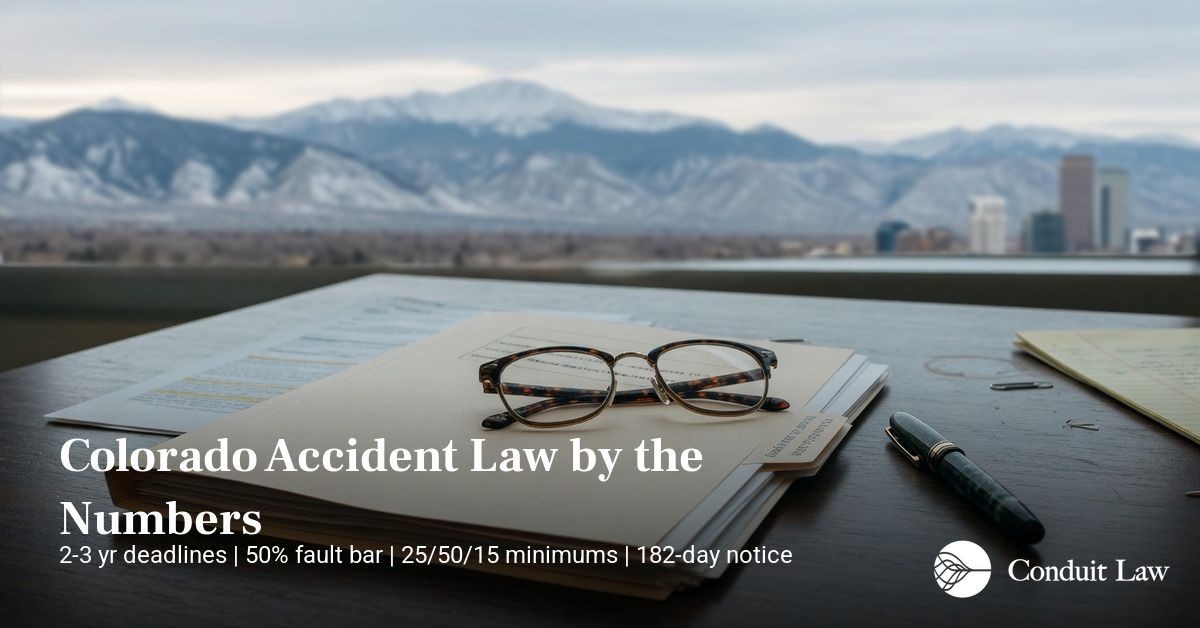
Some rules follow every Colorado accident claim, whatever caused it. Deadlines come first. Most motor vehicle injury lawsuits must be filed within three years under C.R.S. § 13-80-101(1)(n), and most other injury claims, including falls and dog bites, within two years under C.R.S. § 13-80-102(1)(a). Fault comes second. Under C.R.S. § 13-21-111, your damages are reduced by your percentage of fault, and you recover nothing if you are 50% or more at fault, so a disputed share of blame changes the claim directly. Damages limits come third: Colorado limits some noneconomic damages, such as pain and suffering, under C.R.S. § 13-21-102.5, and which limit applies depends on dates in your case. Special notice rules come last, and they are the easiest to miss because they are so short.
- Government defendants: written notice within 182 days of discovering the injury, C.R.S. § 24-10-109.
- Workplace injuries: report the injury to your employer in writing promptly, and within 10 days under C.R.S. § 8-43-102, and file a workers' comp claim within the statutory deadline, generally two years.
- Car crashes: three years to sue the driver; UIM claims can carry separate timing rules, so do not assume the same date applies.
- Everything else: two years is the default for most negligence-based injury claims in Colorado.
Frequently Asked Questions
Who pays my medical bills while the claim is open?
Usually your own coverage pays first: MedPay if you have it, then your health insurance, Medicare, or Medicaid. The at-fault party's insurer generally pays only at settlement. Health plans, Medicare, and Medicaid may expect to be repaid from the settlement (Colorado MedPay generally does not), so keep every explanation of benefits.
Can I use my own car insurance if I was hit as a pedestrian or cyclist?
Often yes. Colorado MedPay and UM/UIM coverage commonly follow the insured person, not just the vehicle, so they can apply when you are struck while walking or riding. The policy language controls, so read the declarations page and the definitions section.
Can I sue my employer for a workplace accident?
Generally no. Workers' compensation is usually the exclusive remedy against your employer in Colorado, but you may have a separate claim against a third party, such as another driver or a subcontractor, under C.R.S. § 8-41-203.
Do I have to repay my accident or AD&D policy if I settle with the at-fault party?
Usually not. Fixed-benefit accident and AD&D policies typically pay a scheduled amount with no repayment right, unlike health plans, Medicare, and workers' comp. Confirm by reading the policy's subrogation or reimbursement clause.
This article is general information about Colorado law, not legal advice, and it does not create an attorney-client relationship. Statutes and insurance policy terms change, and the outcome of any case depends on its specific facts and the language of the policies involved. Prior results do not guarantee or predict a similar outcome in any future matter. Consult a licensed Colorado attorney about your own situation.
Consultations are free, and there is no attorney fee unless we recover. If you're not sure which policy pays first, our Denver personal injury practice can map it on a free call.

Written by
Elliot Singer, Esq.
Personal injury attorney at Conduit Law, dedicated to helping Colorado accident victims get the compensation they deserve.
Learn more about our team