Conduit Law - Colorado Personal Injury AttorneysAccident Attorneys
Premises Liability8 min read

Vail Ski Injury Lawyer | Conduit Law

Injured at Vail? Our Vail ski injury lawyer is ready to fight Vail Resorts for your serious injury, including TBI and spinal injuries. Get fair compensation.

December 4, 2025By Conduit Law
#Vail Ski Injury Lawyer, Vail Resorts Lawsuit, Colorado Ski Lawyer, Catastrophic Ski Injury, Skier Collision Lawyer
Vail Ski Injury Lawyer | Conduit Law
Table of Contents

A day at Vail is supposed to be perfect—a high-alpine escape into a world of endless powder and panoramic views. But when that perfection shatters, when the unthinkable happens in the Back Bowls or on a high-speed groomer, the consequences extend far beyond the immediate injury. Victims suddenly find themselves navigating complex legal terrain while facing off against a corporate giant with extensive resources and legal teams. Understanding Colorado's legal framework becomes critical. Under C.R.S. § 13-80-101, injured parties have three years from the date of injury to file a lawsuit—a deadline that demands prompt action. Colorado's modified comparative negligence rule under C.R.S. § 13-21-111 allows recovery only if the plaintiff is less than 50% at fault. Additionally, non-economic damages are capped at $1,500,000 as of 2025. These statutory protections and limitations shape every aspect of ski injury claims, making experienced legal guidance essential for maximizing recovery within Colorado's unique legal framework.

Your search for a Vail ski injury lawyer means you've already discovered the ugly truth hiding behind the billion-dollar marketing. Vail Resorts isn't your friend. It's a publicly traded corporation with an army of lawyers whose only job is to crush your claim using two powerful weapons: the Colorado Ski Safety Act and that waiver you signed. But here's what the resort won't tell you: Colorado law still protects injured skiers in specific ways. Under Colorado's modified comparative negligence rule (C.R.S. § 13-21-111), an injured party can recover damages even if partially at fault, provided their negligence doesn't exceed 50%. Additionally, Colorado imposes a three-year statute of limitations for personal injury claims (C.R.S. § 13-80-101), meaning the clock is ticking. Non-economic damages are capped at $1,500,000 as of 2025. Understanding these legal boundaries—and how they intersect with resort defenses—is essential when pursuing compensation for ski-related injuries in Colorado.

They want you to believe what happened was just an "inherent risk." That's a lie. A convenient, profitable lie designed to protect their bottom line at your expense. Tearing that lie apart, piece by painful piece, is exactly what Colorado personal injury law exists to do. Colorado recognizes that some injuries result from negligence—not fate. Under C.R.S. § 13-21-111, Colorado's modified comparative negligence rule, injured parties can recover damages even if partially at fault, as long as their negligence doesn't exceed 50%. This means responsibility often extends beyond what defendants claim. The clock matters too. Colorado's statute of limitations allows three years from injury to file suit under C.R.S. § 13-80-101. Beyond that window, claims vanish forever. Compensation includes medical expenses, lost wages, and non-economic damages—currently capped at $1,500,000 as of 2025. These cases demand serious legal strategy. Negligence claims require evidence, expert testimony, and aggressive advocacy to overcome the "inherent risk" defense.

You're Not Suing a Ski Hill—You're Suing a Corporation

The entire defense strategy for Vail Resorts is built to intimidate injury victims into silence. They flash the resort waiver—that wall of fine print on every lift ticket—and invoke the Colorado Ski Safety Act like they're an unbreakable shield. They want injured skiers and snowboarders to feel powerless against a corporation worth billions. However, Colorado law provides meaningful protections. Under C.R.S. § 13-80-101, injured parties have three years from the date of injury to file a lawsuit, providing a substantial window for pursuing claims. Additionally, Colorado's modified comparative negligence rule under C.R.S. § 13-21-111 allows recovery even if an injured person is partially at fault—as long as they're less than 50% responsible. Non-economic damages are capped at $1,500,000 as of 2025. These legal frameworks exist specifically to balance the playing field between individual injury victims and large resort corporations, ensuring that waivers and safety statutes don't become absolute barriers to justice.

They want you to give up before you even start.

We see right through it. While the waiver does protect the resort from the true inherent risks of skiing—like catching an edge or hitting a tree in a glade—it is not a license for corporate carelessness. A waiver is not a get-out-of-jail-free card for negligence. Colorado courts recognize this distinction, understanding that corporations cannot hide behind liability waivers to escape responsibility for their own failures. Under Colorado's modified comparative negligence rule (C.R.S. § 13-21-111), plaintiffs can still recover damages even if partially at fault, as long as their negligence doesn't exceed 50%. Additionally, Colorado's three-year statute of limitations (C.R.S. § 13-80-101) provides a meaningful window to pursue claims. For non-economic damages like pain and suffering, Colorado caps awards at $1,500,000 as of 2025. When a resort fails to maintain equipment, inadequately trains staff, or ignores dangerous conditions, the waiver becomes irrelevant. The corporation's own negligence—not the inherent nature of the sport—becomes the basis for liability.

Your case isn't about bad luck. It's about proving that your catastrophic injury—the Traumatic Brain Injury, the spinal cord damage, the life-altering orthopedic trauma—was caused by a failure of the resort corporation itself. As Colorado personal injury counsel focused on high-stakes ski injury litigation, understanding their institutional playbook is essential. Every major ski resort operates with knowledge of specific hazards on their mountain, from chaotic lift lines at Gondola One to the dangerously sparse patrol presence in Blue Sky Basin, where fatigue leads to tragedy. Under Colorado law (C.R.S. § 13-80-101), victims have three years from the date of injury to file suit. Courts apply modified comparative negligence principles (C.R.S. § 13-21-111), allowing recovery if the plaintiff is less than 50% at fault. Non-economic damages are capped at $1,500,000 as of 2025. This framework means building a compelling case requires documenting the resort's institutional negligence, not just individual negligence.

Many out-of-state clients find themselves trapped in a medical and legal nightmare far from home after a Colorado accident. Specialized legal representation is essential in these situations. Our firm handles every aspect of a Colorado personal injury claim remotely—the filings, the depositions, the negotiations—allowing clients to focus solely on healing. Understanding Colorado's legal landscape is critical: claims must be filed within three years under C.R.S. § 13-80-101, and Colorado's modified comparative negligence system means plaintiffs cannot recover if found more than 50% at fault under C.R.S. § 13-21-111. Additionally, non-economic damages are capped at $1,500,000 as of 2025. When pursuing claims against major ski corporations or resort operators, these nuances matter significantly. Remote case management eliminates geographical barriers while ensuring comprehensive legal strategy and aggressive advocacy, regardless of where the client resides.

Being prepared with travel insurance designed for adventure sports is undoubtedly smart, but purchasing such coverage doesn't absolve a resort of its legal duty to maintain reasonably safe premises and warn of known hazards. When injuries occur due to resort negligence—whether from inadequate slope maintenance, failure to warn of dangerous conditions, or insufficient safety protocols—injured parties have recourse under Colorado law. Under the modified comparative negligence standard established by C.R.S. § 13-21-111, plaintiffs can recover damages even if partially at fault, provided their negligence doesn't exceed 50%. However, time is critical: Colorado's statute of limitations under C.R.S. § 13-80-101 allows three years from the injury date to file suit. Non-economic damages, including pain and suffering, are capped at $1,500,000 as of 2025. Understanding these legal protections and limitations is essential for anyone injured at a Colorado ski resort seeking to hold corporate operators accountable.

The Trick to Suing Vail Resorts Is Exposing Their Negligence

Let's get one thing straight. The lift ticket waiver is real, but it has limits. It cannot and does not protect Vail Resorts from its own failures. While ski resorts use liability waivers to shield themselves from certain claims, Colorado law recognizes that these documents cannot waive responsibility for negligence or misconduct by the resort itself. Under Colorado's modified comparative negligence standard (C.R.S. § 13-21-111), a plaintiff can recover damages even if partially at fault, provided their responsibility does not exceed 50 percent. This means that even if a skier's actions contributed to an accident, Vail Resorts remains liable for their own negligent conduct. Additionally, injured parties have three years from the date of injury to file a lawsuit under Colorado's statute of limitations (C.R.S. § 13-80-101). Non-economic damages—covering pain, suffering, and emotional distress—are capped at $1,500,000 as of 2025. Understanding these protections is essential when pursuing a claim against a major resort operator.

The key to a successful case—the only key—is proving negligence. A skilled personal injury attorney must demonstrate that the injury wasn't merely a consequence of skiing, but a direct result of the resort failing to fulfill its duty of care. This legal shift moves the conversation from inherent risk to corporate irresponsibility. Under Colorado law (C.R.S. § 13-80-101), injured parties have three years from the date of injury to file suit against Vail Resorts or other defendants. However, Colorado's modified comparative negligence rule (C.R.S. § 13-21-111) means that recovery is barred if the plaintiff is found 50% or more at fault. Additionally, non-economic damages—such as pain and suffering—are capped at $1,500,000 as of 2025. Successfully navigating these legal requirements demands detailed evidence: failure to maintain slopes, inadequate warning signage, improper grooming, or violations of industry safety standards. Distinguishing negligence from accepted ski risk is what separates a viable claim from a dismissed case.

This isn't an abstract legal theory. It’s about finding concrete, specific failures. And they happen all the time.

Here's where Vail Resorts drops the ball and becomes liable:

  • Faulty Lift Operation/Maintenance: The Vista Bahn or Gondola One lurches violently, throwing passengers. That’s not a risk you assumed—that's their failure.
  • Improper Terrain Marking: They fail to rope off or clearly mark a known hazard, like exposed snowmaking equipment or an unmarked drop-off. That’s a trap they set.
  • Employee Negligence: A collision with a reckless on-duty ski instructor/snowmobile operator is the resort's fault. Their employee, their liability.

This flowchart breaks down the first critical questions after a serious accident.
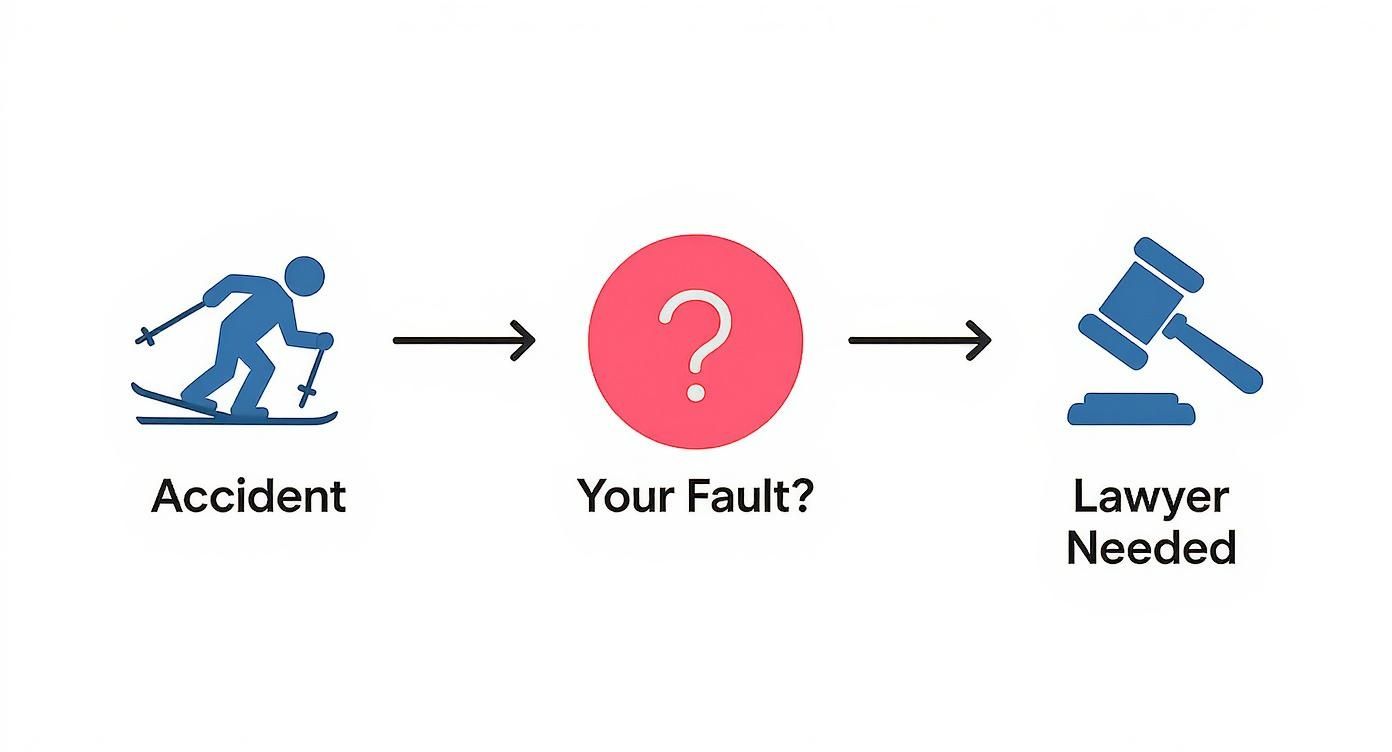
Flowchart depicting a ski accident, followed by questioning fault, and then needing a lawyer.

Determining who is truly at fault is the first and most important step in any resort injury case—it's the difference between a tragic accident and a winnable claim. Vail Resorts' legal team wants injured parties to believe every incident is an inherent risk of the sport, a convenient narrative that lets them avoid accountability. However, Colorado law provides meaningful protections for victims. Under the Modified Comparative Negligence doctrine (C.R.S. § 13-21-111), plaintiffs can recover damages even if partially at fault, as long as their negligence doesn't exceed 50%. This standard shifts the focus to whether the resort failed in its duty to maintain safe conditions or warn of hazards. Non-economic damages for pain and suffering are capped at $1,500,000 as of 2025. Importantly, Colorado's three-year statute of limitations (C.R.S. § 13-80-101) applies to personal injury claims. Exposing resort negligence requires thorough investigation and documentation of the actual facts surrounding the incident.

It’s a cynical tactic—and we don’t let them get away with it.

Your Fight Is Against a Reckless Skier—and Their Insurance Company

Sometimes the enemy isn't the resort—it's the out-of-control skier who used an innocent person as their personal slalom gate. The reckless skier who decided Riva Ridge was their private downhill course, shattering lives in a flash of gross incompetence. When that happens, the injured party faces a two-front battle: holding the negligent skier accountable while navigating their insurance company's resistance. Colorado law provides a reasonable window for action. Under C.R.S. § 13-80-101, injured skiers have three years from the date of injury to file a personal injury lawsuit. However, Colorado's modified comparative negligence rule under C.R.S. § 13-21-111 means an injured party can only recover damages if they're found less than 50% at fault. Additionally, non-economic damages—including pain and suffering—are capped at $1,500,000 as of 2025. Understanding these limitations is crucial for pursuing maximum compensation against both the reckless skier and their insurance carrier.

The law on this is brutally simple. It’s absolute.

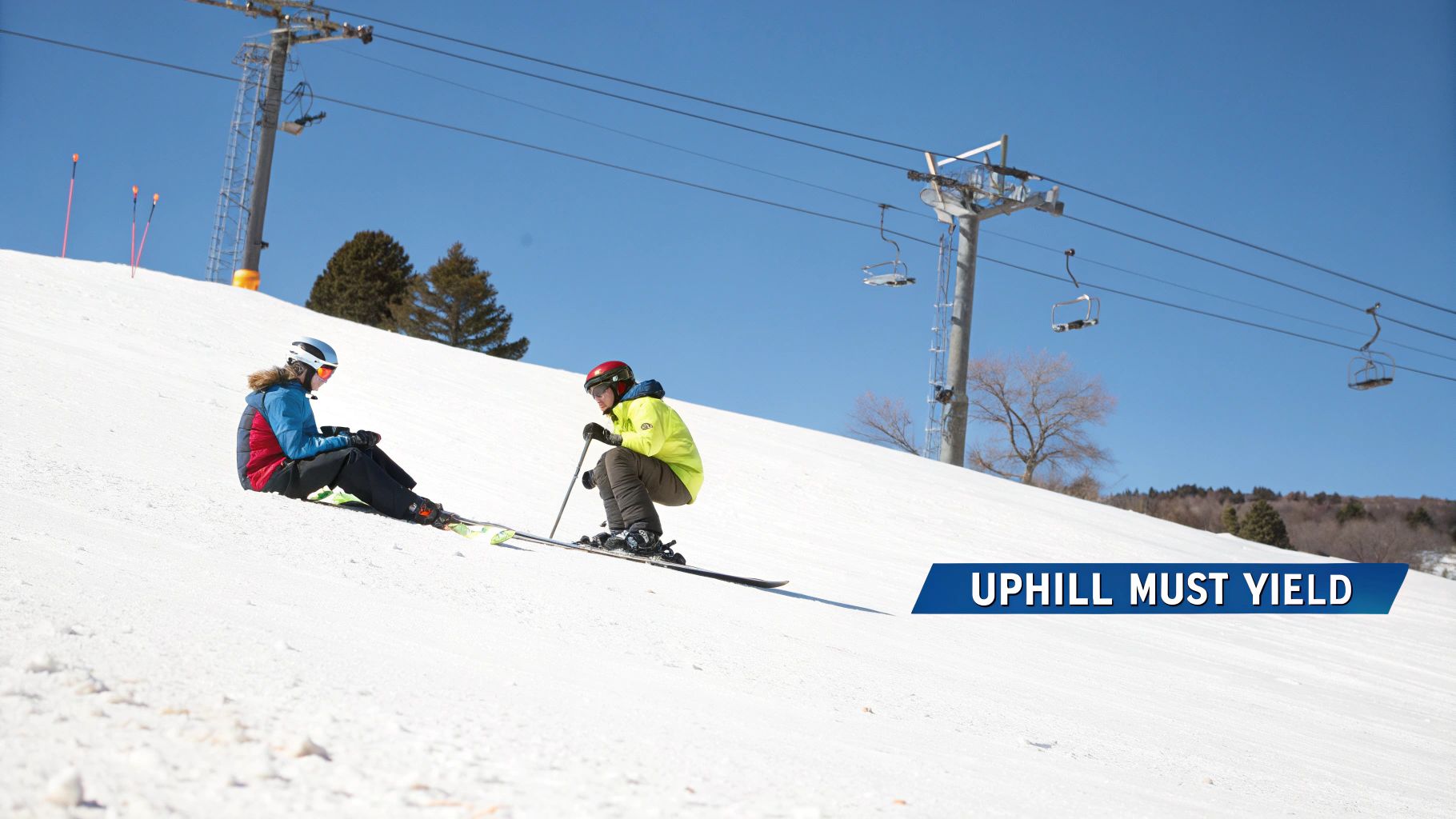
Two skiers on a sunny day on a snow-covered mountain slope with ski lifts in the background.

The uphill skier carries a 100% duty to yield to everyone downslope, regardless of circumstance. It doesn't matter if the downhill skier stopped suddenly or turned unexpectedly—the legal responsibility to avoid collision rests entirely on the uphill skier. Colorado law is clear on this point of liability. When an uphill skier fails to yield and causes a collision, they become liable for every dollar of resulting damage. However, Colorado's modified comparative negligence standard under C.R.S. § 13-21-111 means the downhill skier cannot recover damages if found more than 50% at fault. This makes establishing the uphill skier's clear duty violation essential to any claim. Additionally, injured parties should note Colorado's three-year statute of limitations under C.R.S. § 13-80-101, which sets the deadline for filing a personal injury lawsuit. Non-economic damages—such as pain and suffering—are capped at $1,500,000 as of 2025. Understanding these legal frameworks is crucial when pursuing compensation against both the negligent skier and their insurance carrier.

But here's the rub—that skier is almost certainly a tourist. They'll give a quick statement to patrol, hop on a plane back to New York or Florida, and assume the injured party will never find them. However, Colorado law provides a powerful tool: a three-year statute of limitations under C.R.S. § 13-80-101 allows time to locate the responsible party and file suit. Even if the skier vanishes, their ski resort insurance typically remains accessible. Under Colorado's modified comparative negligence rule (C.R.S. § 13-21-111), an injured person can still recover damages as long as they bear less than 50% of the fault. Non-economic damages are capped at $1,500,000 as of 2025, but combined with medical expenses and lost wages, a solid claim can still yield substantial compensation. Distance and time don't eliminate liability—they just require persistence and skilled legal investigation to hold the responsible party accountable.

They assume wrong. Our firm is relentless in pursuing these cases. We have deep expertise in tracking down out-of-state defendants and holding them accountable, no matter where they reside. We find them, we serve them properly, and we pursue a claim against the one thing they almost always have—a substantial homeowner's or umbrella insurance policy. This is the key to recovery. Colorado law provides a three-year statute of limitations to file suit (C.R.S. § 13-80-101), giving injured parties a meaningful window to act. Under Colorado's modified comparative negligence standard, plaintiffs can recover damages as long as their fault does not exceed 50% (C.R.S. § 13-21-111). Non-economic damages are capped at $1,500,000 as of 2025. Understanding these legal parameters—combined with aggressive defendant location and insurance policy analysis—transforms what appears to be an impossible case into a viable path to meaningful compensation.

A reckless skier lawsuit in Colorado requires an aggressive, strategic approach. The defendant isn't just an individual—the case is ultimately against their insurance company, an entity well-versed in minimizing payouts. Skier-on-skier collisions represent a primary cause of severe trauma on crowded mountains, and these incidents underscore the genuine risks present on congested slopes. Success demands understanding Colorado's legal framework: claims must be filed within three years under C.R.S. § 13-80-101, and Colorado's modified comparative negligence rule bars recovery if the plaintiff is found more than 50% at fault under C.R.S. § 13-21-111. Non-economic damages are capped at $1,500,000 as of 2025. Navigating these statutes while building a compelling case against well-resourced insurers requires specialized knowledge and relentless advocacy. Geographic distance need not prevent injured parties from accessing experienced legal representation and the justice they deserve.

The Only Number That Matters Is Your Lifetime Cost of Care

In the world of catastrophic injuries, the first hospital bill is a rounding error. A Traumatic Brain Injury or spinal cord injury isn't an event—it's a life sentence. The insurance company's entire strategy is to get the injured party to settle for the cost of the event, not the cost of the sentence. Lifetime medical care, adaptive equipment, in-home assistance, and lost earning capacity dwarf initial treatment expenses. Colorado law gives victims three years to pursue claims under C.R.S. § 13-80-101, but the clock ticks fast when facing mounting bills. While Colorado's modified comparative negligence standard under C.R.S. § 13-21-111 allows recovery even if the victim is up to 50% at fault, non-economic damages are capped at $1,500,000 as of 2025. These statutory limits underscore why calculating true lifetime costs of care—not settlement offers—must drive any serious injury case. The only number that matters is what it will actually cost to live with permanent disability.

They will rush in with a lowball offer, hoping to close the case before the injured party—or their family—can grasp the devastating financial reality of a lifetime of care. It's a predatory, disgusting tactic that exploits urgency and confusion. Insurance companies understand that most people don't know their actual lifetime care costs: medications, medical equipment, therapy, home modifications, lost wages, and pain and suffering can easily exceed millions of dollars. Under Colorado's modified comparative negligence statute (C.R.S. § 13-21-111), settlements must account for the injured party's degree of fault—but only if it doesn't exceed 50%. Meanwhile, non-economic damages are capped at $1,500,000 as of 2025, making it even more critical to maximize other recoverable categories. With Colorado's three-year statute of limitations (C.R.S. § 13-80-101) ticking away, accepting inadequate compensation early can mean catastrophic financial consequences for decades to come.

A desk setup with a 'Lifetime Costs' banner, calculator, spine model, and documents, suggesting medical expenses calculation.

To fight this, we build a fortress of evidence. Colorado law imposes a three-year statute of limitations for personal injury claims (C.R.S. § 13-80-101), making swift action critical. We assemble a team of nationally recognized experts to calculate the true cost of what was taken. This includes lifetime medical care, rehabilitation, lost wages, and pain and suffering. Under Colorado's modified comparative negligence standard (C.R.S. § 13-21-111), claimants can recover damages even if partially at fault—provided they're less than 50% responsible. Non-economic damages, including pain and suffering, are capped at $1,500,000 as of 2025. Our experts meticulously document every expense and impact, from immediate treatment to decades of ongoing care. This comprehensive approach ensures nothing is overlooked and that settlements reflect the true lifetime burden of injury, not just immediate costs.

  1. Life Care Planners: Experts who create a detailed, line-item budget for every single medical need you will have for the rest of your life—surgeries, therapies, medications, in-home assistance.
  2. Vocational Specialists: Experts who determine your lost earning capacity—not just your salary today, but the career you will now never have.
  3. Economists: Experts who project these costs decades into the future, accounting for inflation to arrive at a precise, undeniable number.

This is how high-stakes cases are valued correctly. It's not about guessing—it's about a methodical, expert-driven calculation of a client's entire future. Rather than simply asking for what's needed, skilled representation proves the actual cost of care through meticulous documentation and analysis. That approach makes it impossible for insurers and defendants to look away. Under Colorado law (C.R.S. § 13-80-101), injured parties have three years to file suit, making early and thorough case valuation critical. Lifetime care costs—medical treatment, rehabilitation, home care, lost wages, and assistive devices—form the foundation of damages calculations. Non-economic damages, including pain and suffering, are capped at $1,500,000 as of 2025. However, Colorado's modified comparative negligence rule (C.R.S. § 13-21-111) means plaintiffs cannot recover if they're more than 50% at fault, requiring precise liability analysis alongside damage assessment. Expert testimony, medical records, and vocational evaluations transform abstract claims into compelling, evidence-based narratives that courts and juries cannot dismiss.

Your First Moves on the Mountain Will Make or Break Your Case

In the moments after a collision, everything is a blur of pain and confusion. But what you do right then is critical. You have to understand one thing above all else: Vail Ski Patrol works for Vail Resorts. They are not an objective police force. Their primary allegiance is to the resort, not to injured skiers. This distinction matters enormously because Colorado's modified comparative negligence rule under C.R.S. § 13-21-111 means that if an injured party is found more than 50% at fault, they cannot recover damages at all. Early statements to patrol or resort representatives can undermine a legitimate claim. Additionally, injured parties have three years from the date of injury to file suit under C.R.S. § 13-80-101, but evidence gathered immediately—witness contact information, photographs, medical records—proves invaluable. Non-economic damages are capped at $1,500,000 as of 2025, making every detail of documentation count. Securing independent witnesses and medical evaluation before speaking with resort personnel protects your legal position significantly.

Their incident reports are written by employees, for their employer, with the primary goal of protecting their employer from liability rather than establishing objective truth. This inherent bias means independent evidence collection becomes essential. Under Colorado law, plaintiffs have three years from the date of injury to file a personal injury claim (C.R.S. § 13-80-101), but evidence degrades quickly. Photographs, witness statements, medical records, and physical evidence must be documented immediately while details remain fresh and accessible. Colorado's modified comparative negligence rule allows recovery even if the injured party is partially at fault, provided their negligence does not exceed fifty percent (C.R.S. § 13-21-111). However, establishing fault requires compelling evidence. Non-economic damages—compensation for pain, suffering, and emotional distress—are capped at $1,500,000 as of 2025, making thorough documentation of injuries critical to maximizing recovery. Victims who proactively gather evidence, rather than relying solely on institutional records, significantly strengthen their position.

This is your immediate, non-negotiable checklist:

  • Get Witness Info: Do not rely on ski patrol. Get the names and cell numbers of everyone who saw what happened. They are your unbiased truth-tellers.
  • Document Everything: Use your phone. Take photos/videos of the scene, your injuries, the other person, and any unmarked hazards before the resort can clean them up.
  • Preserve Your Gear: Your helmet, skis, bindings, and torn clothing are all evidence. Do not let anyone take them or repair them.
  • Decline a Recorded Statement: An insurance adjuster will call. They will be friendly. They are not your friend. Politely decline to give a recorded statement. It is a trap designed to get you to say something they can use to kill your claim.

It's a cynical tactic—adjusters call when victims are vulnerable and medicated to lock them into a version of events that benefits the insurance company. It happens every single day. These early statements, made under pain medication and shock, can undermine a case later. Under Colorado law (C.R.S. § 13-80-101), there's a three-year statute of limitations to file a personal injury claim, but that window closes fast when early admissions contradict the evidence. Additionally, Colorado's modified comparative negligence rule (C.R.S. § 13-21-111) means plaintiffs cannot recover if found 50% or more at fault. Insurance companies exploit this aggressively, using recorded statements to establish comparative fault. Non-economic damages are also capped at $1,500,000 as of 2025, making every strategic decision count. The first conversation with an adjuster often determines whether a case survives or gets derailed by the victim's own words. Silence during this critical phase protects legal rights far more than cooperation does.

You can learn more about the entire journey ahead in our guide to the Colorado personal injury claim process. But know this: your first hour post-injury can determine the outcome years later. Colorado law provides a three-year statute of limitations to file a claim under C.R.S. § 13-80-101, which means procrastination is not an option. The immediate actions taken—documenting the scene, gathering witness information, and seeking medical attention—establish the foundation for everything that follows. Under Colorado's modified comparative negligence standard outlined in C.R.S. § 13-21-111, a claimant can recover damages only if less than 50% at fault. Additionally, non-economic damages such as pain and suffering are capped at $1,500,000 as of 2025. These early decisions and actions directly influence how evidence is preserved, liability is established, and ultimately, how much compensation can be recovered. The critical window is now.

This isn't a fair fight, which is why ski injury victims need a premier Vail personal injury lawyer who understands the complexities of mountain accident claims. Defense teams know their playbook—from the initial incident report through the reasons why insurance companies systematically deny claims. Colorado law imposes a three-year statute of limitations for personal injury actions (C.R.S. § 13-80-101), making early representation critical. Additionally, Colorado's modified comparative negligence standard allows recovery only if a claimant is less than 50% at fault (C.R.S. § 13-21-111), a threshold that requires careful case evaluation. Non-economic damages are capped at $1,500,000 as of 2025, emphasizing the importance of strategic claim construction. Being findable by injured parties is equally important; experienced ski injury attorneys maintain visibility through current legal marketing strategies, ensuring victims can connect with top-tier representation when time matters most.

You've been through enough. Let us take the fight from here.


Disclaimer: The information in this article is for informational purposes only and does not constitute legal advice. Each case is unique, and you should consult with a qualified attorney to discuss your specific situation. No attorney-client relationship is formed by reading this article or contacting our firm.

You are not in this alone. If you or someone you love was seriously hurt at Vail, the next step is a confidential, no-pressure conversation about your rights. An experienced personal injury attorney will listen to your story and give you a clear, honest assessment of your case. Time matters significantly—Colorado law sets a three-year statute of limitations for personal injury claims (C.R.S. § 13-80-101), meaning there is a deadline to file suit. Additionally, Colorado follows a modified comparative negligence standard, which means an injured party can recover damages even if partially at fault, provided their negligence does not exceed 50% (C.R.S. § 13-21-111). Non-economic damages such as pain and suffering are capped at $1,500,000 as of 2025. Understanding these legal frameworks early protects your rights and ensures no critical deadlines pass. A consultation clarifies what compensation may be available and what steps come next in your specific situation.

Call Conduit Law for a free consultation. I got you.

CL

Written by

Conduit Law

Personal injury attorney at Conduit Law, dedicated to helping Colorado accident victims get the compensation they deserve.

Learn more about our team

Locations We Serve

Our injury attorneys serve clients throughout Colorado and nearby communities.

Explore Our Practice Areas

We handle 24+ types of personal injury cases throughout Colorado.

Need Legal Assistance?

If you have been injured, our experienced personal injury attorneys are here to help you get the compensation you deserve.