

Table of Contents
Your apartment management company, whether it's a national firm or a local outfit, operates a business, and that business comes with legal duties to the people who live there. Under Colorado law, property managers who control common areas must use reasonable care about dangers they know or should know about, including icy walkways, broken drainage, and inadequate snow removal that could foreseeably lead to injury.
Many people who slip on an icy walkway blame themselves: their shoes, their luck, their attention. But Colorado law allows recovery even when the injured person bears some responsibility, as long as their share of fault is less than the defendant's and below 50 percent (C.R.S. § 13-21-111).
As an apartment complex ice slip and fall attorney, our job is to look at whether the fall was the foreseeable, preventable result of a landlord not maintaining safe common areas.
The High Bar for Apartment Management
One minute you're walking from your car to your front door, a path you take every day, and the next you're on the ground in pain.
It is natural to feel frustrated, especially if the ice was there for days or a simple application of ice melt might have prevented it. If the management company's failure to maintain the walkway caused your fall, it may be responsible for your injuries and medical bills.
Under the Colorado Premises Liability Act (C.R.S. § 13-21-115), people who come onto property are classified as trespassers, licensees, or invitees. A tenant using common areas will often qualify as an invitee, the category with the most protection. An invitee can recover for a landowner's unreasonable failure to use reasonable care to protect against dangers the landowner actually knew or should have known about, which can include ice buildup on walkways, stairs, and parking lots.
When apartment management fails to meet that standard, the claim is about responsibility, not clumsiness.
Your Landlord Owes You The Highest Duty of Care
The Colorado Premises Liability Act governs landowner liability, so claims are framed under it rather than ordinary negligence. Here's what every apartment tenant needs to know:
- Invitee status: A tenant using common areas often qualifies as an invitee, the most protected category under the Act.
- Modified comparative negligence (C.R.S. § 13-21-111): You can recover damages even if you're partially at fault, reduced by your share, as long as your fault is below 50% and less than the defendant's.
- Statute of limitations (C.R.S. § 13-80-102): You have two years from the date of injury to file a lawsuit.
- Damages cap: Non-economic damages—pain, suffering, and emotional distress—are capped at $1,500,000 for claims that accrue on or after January 1, 2025, and actions filed during 2025. Economic damages like medical bills and lost wages have no cap.
For an invitee, the duty is not only to fix dangers management was told about, but also dangers it should have discovered with reasonable care.
This duty covers all the common areas—every square inch of property outside your front door that the landlord controls.
- Sidewalks and walkways.
- Parking lots and garages.
- Shared stairwells, both inside and out.
- Paths to the mailboxes/dumpsters.
In these shared spaces, whether management should have known about ice often turns on its inspection and maintenance practices.
Natural vs. Unnatural Ice Accumulation
Not every icy surface leads to a claim, and there is no simple rule that decides these cases. Under the Premises Liability Act, liability turns on the injured person's status, what the landlord knew or should have known, and who controlled the area.
Ice that forms because of a maintenance problem, sometimes called unnatural accumulation, is often the strongest evidence. It comes from a failure to repair gutters, clear drainage, or remove snow and ice, rather than from the weather alone.
It looks like this:
- A leaky gutter dripping water onto a walkway, creating a perfect sheet of black ice.
- A poorly graded parking lot where meltwater always pools and refreezes into an ice rink.
- Plowed snow piled up so high that it melts during the day, sending water across a sidewalk that freezes solid at night.
When a maintenance problem keeps producing ice in the same spot, it can show that the hazard was foreseeable and preventable. An apartment complex ice slip and fall attorney documents that pattern through records, photos, and witnesses. Falls on natural snowfall are evaluated on the same factors, status, notice, and control, rather than ruled out automatically.
Proving the Landlord Knew or Should Have Known
Large property management companies and their insurers will look closely at whether they had notice of the ice before you fell.
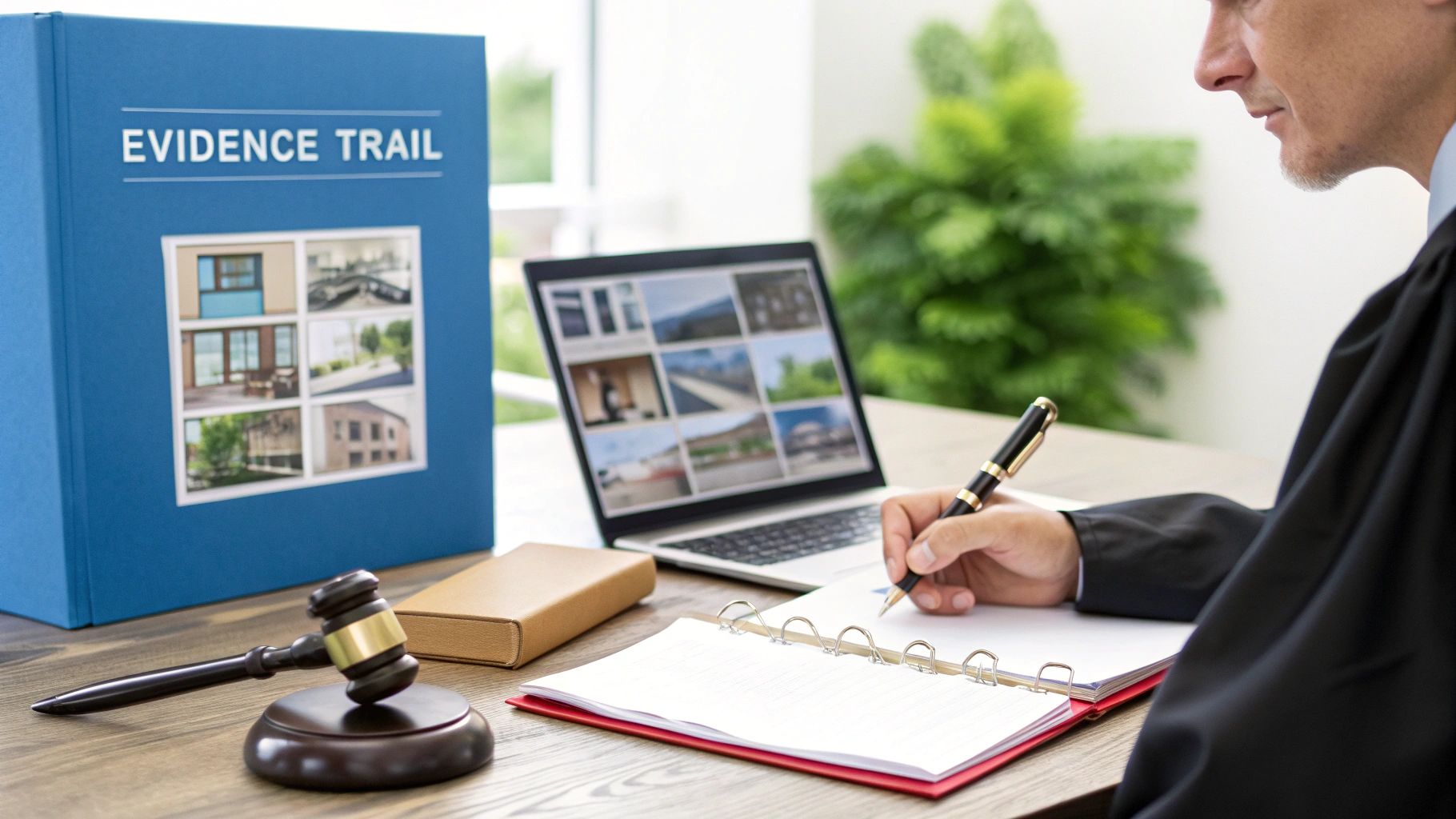
Our job is to establish notice, the foundation of most premises claims: that the property owner either knew about the dangerous ice or should have known about it through reasonable inspection, and did not take corrective action.
Actual Notice
Actual notice means the property owner was told about the hazard and did not act. The evidence often lies in its own records: incident reports, maintenance logs, employee statements, or prior complaints.
- Tenant Emails: Did you or a neighbor complain about that icy spot last week? We'll find that email.
- Maintenance Requests: We subpoena the work order history from the tenant portal.
- Phone Logs: Voicemails to the property manager are powerful evidence.
When the proof is sitting in an inbox, notice is much harder to dispute.
Constructive Notice
More often, the case hinges on constructive notice—the legal doctrine that says a danger existed for so long that any reasonably competent landlord should have discovered and fixed it through ordinary inspection and maintenance practices.
The duty includes looking. When a hazard exists long enough that a reasonable property manager would have found it, constructive notice can apply.
As your slip and fall on ice lawyer in Denver, we use legal discovery to understand the property's winter maintenance practices. We ask for internal documents such as:
- Maintenance Logs: We look for gaps and entries that don't match conditions.
- Employee Schedules: We find out who was supposed to be inspecting the area.
- Security Footage: We ask that camera footage be preserved, since it can show how long the hazard existed.
- Purchase Orders for Salt/De-Icer: Purchase records show whether materials were on hand.
- Weather Reports: We compare freeze/thaw cycles with maintenance records.
We combine this evidence with statements from neighbors and witnesses. A neighbor who saw the same icy sidewalk for days can be important evidence, and together these records can build a timeline showing whether the problem was a one-time lapse or a recurring one.
Winter Maintenance Failures: What Landlords Must Do
Colorado winters bring repeated freeze-thaw cycles, and apartment complexes face recurring ice hazards in shared areas. Maintenance failures can create the conditions that lead to serious falls.
Snow Removal Obligations
Local snow-removal rules vary by city, and some apartment complexes fall short in practice by relying on an under-resourced contractor, running low on de-icing materials, or overlooking secondary walkways tenants use daily.
Common winter maintenance failures we see in apartment complex ice cases include:
- Inadequate salting: Applying salt only to main entrances while ignoring parking lot walkways, stairwells, and paths to dumpsters and mailboxes.
- Gutter and drainage neglect: Failing to maintain gutters and downspouts that drip water onto walkways, creating sheets of black ice overnight.
- Poor grading and drainage: Parking lots and walkways that pool water during the day, then freeze into treacherous ice rinks at night.
- Snow pile mismanagement: Plowing snow into piles that melt and refreeze across pedestrian paths.
- No inspection schedule: Failing to inspect common areas after freeze-thaw cycles, which are frequent throughout Colorado winters from October through April.
Each of these failures can create unnatural ice accumulation and is evidence of what management knew or should have known. As an apartment complex ice slip and fall attorney, we use maintenance records, weather data, and expert testimony to show whether these failures were foreseeable and preventable.
How Fault Questions Come Up
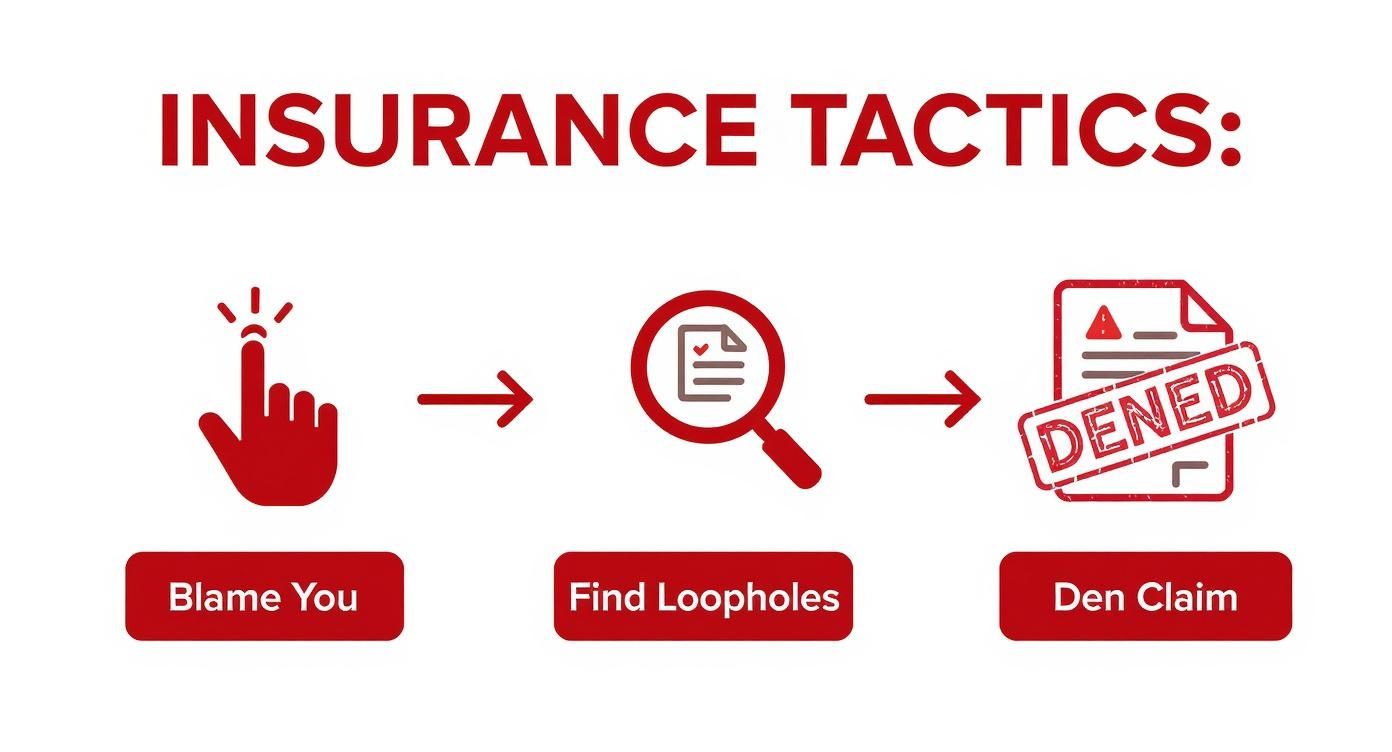
Once a claim is filed, the landlord's insurance company will evaluate it, and one of the first questions is usually whether the injured tenant shares some responsibility for the fall.
Comparative Negligence Questions
An adjuster may call and ask questions like these:
- "What kind of shoes were you wearing?"
- "Were you on your phone?"
- "Did you see the ice before you stepped on it?"
These questions go to comparative fault. Under C.R.S. § 13-21-111, your recovery is reduced by your share of fault, and it is barred if your fault reaches 50 percent or more. It is worth speaking with a lawyer before answering them.
A tenant walking a path they use every day is not expected to treat it as a hazard course. The landlord's duty under the Premises Liability Act still applies, and you can recover damages even if you bear some fault, as long as your share is below 50 percent and less than the defendant's.
Lease Clauses About Snow Removal
Some leases include a clause that tries to shift responsibility for snow removal to tenants.
A lease clause does not automatically end a landlord's duties under the Premises Liability Act. A landlord can be a "landowner" under the Act based on possession and control, so the key question is who controlled the area where you fell. Shared sidewalks, parking lots, and walkways are often under management's control.
Fault and lease questions are fact-specific, and an apartment complex ice slip and fall attorney can review the lease, the property records, and the scene together.
Your First Moves to Protect Your Claim
What happens in the first 48 hours after a slip-and-fall can shape your case. Snow melts, surveillance footage gets overwritten, and witness memories fade, so early steps matter.
- Document the Scene. Use your phone. Take photos and videos of the ice, its source (leaky gutter, faulty drainage, unsalted walkway), and the lack of any salt or sand. Capture timestamps.
- Get Medical Care. Go to an urgent care or ER immediately. This creates an official record linking your injuries directly to the fall. A delay in care can be read as a sign the injury was minor.
- Report It in Writing. Follow up any phone call to the management office with a simple, factual email. State the date, time, and location of your fall. No apologies, no excuses. Just the facts.
- Talk to Your Neighbors. Your community is your best source of evidence. Discreetly ask neighbors if they also saw the ice or if it had been there for days. What they saw can help show constructive notice.
- Preserve Everything. Don't wash your clothes from the fall. Keep the shoes you were wearing. Save every text, email, and photo. This evidence disappears fast.
Claims like these take patience. Our job is to build the record and present it clearly so responsibility can be fairly assessed.
The path forward can feel overwhelming right now, especially when the other side is a large company. You don't have to navigate it alone. Colorado generally allows two years to file a premises injury lawsuit (C.R.S. § 13-80-102), but the sooner you act, the better the evidence will be.
Let's talk.
Elliot A. Singer
Managing Attorney | Conduit Law
Disclaimer: The information in this blog post is for general informational purposes only and does not constitute legal advice. No attorney-client relationship is formed by reading or using the information on this site. You should consult with a licensed attorney for advice regarding your individual situation.
Call us 24/7 for a free, no-obligation consultation to discuss your case.

Written by
Elliot Singer, Esq.
Personal injury attorney at Conduit Law, dedicated to helping Colorado accident victims get the compensation they deserve.
Learn more about our team

