Table of Contents
The snow starts falling—heavy, wet, and fast—right around 4 p.m. You're inching your way through the I-25/I-70 Mousetrap, a special kind of Denver hell on a good day, a full-blown demolition derby in a storm. The conditions are treacherous, and accidents happen in seconds. Colorado recorded 628 traffic fatalities in 2023, many occurring during winter weather events. What makes matters worse is that roughly 16% of Colorado drivers are uninsured, meaning victims often struggle to recover damages. Colorado law requires drivers to carry minimum liability coverage of $25,000 per person and $50,000 per accident under C.R.S. § 10-4-609, yet many drivers fall short of even these baseline protections. When a collision occurs in poor conditions, determining fault becomes complicated. Weather, visibility, and driver error all factor into investigations. Victims injured in winter weather accidents face mounting medical bills, lost wages, and property damage—often with limited recovery options when the at-fault driver lacks adequate insurance.
For year-round guidance after any Denver crash, our Denver car accident lawyer resource explains fault, deadlines, insurance coverage, injuries, and settlement factors in one place.
You're doing everything right. You've left acres of following distance. You're easing into your stops like the brake pedal is made of glass. You're white-knuckling it, focused, present. And then someone else isn't. In 2023, Colorado recorded 628 traffic fatalities—a sobering reminder that defensive driving alone cannot protect against negligent or reckless drivers. The reality is that roughly 16% of Colorado drivers carry no insurance whatsoever, meaning even a minor collision could leave an injured party without recourse for medical bills and lost wages. Colorado law requires minimum liability coverage of $25,000 per person and $50,000 per accident under C.R.S. § 10-4-609. However, these limits often fall short of actual damages in serious crashes. The most cautious driver can do everything correctly and still become a victim of someone else's inattention, intoxication, or recklessness. When that happens, understanding insurance requirements and legal remedies becomes essential.
Then—wham.
Those headlights in the rearview mirror were way too bright and way too close. Now the neck is throbbing, and the bumper is practically in the back seat. The other driver climbs out, throws up their hands, and says the six words every insurance company dreams of: "Roads are slick, what can you do?" That casual dismissal ignores a hard reality: Colorado recorded 628 traffic fatalities in 2023, many involving weather-related accidents and negligent driving. It also glosses over Colorado's minimum liability insurance requirements of $25,000 per person and $50,000 per accident, as mandated by C.R.S. § 10-4-609. Complicating matters further, approximately 16% of Colorado drivers carry no insurance at all, leaving victims with limited recovery options. When road conditions are slippery, drivers have a legal duty to adjust their speed and following distance accordingly. A rear-end collision caused by tailgating—regardless of weather—remains negligence under Colorado law.
Right there, that's it. That's the entire defense strategy in a nutshell. They will grab onto that lazy excuse—that it was just the weather, an unavoidable accident, an "Act of God"—and try to ride it all the way to a denied claim. This deflection tactic is particularly common in Colorado, where winter conditions and unpredictable weather patterns create genuine hazards. However, Colorado law, specifically C.R.S. § 10-4-609, establishes minimum liability requirements of $25,000 per person and $50,000 per accident, reflecting the state's recognition that drivers bear responsibility for safe operation regardless of conditions. With 628 traffic fatalities recorded in Colorado during 2023 alone, and 16% of drivers carrying no insurance whatsoever, the stakes couldn't be higher. The reality is straightforward: drivers must adjust their speed and behavior to match road conditions. Blaming the weather is not a legitimate legal defense—it's an evasion tactic designed to avoid accountability and leave injured parties without compensation.
They are wrong. Dead wrong. As a dedicated Denver winter car accident lawyer, my job is to prove it.
Your Crash Wasn't an Act of God—It Was an Act of Negligence
You know that feeling in your gut when the other driver slides through a stop sign and T-bones you? The one that tells you they should have known better than to drive like that in a Denver snowstorm? That instinct is legally sound. Colorado recorded 628 traffic fatalities in 2023, many resulting from preventable driver errors rather than unavoidable accidents. When negligence causes a crash, the responsible party bears legal liability. Colorado law requires drivers to carry minimum liability coverage of $25,000 per person and $50,000 per accident under C.R.S. § 10-4-609. However, with 16% of Colorado drivers uninsured, many victims find themselves facing significant gaps in recovery. Negligence occurs when a driver fails to exercise reasonable care—whether through speeding in hazardous conditions, ignoring traffic signals, or distracted driving. These aren't acts of God; they're choices that have real consequences for injured parties seeking compensation.
That feeling isn’t just frustration. It’s the very foundation of Colorado law.
Insurance companies love to throw around phrases like "Act of God" or "unavoidable accident." It's a cynical, calculated attempt to make crash victims feel like their collision was simply bad luck—nothing more than fate. It's a lie. In reality, the vast majority of car accidents result from negligent driving decisions, not divine intervention or unavoidable circumstances. Colorado's legal system recognizes this fundamental truth. Under C.R.S. § 10-4-609, drivers are required to carry minimum liability coverage of $25,000 per person and $50,000 per accident, acknowledging that preventable crashes cause real harm. The numbers tell the story: Colorado recorded 628 traffic fatalities in 2023 alone, most stemming from preventable driver behavior. Additionally, with 16% of Colorado drivers uninsured, many crash victims face further injustice when defendants lack adequate coverage. When insurers invoke "Act of God" language, they're attempting to evade responsibility. The truth is far different—negligence caused the crash, and accountability should follow.
In Colorado, the law hinges on a simple, powerful principle: every driver has a legal duty to operate their vehicle in a safe and prudent manner for the conditions. When those conditions include a foot of fresh powder or a patch of black ice on a DU side street, that duty of care becomes higher—not lower. Under Colorado Revised Statutes § 10-4-609, drivers must maintain minimum liability coverage of $25,000 per person and $50,000 per accident. Yet despite these legal requirements, approximately 16% of Colorado drivers operate uninsured or underinsured vehicles, compounding the risks on roadways. In 2023 alone, Colorado recorded 628 traffic fatalities, many resulting from preventable negligence. When a driver fails to adjust speed, increase following distance, or exercise appropriate caution during winter weather or hazardous conditions, that failure constitutes negligence—not an unavoidable accident. The law recognizes no "weather exception" to the duty of care. Negligent drivers remain legally and financially responsible for the injuries and damages they cause.
The weather didn’t cause the accident. The other driver’s failure to respect the weather caused the accident.
When Is the Other Driver Legally Negligent?
Your instinct that the other driver was at fault is valid. Here's what their negligence often looks like in the real world. Negligence occurs when a driver fails to exercise reasonable care, breaching a duty owed to others on the road. In Colorado, this breach must directly cause injury or damages. The state recorded 628 traffic fatalities in 2023, many resulting from preventable negligent driving. Common examples include speeding, distracted driving, running red lights, failing to yield, and driving under the influence. Colorado law requires all drivers to carry minimum liability insurance of $25,000 per person and $50,000 per accident, as outlined in C.R.S. § 10-4-609. However, roughly 16% of Colorado drivers remain uninsured, creating additional financial risk for victims. Establishing negligence requires proving four elements: duty, breach, causation, and damages. Even if the other driver carried insurance, proving negligence remains essential for recovering compensation.
- Excessive Speed for Conditions: This is the big one. Driving 65 mph on I-70 during a whiteout isn’t just a bad idea; it’s a clear breach of their duty to you, even if the posted speed limit is 65.
- Improper Following Distance: The classic rear-end collision on an icy road is almost always the fault of the trailing driver. They failed to account for longer stopping distances, and you paid the price. Our firm specializes in dissecting the physics and legal arguments for when you are rear-ended on an icy road.
- Unsafe/Defective Equipment: This is a crucial, often overlooked factor. If the at-fault driver was on bald or dangerously worn tires, they knowingly put an unsafe machine on the road. This isn’t an accident; it’s a reckless choice.
They made a choice, and you paid the price. That’s negligence. Period.
We Use Denver’s Reality to Dismantle Their Excuses
Winning a car accident case isn't just about knowing the law—it's about knowing Denver. It's about understanding the specific, hyper-local dangers that define winter commutes on icy I-25, treacherous mountain passes, and unpredictable weather conditions that catch drivers off-guard. Colorado recorded 628 traffic fatalities in 2023, and Denver's unique geography and seasonal challenges contribute significantly to these statistics. Using this localized knowledge, an effective strategy dismantles the defendant's excuses. When insurance companies claim liability is unclear or blame unavoidable weather, that argument falls apart against someone who understands Denver's actual driving conditions and patterns. Additionally, Colorado requires minimum liability coverage of $25,000/$50,000 under C.R.S. § 10-4-609, yet 16% of Colorado drivers operate uninsured—a fact that strengthens claims against underinsured motorists. Building an unshakeable case means grounding every argument in Denver's reality: the roads drivers navigate, the conditions they face, and the legal standards they must meet.
An insurance adjuster in Omaha doesn't know—or care—about the chaos of the Mousetrap during a snow squall. Local counsel does. They won't think to look for the city maintenance logs for a specific off-ramp where black ice forms every year. Experienced Denver-area attorneys will. This local knowledge matters enormously. Colorado recorded 628 traffic fatalities in 2023, and many resulted from hazardous road conditions that adjusters from out of state simply cannot fathom. Understanding Denver's unique infrastructure, seasonal weather patterns, and municipal maintenance records transforms how accidents get investigated and litigated. Moreover, Colorado's minimum liability limits under C.R.S. § 10-4-609 require $25,000 per person and $50,000 per accident—thresholds that often prove insufficient for serious injuries. When 16% of Colorado drivers carry no insurance at all, gaps in coverage become critical. Adjusters operating from distant offices lack the granular understanding of local conditions necessary to identify negligence, establish causation, and overcome their predictable defenses.
This is the home-field advantage. Our strategy is grounded in Denver’s reality.
The Hyper-Local Evidence That Wins Cases
Insurance companies love to fall back on broad, lazy arguments. It was the weather! is a classic deflection. Yet defeating these dismissive claims requires specific, undeniable facts—evidence only a dedicated Denver attorney would know how to find. With 628 traffic fatalities recorded across Colorado in 2023, courts and insurers recognize that weather alone rarely causes accidents. The real culprit is driver negligence. By gathering hyper-local evidence—weather service records for the exact time and location, road condition reports, traffic camera footage, and witness statements—skilled legal advocates dismantle the weather excuse entirely. This approach matters especially in Colorado, where 16% of drivers remain uninsured. When an uninsured motorist causes a collision, pursuing the at-fault driver's minimum liability coverage of $25,000 per person/$50,000 per accident under C.R.S. § 10-4-609 demands aggressive fact-finding. Insurance adjusters count on injured parties accepting convenient narratives. Strong evidence transforms the case.
- CDOT & City Traffic Cameras: Footage from cameras monitoring I-25 or Speer Boulevard is invaluable, but it’s often deleted within days. We move immediately to send preservation letters, securing digital proof of the other driver's reckless speed before it vanishes.
- Forensic Meteorology: We bring in experts who can create hyper-local weather reports for a specific intersection at a specific time. This proves that the black ice on that shaded Capitol Hill side street wasn't a surprise—it was a predictable result of a documented freeze-thaw cycle.
- Maintenance & Plow Logs: Was a particular stretch of I-70 recently treated or plowed? City and state records can establish road conditions and prove that other drivers were navigating the area safely, isolating the at-fault driver's behavior as negligent.
This isn't just gathering paperwork. It's about telling a story so compelling that the insurance company's "Act of God" defense sounds as ridiculous as it actually is. Colorado recorded 628 traffic fatalities in 2023 alone, yet insurers routinely invoke weather or unforeseen circumstances to dodge liability. Strategic evidence collection—weather service records, traffic camera footage, witness statements, vehicle maintenance logs—transforms abstract claims into irrefutable narratives. Under C.R.S. § 10-4-609, Colorado requires minimum liability coverage of $25,000 per person and $50,000 per accident, yet 16% of Colorado drivers remain uninsured, complicating recovery efforts. When evidence is hyper-local and specific—the exact road conditions at that intersection, the documented weather patterns that day, the failure of another driver to adjust for circumstances—the insurance company's defense crumbles. Compelling evidence doesn't just support a claim; it reframes the entire accident narrative from ambiguous incident to preventable harm caused by negligence.
Proving Fault in Complex Denver Scenarios
The other driver's insurance company will always have an excuse. Our job is to dismantle it.
- The Multi-Car Pileup on I-25/I-70: In a chain reaction, liability can almost always be traced back to the initial negligent driver. We use accident reconstruction to untangle the chaos and pinpoint the person whose mistake started it all.
- Black Ice on Ramps/Surface Streets: We prove liability by focusing on what a prudent driver should have known. Was it a shaded overpass after a sunny day? A notorious low spot after a freeze? We establish that the hazard was foreseeable, making the failure to slow down a negligent act.
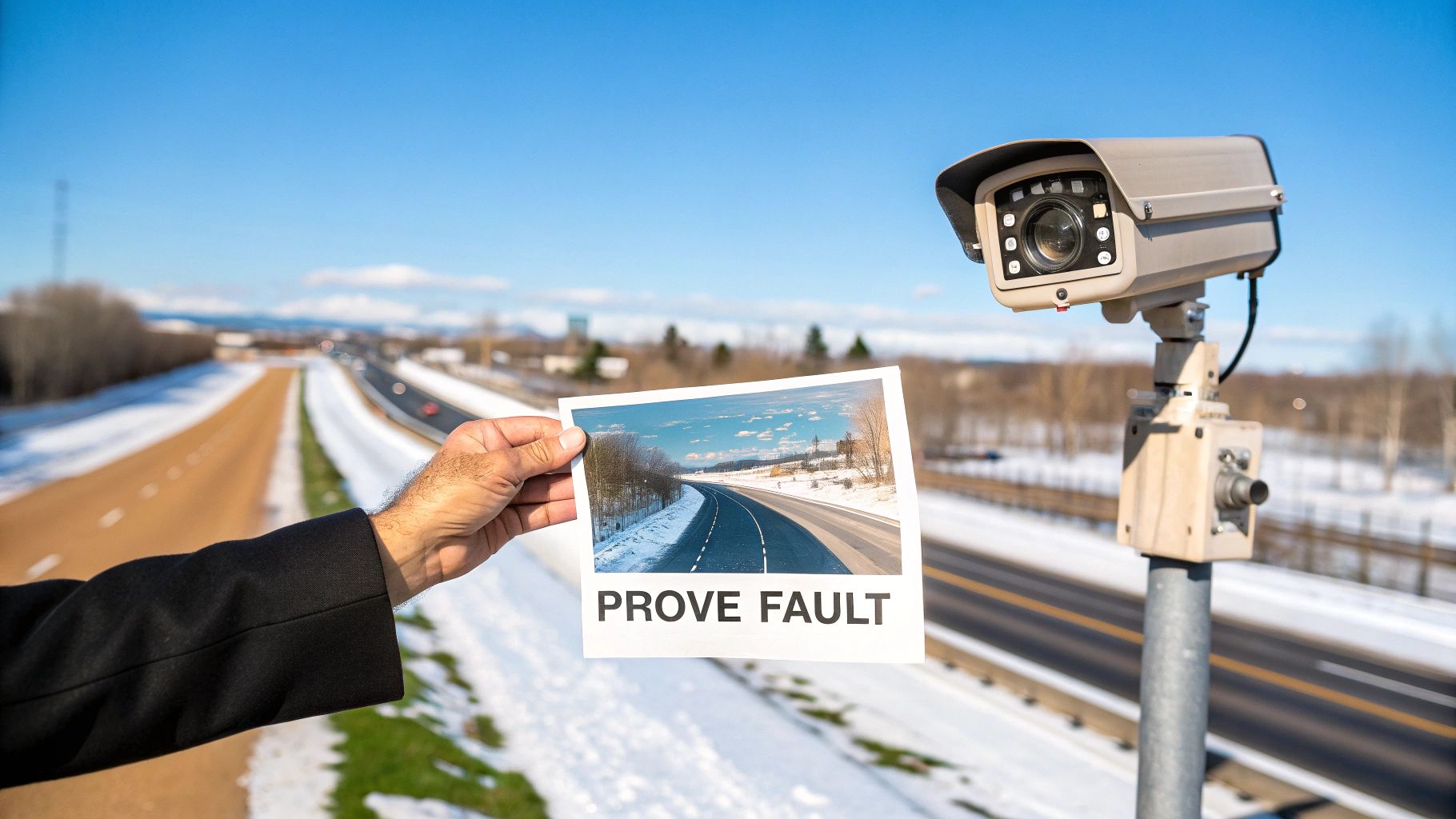
We use every tool—from hyper-local weather reports to black box data—to prove the other driver failed you.
The Trick Insurance Companies Don't Want You to Know
Get ready for the insurance adjuster's favorite move. It's a cynical little game called comparative fault, and it's designed to do one thing: pay less. Or better yet, nothing at all. Under Colorado law (C.R.S. § 10-4-609), drivers must carry minimum liability coverage of $25,000 per person and $50,000 per accident. Yet despite these requirements, 16% of Colorado drivers remain uninsured, creating additional complications in accident claims. Insurance companies weaponize comparative fault by arguing that accident victims share blame for their injuries—even when responsibility is clearly one-sided. By shifting partial liability onto injured parties, adjusters reduce payouts significantly or deny claims entirely. This strategy becomes especially aggressive in Colorado's high-traffic corridors, where 628 traffic fatalities were recorded in 2023 alone. Understanding how comparative fault actually works in Colorado is critical for protecting claim value. The law allows victims to recover damages even when partially at fault, but only if their negligence doesn't exceed the defendant's. Insurance adjusters count on accident victims not knowing this distinction.
They'll listen to your story. They'll nod along, appearing sympathetic and understanding. Then, they'll gently suggest that maybe—just maybe—you were also a little bit to blame. This tactic, known as comparative negligence, is one of the most effective tools insurance companies use to reduce payouts. By shifting even a small percentage of fault to the accident victim, they can legally diminish their liability obligation. In Colorado, where 628 traffic fatalities were recorded in 2023 according to CDOT data, accidents are serious matters. Yet insurance adjusters routinely downplay their client's responsibility. Under Colorado Revised Statutes § 10-4-609, drivers must carry minimum liability coverage of $25,000 per person and $50,000 per accident. However, with 16% of Colorado drivers uninsured, many victims struggle to recover damages. Insurance companies rely on accident victims not understanding their rights or the legal standards governing fault determination.
Maybe you were going one mile over the speed limit. Maybe you didn't slam on your brakes the microsecond you saw the other car lose control. Insurance adjusters will pick apart every move, searching for any scrap of fault they can pin on you. This tactic is deliberate and calculated. They know that Colorado law, under C.R.S. § 10-4-609, only requires minimum liability coverage of $25,000 per person and $50,000 per accident—amounts that quickly evaporate in serious injury cases. With 16% of Colorado drivers uninsured and 628 traffic fatalities recorded in 2023 alone, the stakes have never been higher. Insurance companies exploit comparative negligence rules, attempting to shift blame to injured parties to reduce payouts. Even minor alleged infractions become ammunition in their defense strategy. Understanding this manipulation tactic is essential for accident victims seeking fair compensation for their injuries and damages.
Why They Play the Blame Game
Here's why insurance companies play this blame game so aggressively. Colorado operates under a modified comparative fault system, codified in state law, which fundamentally shapes how accident claims are handled. In plain English, that means an injured driver can still recover compensation for injuries as long as they're found to be less than 50% at fault for the accident. This legal threshold creates significant financial incentives for insurers to maximize the plaintiff's percentage of blame, thereby reducing their payout obligations. Given that Colorado recorded 628 traffic fatalities in 2023, accident liability determinations carry serious weight. Additionally, with 16% of Colorado drivers uninsured, fault disputes become even more contentious. State law requires minimum liability coverage of $25,000 per person and $50,000 per accident under C.R.S. § 10-4-609, making fault allocation a critical factor in whether injured parties receive full compensation for their losses.
But your final compensation is reduced by your percentage of fault under Colorado's comparative negligence system. If a jury decides the injured party was 10% to blame for the accident, the awarded damages get cut by 10%. This reduction applies regardless of the accident's severity. In 2023 alone, Colorado recorded 628 traffic fatalities, many involving disputed liability claims. Insurance companies scrutinize fault percentages carefully because they directly impact payouts. Colorado law, specifically C.R.S. § 10-4-609, sets minimum liability coverage requirements at $25,000 for bodily injury per person and $50,000 per accident. Additionally, roughly 16% of Colorado drivers carry no insurance at all, complicating fault determinations when uninsured motorists cause crashes. The "blame game" insurers play during settlement negotiations often hinges on pinpointing exact fault percentages. Even a small increase in assigned fault can substantially reduce the final recovery amount, making accurate fault assessment critical in personal injury cases.
And here's the knockout punch: if the insurance company can convince a jury that the injured party was 50% or more at fault, that person gets exactly zero. Nothing. This is Colorado's modified comparative negligence rule, codified in law and strictly enforced in courtrooms across the state. Given that Colorado recorded 628 traffic fatalities in 2023 alone, the stakes in these liability determinations couldn't be higher. Insurance adjusters know this rule well and weaponize it aggressively. They deploy accident reconstruction experts, challenge witness credibility, and dissect every detail of a driver's actions leading up to the collision. The strategy works because juries must assign fault percentages—and once that threshold of 50% hits, recovery disappears entirely. This is particularly devastating when dealing with uninsured or underinsured drivers; approximately 16% of Colorado drivers carry no insurance whatsoever. Meanwhile, Colorado's minimum liability coverage stands at just $25,000 per person and $50,000 per accident under C.R.S. § 10-4-609, often insufficient for serious injuries.
They aren't just trying to reduce the payout; they're trying to eliminate it completely. Insurance companies and at-fault drivers understand that Colorado's minimum liability requirements—$25,000 per person and $50,000 per accident under C.R.S. § 10-4-609—represent significant financial exposure. Their goal is always to shift blame away from their client and deny payment altogether. By questioning the accident narrative, challenging injury severity, or finding any technical violation by the injured party, adjusters create reasonable doubt. This strategy is particularly aggressive in a state where 628 traffic fatalities occurred in 2023, making high-liability claims common. The situation becomes even more complicated when uninsured drivers are involved; approximately 16% of Colorado drivers carry no insurance, creating additional complications for legitimate claims. Defense teams exploit every opportunity to minimize their client's responsibility, knowing that even partial fault determinations can substantially reduce what injured victims ultimately receive.
How We Shut Their Arguments Down
This is where a real trial lawyer earns their keep. Insurance adjusters count on injured drivers accepting lowball settlements without understanding their rights. Colorado law requires minimum liability coverage of $25,000 per person and $50,000 per accident (C.R.S. § 10-4-609), yet many claims fall far short of actual damages. The statistics underscore why skilled representation matters: Colorado recorded 628 traffic fatalities in 2023, and with 16% of state drivers operating uninsured, legitimate claims face constant resistance. Rather than simply arguing with adjusters, experienced trial lawyers systematically dismantle their case with cold, hard evidence—medical records, accident reconstruction, lost wage documentation, and expert testimony. This methodical approach exposes the gaps in their damage calculations and contradictions in their liability arguments. When adjusters realize a case is thoroughly documented and trial-ready, settlement negotiations shift dramatically in the injured party's favor.
- Accident Reconstruction: We bring in forensic experts who prove the other driver's unsafe speed was the primary cause, not your reaction time.
- Witness Testimony: We track down everyone who saw what happened to establish a clear pattern of the other driver's reckless behavior.
- Vehicle "Black Box" Data: We move quickly to secure this data to get objective proof of speed, braking, and steering inputs from the at-fault vehicle.
- Local Weather and Road Data: We pull hyper-local meteorological reports and CDOT logs to show that road conditions, while challenging, were perfectly navigable for any driver exercising reasonable care.
Their goal is straightforward: shift blame and deny payment. Insurance adjusters employ tactics designed to minimize or reject legitimate claims, leaving injured drivers without compensation. For a deeper look into their tactics, our detailed guide explains why insurance companies deny claims and what strategies they use. Colorado's roads are particularly dangerous, with 628 traffic fatalities recorded in 2023 alone. Adding to this crisis, approximately 16% of Colorado drivers operate without any insurance whatsoever. Yet Colorado law requires minimum liability coverage of $25,000 per person and $50,000 per accident under C.R.S. § 10-4-609—a baseline that often falls short of actual damages. Insurance companies exploit these gaps and use victim statements against claimants. They counter legitimate claims with procedural delays, lowball settlements, and arguments designed to protect their bottom line. Effective car accident representation requires countering their strategy with undeniable proof: medical records, accident reconstruction evidence, witness testimony, and clear documentation of liability.
The Steps That Secure Your Claim and Protect Your Rights
The moments after a winter crash are a chaotic blur. Adrenaline is pumping, and it's easy to feel disoriented. But what happens in those critical minutes—and the hours that follow—will shape the entire injury claim. Every detail matters, from photographs of vehicle damage and road conditions to the names and contact information of witnesses. Colorado law requires drivers to carry minimum liability coverage of $25,000 per person and $50,000 per accident (C.R.S. § 10-4-609), yet approximately 16% of Colorado drivers remain uninsured. Given that Colorado recorded 628 traffic fatalities in 2023 alone, winter driving presents serious risks. Documentation gathered immediately after the crash becomes the foundation of any personal injury case. Police reports, medical records, and witness statements establish liability and damages. Waiting to act—or failing to preserve evidence—can severely compromise a claim's strength. The first steps taken at the scene and immediately thereafter directly influence settlement negotiations, insurance coverage decisions, and ultimately, the compensation an injured party receives.
Your memory of the details will fade. The evidence—the slush, the ice, the skid marks—will literally melt away. You need a game plan. In Colorado, where 628 traffic fatalities occurred in 2023, the consequences of insufficient documentation can be severe. Physical evidence vanishes quickly, witness recollections blur, and critical details slip away. Photographs of vehicle damage, road conditions, and accident scene geography become invaluable when memory alone cannot sustain a claim. Additionally, Colorado law requires drivers to carry minimum liability coverage of $25,000 per person and $50,000 per accident (C.R.S. § 10-4-609). With 16% of Colorado drivers operating uninsured, securing documentation becomes even more critical—it may be the only reliable evidence available if the at-fault party lacks adequate coverage. Taking immediate steps to preserve evidence, gather witness contact information, and document conditions protects your legal position while details remain fresh and tangible proof still exists.
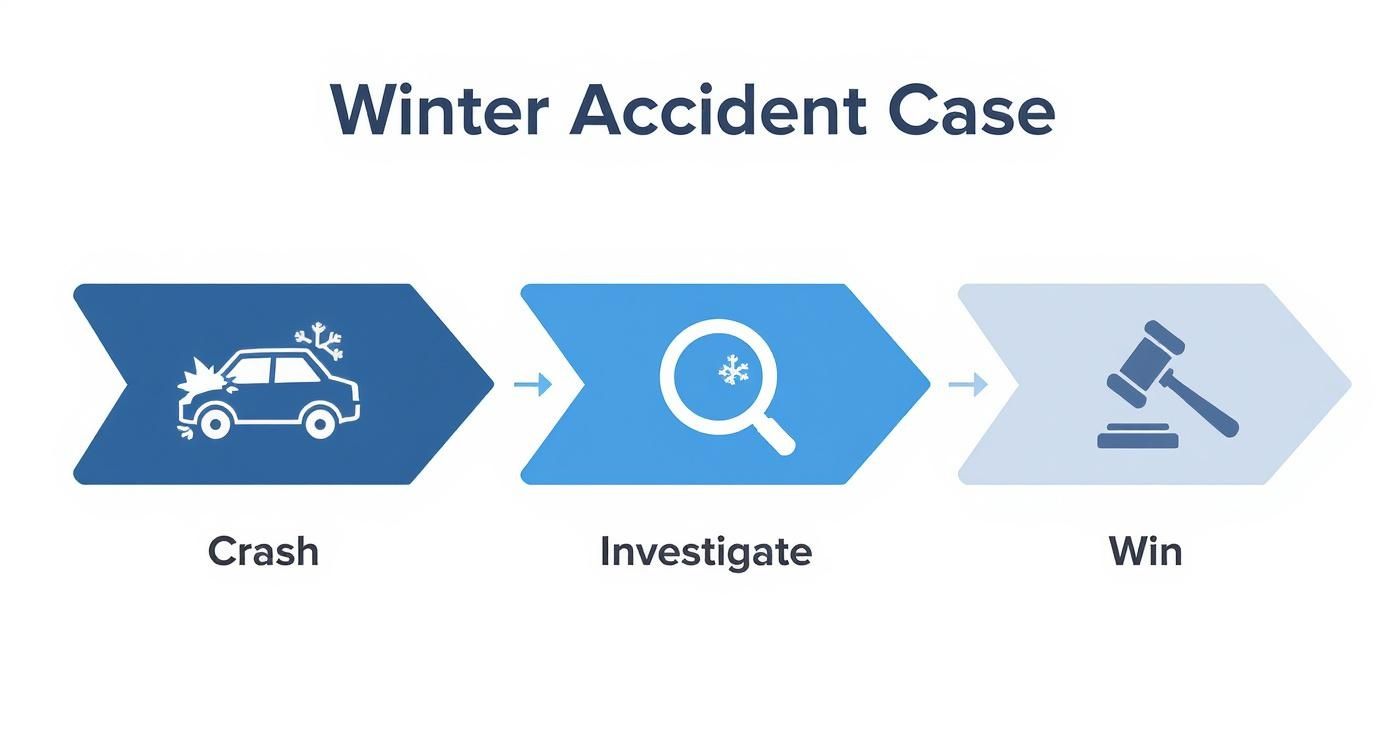
Your Immediate Action Checklist
Follow these steps to protect yourself from the insurance company's blame game before it even starts.
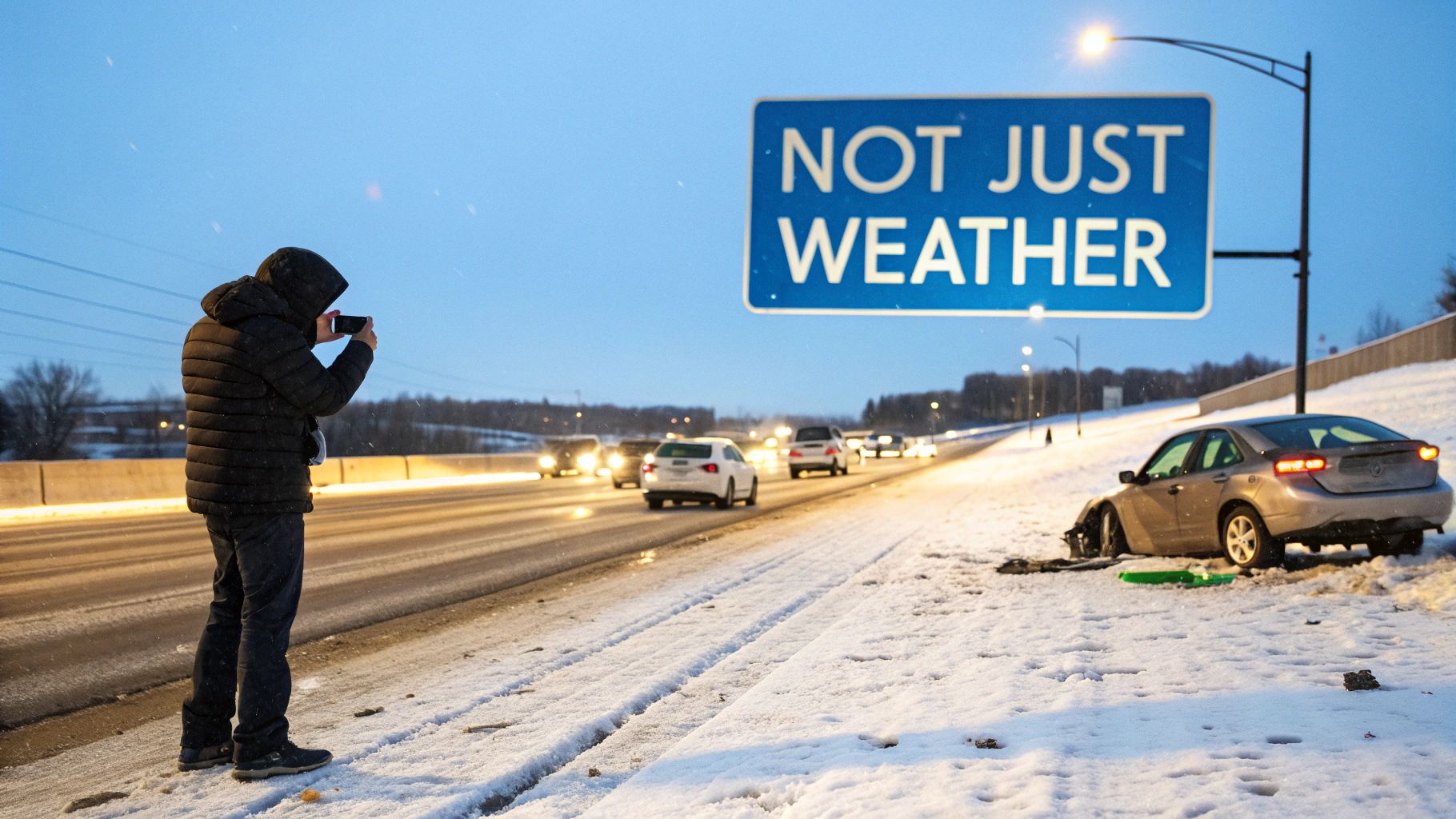
- Document the Scene Before It Vanishes: Pull out your phone immediately. Take photos and videos of everything before the plows arrive. Get wide shots showing the road conditions and car positions. Snow and ice are temporary evidence—capture them while you can.
- Photograph the Tires: This is a pro tip. Get clear pictures of the tire treads on all vehicles involved. Bald tires on the other car are powerful, direct proof of their negligence. It completely undermines the "I couldn't stop" excuse.
- Gather Witness Information: Get names and phone numbers from everyone. A single independent witness who saw the other driver going way too fast for the conditions can be the key to winning your case.
- Seek Immediate Medical Attention: Adrenaline is a powerful painkiller. You might feel fine at the scene only to wake up in serious pain the next day. Go to an urgent care clinic or the ER. If you delay treatment, the insurance company will argue you weren't really hurt. Don't give them that ammunition.
- NEVER Give a Recorded Statement: The other driver's insurance adjuster will call you, and they will sound incredibly friendly. Politely but firmly decline. Their only goal is to trick you into saying something they can twist and use to deny your claim later.
The single most important step after a winter car accident is contacting an experienced Denver personal injury lawyer before speaking with anyone else. With Colorado recording 628 traffic fatalities in 2023, the stakes are serious. An attorney protects the injured party's rights while navigating complex insurance claims and legal requirements. Colorado law mandates minimum liability coverage of $25,000 per person and $50,000 per accident under C.R.S. § 10-4-609, yet approximately 16% of Colorado drivers remain uninsured. Insurance companies employ tactics designed to minimize payouts, and statements made without legal counsel can jeopardize a claim's value. By retaining representation immediately, accident victims gain an advocate who communicates directly with insurers, investigates the collision thoroughly, and preserves critical evidence. This allows the injured party to concentrate on medical recovery and rehabilitation without the stress of managing insurance negotiations or understanding intricate Colorado traffic laws.
You need a specialist who handles the unique challenges of proving fault on icy roads, especially when city equipment is involved. Colorado recorded 628 traffic fatalities in 2023, with winter conditions contributing significantly to these devastating outcomes. A dedicated Denver snow plow accident attorney understands the complexities of establishing liability when municipal vehicles are responsible for injuries or damages. These cases require navigating governmental immunity defenses, proving negligence against city contractors, and gathering evidence before it disappears. Additionally, Colorado law requires minimum liability coverage of $25,000 per person and $50,000 per accident under C.R.S. § 10-4-609, yet 16% of Colorado drivers remain uninsured. An experienced attorney knows how to identify all responsible parties, challenge inadequate coverage limits, and build a compelling case that accounts for the specific hazards of winter driving and municipal negligence on icy Colorado roadways.
Disclaimer: The information in this article is for informational purposes only and does not constitute legal advice. No attorney-client relationship is formed by reading or using the information on this site. You should consult with a licensed attorney for advice regarding your individual situation.
This is a lot, I know. You’re hurt, you’re stressed, and you’re staring down a fight you never asked for.
After a car accident, the path forward can feel overwhelming. That's where experienced legal guidance makes all the difference. A consultation with a knowledgeable personal injury attorney provides clarity when you need it most—a straightforward assessment of what happened, the injuries sustained, and the realistic options available. Colorado's roads claimed 628 traffic fatalities in 2023, underscoring how serious even routine accidents can become. Adding to the complexity, approximately 16% of Colorado drivers carry no insurance, potentially complicating recovery efforts. State law requires minimum liability coverage of $25,000/$50,000 under C.R.S. § 10-4-609, yet many accident victims face significant medical bills and lost wages that exceed these thresholds. An initial consultation is typically free, offering a no-pressure opportunity to discuss the accident's circumstances and understand next steps. During this conversation, an attorney can explain liability, policy limits, statute of limitations, and whether a claim is worth pursuing. This clarity alone—knowing where you stand—brings invaluable peace of mind during a difficult time.
Not every winter injury is a roadway crash. If the injury happened on a slope, lift, or resort-controlled area rather than a public road, our Denver skiing accident attorney guide explains the separate issues created by waivers, resort duties, and the Colorado Ski Safety Act.

Written by
Elliot Singer, Esq.
Personal injury attorney at Conduit Law, dedicated to helping Colorado accident victims get the compensation they deserve.
Learn more about our team