![Average Car Accident Settlements Colorado [2026]](/_next/image?url=https%3A%2F%2Fleui45a2n5ivp3hb.public.blob.vercel-storage.com%2Fimages%2Fblog%2Fhero%2Fcar-accident-settlement-1777052866225.jpg&w=1536&q=75)
Table of Contents
Most Colorado car accident settlements land somewhere between $15,000 and $100,000+—but an average is the wrong lens; the right number turns on your injuries, your treatment, and the specifics of your case. A car accident settlement isn't lottery winnings. It's not a windfall. It's simple repayment—the money an insurance company owes for everything lost when their driver wasn't paying attention. It's a negotiated agreement to cover medical bills, lost income, and the physical and emotional toll of someone else's carelessness. Colorado law requires drivers to carry minimum liability coverage of $25,000 per person and $50,000 per accident, as outlined in C.R.S. § 10-4-609. Yet approximately 16% of Colorado drivers remain uninsured, leaving accident victims vulnerable. When a settlement is reached, it addresses documented losses: emergency room visits, ongoing treatment, rehabilitation costs, wages missed during recovery, and pain and suffering damages. Understanding this distinction matters. A settlement represents fair compensation for genuine harm—not sudden wealth. The amount reflects the actual impact of the accident on the victim's life, health, and finances. It's the responsible party's obligation to make things whole again.
The goal isn't to get rich—it's to get your life back.
But let’s be brutally honest. That’s not how the other side sees it.
To the insurance company, you are a line item—a financial exposure to be managed. A problem to be minimized. And they have a playbook, refined over decades, to pay you as little as possible. This guide is here to tear that playbook apart and show you how to fight back for the car accident settlement deserved. Colorado's roads are dangerous. In 2023 alone, CDOT recorded 628 traffic fatalities across the state. Yet insurance companies continue employing tactics designed to undervalue legitimate claims. They know that many injured drivers don't understand their rights under Colorado law, including the state's minimum liability requirements of $25,000 per person and $50,000 per accident, as outlined in C.R.S. § 10-4-609. The situation worsens when uninsured drivers are involved—approximately 16% of Colorado drivers carry no insurance. Understanding how insurers operate and knowing the applicable laws levels the playing field for accident victims pursuing fair compensation.
Want a quick estimate?
Use our free settlement calculator to see what your case might be worth in 60 seconds—no email required.
What Is the Average Car Accident Settlement in Colorado?
The average car accident settlement in Colorado is often reported in a broad $15,000 to $100,000+ range, but that number is only a starting point. A low-speed Denver rear-end crash with short-term soft tissue treatment may resolve near the lower end. A crash involving surgery, permanent impairment, disputed wage loss, or limited BI/UM/UIM insurance can move far above any published "average."
For Denver and other Colorado drivers, the better question is not just "what is the average?" It is: what proof changes the value of this specific claim? Medical bills, future care, lost income, injury duration, comparative fault, policy limits, and treatment gaps all matter. If you want a more case-specific starting point, use the Colorado settlement calculator, then compare the result with our car accident case-worth guide and talk with a lawyer before signing a release.
If your crash happened in Denver, you should also consider the local facts: where the collision occurred, whether police or CDOT data supports the danger at that intersection, which providers documented your injuries, and whether the insurer is trying to use city traffic congestion or shared-fault arguments to discount the claim. A Denver car accident lawyer can connect those local details to the settlement value instead of treating your case like a generic spreadsheet entry.
This is about more than a crumpled bumper. It's for the searing pain from a herniated disc that makes it impossible to pick up your child. For the wave of anxiety that hits every time one has to get behind the wheel. For the lost wages from missing weeks—or months—of work. Car accidents in Colorado carry serious consequences. In 2023 alone, Colorado recorded 628 traffic fatalities, underscoring how dangerous these collisions can be. Beyond the tragic cases, many accident victims face mounting medical bills, physical therapy costs, and ongoing treatment expenses. Colorado law requires drivers to carry minimum liability coverage of $25,000 per person and $50,000 per accident, as outlined in C.R.S. § 10-4-609. Yet with 16% of Colorado drivers uninsured, many victims discover their damages far exceed available coverage. The financial and emotional toll extends far beyond the initial impact—affecting quality of life, family relationships, and long-term earning capacity.
The insurance company's only goal is to protect their profits—not the injured victim. When a Colorado car accident occurs, insurers deploy strategies designed to minimize payouts, even when their policyholder bears clear responsibility. The unvarnished truth is that victims deserve accurate information about their rights and claim value. With 628 traffic fatalities recorded across Colorado in 2023, the stakes of these collisions are unmistakably high. Colorado law requires minimum liability coverage of $25,000 per person and $50,000 per accident under C.R.S. § 10-4-609, yet 16% of Colorado drivers remain uninsured. This means many accident victims face significant barriers to recovery. The difference between accepting an insurer's lowball settlement and securing fair compensation often determines whether an injured person can truly rebuild their life. This isn't merely transactional. It's about reclaiming what was taken—whether that's medical expenses, lost wages, or peace of mind.
One critical point that often surprises accident victims: case value and actual recovery are frequently two different figures, primarily due to insurance coverage limits. Colorado drivers are required to carry minimum liability coverage of $25,000 per person and $50,000 per accident under C.R.S. § 10-4-609, yet these limits may fall far short of legitimate damages. The problem intensifies when considering that approximately 16% of Colorado drivers operate uninsured, leaving injured parties with fewer recovery options. With Colorado recording 628 traffic fatalities in 2023 alone, the consequences of inadequate coverage become painfully evident. Understanding the distinction between what a claim is worth and what insurance will actually pay is essential for setting realistic expectations. Variables including policy limits, uninsured motorist coverage, underinsured motorist protection, and available assets all factor into final recovery amounts. A comprehensive guide addressing settlement valuation and coverage limitations provides clarity on these critical distinctions.
The Cold, Hard Math Insurers Use to Diminish Your Pain
Think of your car accident settlement claim as two distinct piles of money. One pile is simple math—receipts and invoices. Insurance companies love this part. They call it economic damages. Medical bills, repair estimates, lost wages, and pharmacy receipts all fall into this category. Colorado law requires minimum liability coverage of $25,000 per person and $50,000 per accident under C.R.S. § 10-4-609, yet with 16% of Colorado drivers uninsured, many accident victims face significant gaps in recovery. The numbers seem straightforward: add up what was spent, and that's the settlement floor. Insurance adjusters calculate these figures with mechanical precision, knowing that economic damages are documented, verifiable, and difficult to dispute in court. This is the cold, hard math insurers use—not because it's fair, but because it's defensible and quantifiable. Yet this measurable pile represents only half the picture.
This is the black-and-white stuff: every hospital bill, every lost paycheck, every copay for physical therapy. These are the tangible, verifiable costs that accident victims have paid directly because someone else was negligent. It's the easy part—and insurers know it. Economic damages are straightforward to calculate and harder to dispute. Medical expenses, rehabilitation costs, vehicle repair bills, and documented income loss create a clear paper trail. Colorado drivers involved in accidents are required to carry minimum liability coverage of $25,000/$50,000 under C.R.S. § 10-4-609, yet 16% of Colorado drivers remain uninsured, complicating recovery efforts. With 628 traffic fatalities recorded in Colorado in 2023, the stakes of these collisions are undeniably high. But here's where insurers build their defense: they'll accept these numbers while aggressively limiting what comes next. They document, itemize, and reduce every expense to its bare minimum. This calculated approach allows them to acknowledge concrete losses while quietly excluding the damage that can't be itemized on a receipt.
The real story of your crash isn't found on a receipt, though. It's in everything that was taken from your life. Medical bills capture only the immediate cost of treatment, not the months of physical therapy or the wages lost while healing. Insurance companies are trained to reduce claims to spreadsheet entries—focusing narrowly on documented expenses while ignoring the intangible devastation. Colorado's minimum liability requirements under C.R.S. § 10-4-609 mandate only $25,000 per person and $50,000 per accident, amounts that rarely reflect the true impact of serious injuries. Consider that Colorado recorded 628 traffic fatalities in 2023 alone, according to CDOT data. When an uninsured motorist causes a crash—a reality for 16% of Colorado drivers—the gap between minimum coverage and actual damages widens dramatically. The human cost—pain, suffering, lost relationships, diminished quality of life—remains invisible to actuarial tables and adjusters' calculators.
This is where non-economic damages come in—and where the real fight begins. This is about what someone has been through. The chronic back pain that torpedoes a good night's sleep, the panic that rises when tail lights flash ahead, the simple frustration of not being able to live life without wincing. Colorado's roads claimed 628 lives in 2023, yet many drivers carry only the state's minimum liability coverage of $25,000/$50,000 under C.R.S. § 10-4-609. Even worse, 16% of Colorado drivers remain uninsured entirely. Insurance companies have developed sophisticated formulas to quantify suffering—multipliers, per diem calculations, and comparative negligence reductions that systematically downplay legitimate pain and emotional trauma. They assign dollar values to intangible losses as if human suffering follows predictable actuarial tables. Understanding how insurers diminish these damages is crucial when building a claim that reflects the true scope of physical and psychological injury.
Insurance companies have a cold, robotic way of dealing with your very human experience. They plug medical bills into algorithmic software—like the infamous Colossus—and use a secret formula to spit out a number for suffering. They apply a multiplier, usually between 1.5 and 5, to medical bills to determine what pain is worth. In Colorado, where 628 traffic fatalities occurred in 2023, these calculations matter enormously. Yet many drivers carry only the state's minimum liability coverage of $25,000 per person and $50,000 per accident, as required by C.R.S. § 10-4-609. This means victims often receive inadequate compensation regardless of their actual damages. Adding to this problem, 16% of Colorado drivers are uninsured, leaving accident victims with even fewer resources. The insurer's mathematical approach reduces complex human suffering—lost wages, ongoing medical treatment, psychological trauma—to a spreadsheet equation. This depersonalized process prioritizes corporate profits over genuine injury recovery, leaving accident victims shortchanged.
They will never show you their math. They will never tell you what multiplier they used or why. Their entire process is designed to justify the lowest possible offer and dare you to prove you deserve more. Insurance companies employ proprietary formulas that remain hidden from claimants, making it nearly impossible to verify whether settlement calculations are fair or artificially depressed. Colorado law requires minimum liability coverage of $25,000 per person and $50,000 per accident under C.R.S. § 10-4-609, yet many drivers carry nothing—with 16% of Colorado drivers uninsured. Against this backdrop, where traffic fatalities reached 628 in 2023 alone, insurers wield their opacity as a negotiating weapon. They adjust multipliers, dispute medical causation, and minimize pain and suffering valuations without transparency. The burden falls on injured parties to challenge these black-box calculations, forcing claimants into an uphill battle where the insurer controls both the formula and the narrative.
Your Damages Are More Than Just Medical Bills
Let's break down the two main categories of compensation available after a car accident. Understanding this distinction is the first step toward pursuing a claim's actual value—not merely the amount an insurance adjuster initially offers. Colorado's roadways claimed 628 traffic fatalities in 2023, underscoring how serious these incidents can be. With 16% of Colorado drivers operating uninsured vehicles, many accident victims face additional financial hardship. Colorado law requires minimum liability coverage of $25,000 per person and $50,000 per accident under C.R.S. § 10-4-609, yet these thresholds often fall short of true damages. Recoverable compensation extends far beyond immediate medical expenses. Economic damages include lost wages, rehabilitation costs, and property damage. Non-economic damages—pain and suffering, emotional distress, and reduced quality of life—carry significant value but require careful documentation and skilled advocacy. Distinguishing between these categories ensures accident victims pursue full and fair compensation rather than settling prematurely for inadequate offers.
| Damage Category | What It Covers | How It's Valued |
|---|---|---|
| Economic Damages | Medical Bills (past & future), Lost Wages, Lost Earning Capacity, Property Damage | Receipts, Invoices, Pay Stubs, Expert Projections |
| Non-Economic Damages | Pain and Suffering, Emotional Distress, Loss of Enjoyment of Life, Disfigurement | Multiplier Method, Per Diem Method, Legal Precedent |
Knowing what compensation is truly available is critical for Colorado accident victims. The national average car accident settlement hovers around $20,000, but that figure is heavily skewed by low-value claims. A more realistic median sits closer to $12,281. In states like California, average bodily injury claims reached $51,635 by 2021—demonstrating significant regional variation. Colorado presents unique challenges: with 16% of drivers uninsured and 628 traffic fatalities recorded in 2023, many accident victims face additional complications in recovery. State law requires minimum liability coverage of $25,000 per person and $50,000 per accident under C.R.S. § 10-4-609, yet these minimums often fall short of actual damages. Average figures mean little when evaluating an individual case. Each accident involves distinct injuries, lost wages, property damage, and long-term medical needs. Damages extend far beyond initial hospital bills to include ongoing treatment, rehabilitation, pain and suffering, and lost earning capacity.
The multiplier is where the adjuster holds significant leverage—and where skilled legal representation becomes essential to challenge lowball offers. A minor whiplash case might receive a 1.5x multiplier, while a serious injury requiring surgery should command a 5x multiplier or higher. This distinction matters tremendously, especially in Colorado's high-risk driving environment. With 628 traffic fatalities recorded in 2023 and 16% of Colorado drivers operating uninsured vehicles, accident severity varies dramatically. Colorado law requires minimum liability coverage of $25,000 per person and $50,000 per accident under C.R.S. § 10-4-609, yet these limits often fall short of covering substantial injuries. The multiplier calculation directly impacts whether compensation reflects genuine pain, suffering, lost wages, and long-term consequences. Insurers typically favor conservative multipliers that undervalue non-economic damages. An experienced personal injury attorney understands how to justify higher multipliers by presenting medical evidence, expert testimony, and compelling documentation of how injuries have fundamentally altered a victim's life and future earning capacity.
The problem is, the adjuster's first offer will always be based on an offensively low multiplier. They are betting you don't know how to prove the true, human cost of the accident. With 628 traffic fatalities recorded in Colorado in 2023 alone, the state takes vehicle safety seriously—yet insurance companies routinely undervalue non-economic damages. Under C.R.S. § 10-4-609, Colorado requires minimum liability coverage of $25,000 per person, but this baseline rarely reflects the genuine impact of a collision on a victim's life. Pain and suffering damages account for physical agony, emotional distress, lost enjoyment of life, and psychological trauma—costs that extend far beyond medical bills and lost wages. Insurance adjusters know most accident victims lack documentation for these intangible losses, making them easier targets for lowball settlements. Understanding how to properly calculate and substantiate pain and suffering is critical to recovering fair compensation for the full scope of injury-related damages.
The Playbook Insurance Companies Use to Deny and Devalue You
Insurance companies don't see injured drivers as people. To them, claimants are claim numbers—liabilities on a spreadsheet to be managed and minimized. They operate from a well-worn playbook designed to make that liability disappear for as little money as possible. This systematic approach becomes even more critical in Colorado, where 628 traffic fatalities were recorded in 2023 alone, yet 16% of drivers remain uninsured. Under Colorado law (C.R.S. § 10-4-609), minimum liability coverage requires $25,000 per person and $50,000 per accident—amounts that often fall far short of actual damages in serious crashes. Insurance adjusters know these numbers inside and out. They understand exactly how to leverage policy limits, dispute medical necessity, and delay settlements until injured parties run out of resources or patience. Their goal isn't fair compensation—it's loss control. Understanding this reality helps injured drivers recognize when professional representation becomes essential to level an unequal playing field.

They aren't your friend. They aren't on your side. Insurance companies are multi-billion dollar corporations, and every tactic they deploy is designed to frustrate, confuse, and wear claimants down until they accept a fraction of what their claim is actually worth. This strategy is particularly aggressive in Colorado, where the minimum liability coverage required by law is just $25,000 per person and $50,000 per accident under C.R.S. § 10-4-609. Given that Colorado recorded 628 traffic fatalities in 2023 alone, the stakes of these negotiations are extraordinarily high. Insurance adjusters understand that injured drivers are vulnerable—financially stressed, medically compromised, and emotionally exhausted. They exploit this vulnerability systematically. Delay tactics, lowball settlement offers, and disputes over medical necessity are standard playbook moves. The company's goal is profit maximization, not justice or fair compensation. Understanding this fundamental misalignment of interests is the first step toward protecting yourself in the claims process.
Your fight for a fair car accident settlement begins the moment you understand their cynical game.
Their First Move Is a Trap—The Quick Lowball Offer
One of their favorite moves is the quick-and-dirty settlement offer. An adjuster will call, sometimes just days after the crash, sounding impossibly sympathetic and understanding. They'll offer a few thousand dollars on the spot—no hassle, no waiting, just sign here and it's over. This approach is designed to close the case before the injured person fully understands their injuries or the claim's true value. Colorado's minimum liability requirements under C.R.S. § 10-4-609 mandate $25,000 per person and $50,000 per accident, yet these initial offers frequently fall far short. The adjuster knows that accident victims are often overwhelmed, in pain, and desperate for quick resolution. They're banking on the fact that many people don't realize their medical bills, lost wages, and pain and suffering damages will eventually exceed that initial lowball number. In a state where 628 traffic fatalities occurred in 2023, accident victims deserve fair compensation—not a rushed settlement that protects insurance company profits.
This isn't generosity. It's a trap. Insurance adjusters know victims are stressed, out of work, and watching medical bills pile up. They prey on that desperation, hoping claimants will accept a quick settlement before understanding the full extent of injuries. Colorado's roads are dangerous—CDOT reported 628 traffic fatalities in 2023 alone—and many drivers carry only minimum liability coverage of $25,000 per person/$50,000 per accident, as required by C.R.S. § 10-4-609. With 16% of Colorado drivers uninsured, accident victims often face uphill battles securing fair compensation. That early lowball offer? It's designed to resolve the claim cheaply while victims are most vulnerable. Accepting it means signing away the right to any future compensation—forever. Once signed, there's no recourse if medical complications emerge months or years later, or if initial damage assessments prove incomplete.
They want you to settle before your doctor orders an MRI—before you realize that sore neck is actually two herniated discs that will require years of pain management. They are buying your claim for pennies on the dollar before you understand its real value. Insurance adjusters know that accident victims often don't immediately grasp the extent of their injuries. Colorado's minimum liability coverage of $25,000 per person, as required by C.R.S. § 10-4-609, means insurers are acutely aware of their exposure limits and motivated to close claims quickly. With 16% of Colorado drivers uninsured and 628 traffic fatalities recorded in 2023 alone, the roads are dangerous—and insurers want settlements resolved before medical evidence reveals the true severity of injuries. That initial offer, arriving within days of the accident, is designed to lock in a number before diagnostic imaging and specialist consultations demonstrate that what seemed like minor trauma actually requires long-term treatment and ongoing care.
Their Second Move Is a Lie—The Recorded Statement
You will be asked to give a recorded statement. Do not do it. The adjuster will say it's just a routine part of the process. This is a calculated lie. Insurance companies use recorded statements as evidence to minimize payouts or deny claims altogether. Every word spoken becomes part of the official record and can be used against the claimant later. Given Colorado's dangerous roads—which recorded 628 traffic fatalities in 2023 according to CDOT data—the stakes in accident claims are particularly high. The adjuster may seem friendly and sympathetic, but their primary obligation is protecting the insurance company's bottom line, not the injured party's interests. Under Colorado law (C.R.S. § 10-4-609), minimum liability coverage is $25,000 per person and $50,000 per accident. Even with these minimums in place, insurance adjusters employ tactics designed to undermine legitimate claims. Providing a recorded statement without legal representation present allows adjusters to twist language, exploit hesitations, or highlight any inconsistencies for their advantage.
The only purpose of this recording is to get the caller on the record saying something—anything—they can later use to deny the claim. A simple, polite "I'm okay" in response to "How are you?" becomes Exhibit A in their argument that the injury wasn't serious. It's a cynical tactic that weaponizes basic human decency against accident victims. This is particularly concerning in Colorado, where traffic fatalities reached 628 in 2023, and where 16% of drivers remain uninsured despite the state's minimum liability requirements of $25,000/$50,000 per C.R.S. § 10-4-609. Insurance adjusters know that injured people often downplay their condition out of politeness or shock. They deliberately exploit this tendency, recording statements to create a permanent record that contradicts medical evidence developed later. The strategy is calculated: establish a low baseline of harm immediately after the accident, then use that casual statement to undermine any future injury claims. Understanding this tactic is essential before any interaction with an insurance company.
Their Ultimate Weapon Is Silence—The Strategic Delay
Of all the shady tactics insurance companies employ, strategic delay is the one that breaks the most people. These companies have mastered the art of making claims disappear into bureaucratic limbo. They'll lose paperwork. They'll shuffle claims between adjusters without explanation. They will simply ghost claimants for weeks, leaving injured parties in financial limbo while medical bills pile up. In Colorado, where 628 traffic fatalities were recorded in 2023 alone, car accident victims are particularly vulnerable to these delays. With 16% of Colorado drivers uninsured, legitimate claims should move quickly—especially when state law requires minimum liability coverage of $25,000/$50,000 per C.R.S. § 10-4-609. Yet delays persist. The strategy is psychological warfare: injured people desperate for compensation eventually accept lowball settlement offers just to end the suffering. Insurance adjusters know that time erodes resolve. Every delayed response, every lost file, every unanswered call chips away at a claimant's bargaining position. This systematic silence serves one purpose: maximizing insurance company profits at the expense of Colorado accident victims.
This isn't incompetence—it's a deliberate strategy. Insurance companies know that every day without a settlement, financial pressure intensifies on injured claimants. They drag negotiations out for months, sometimes years, betting that desperation will set in. After Colorado recorded 628 traffic fatalities in 2023, many survivors face mounting medical bills and lost wages. When insurers finally reappear with that same lowball offer, claimants are often too exhausted to keep fighting. This tactic exploits the gap between minimum liability requirements under C.R.S. § 10-4-609 ($25,000/$50,000) and actual damages. The strategy works particularly well against uninsured motorist claimants—16% of Colorado drivers lack coverage—who have fewer legal protections. The delay compounds injuries into financial crises, forcing settlements far below what the case is worth.
Delaying the process is their most effective weapon—a war of attrition where insurance companies leverage time as a strategic advantage. With nearly infinite resources at their disposal, they can afford to wait while injured claimants face mounting medical bills and lost wages. Colorado's roadways reflect the stakes: the state recorded 628 traffic fatalities in 2023 alone, underscoring how serious these collisions can be. Yet many drivers carry minimal coverage or none at all; approximately 16% of Colorado drivers remain uninsured, creating additional complications for victims seeking compensation. State law requires minimum liability coverage of $25,000 per person and $50,000 per accident under C.R.S. § 10-4-609, but these limits often prove insufficient for serious injuries. Insurance adjusters exploit the passage of time, hoping claimants will accept lower settlements out of desperation, fade away, or lose critical evidence. Understanding this delay tactic is essential for protecting one's rights after a collision.
The Colorado-Specific Rules That Can Wreck Your Case
Every state plays by different rules. Thinking Colorado's laws are the same as California's or Texas's is a classic, costly mistake. These aren't just details in the fine print—they're the fundamental principles that will make or break a car accident settlement. Colorado's statutory requirements under C.R.S. § 10-4-609 mandate minimum liability coverage of $25,000 per person and $50,000 per accident. Yet 16% of Colorado drivers operate uninsured, creating additional complications for accident victims. With 628 traffic fatalities recorded in Colorado during 2023 alone, the stakes of understanding local regulations are genuinely high. Colorado-specific rules govern comparative negligence, statute of limitations, damage caps, and insurance requirements differently than neighboring states. Applying another state's legal framework to a Colorado claim often results in missed deadlines, reduced settlements, or dismissed cases entirely. Navigating these distinctions requires familiarity with Colorado law, not generic accident guidance.
You can bet the insurance adjuster knows these rules by heart. And they will absolutely use every single one against you if you give them an opening. Under Colorado Revised Statutes § 10-4-609, drivers must carry minimum liability coverage of $25,000 per person and $50,000 per accident—but that baseline protection often proves insufficient for serious injuries. Insurance adjusters are trained to exploit every technical requirement, statute of limitations detail, and procedural rule in Colorado law. They understand comparative negligence standards, damage caps, and evidence admissibility rules far better than most accident victims. Given that Colorado recorded 628 traffic fatalities in 2023 alone, and approximately 16% of Colorado drivers remain uninsured, the stakes are high when claims are mishandled. Adjusters leverage this expertise to minimize payouts, challenge liability, and pressure claimants into accepting settlements that don't reflect actual damages. Without understanding these Colorado-specific rules, injured parties operate at a significant disadvantage during negotiations.
Let's break down the two Colorado laws that will have the biggest impact on your fight for a fair recovery.
The Treachery of Modified Comparative Fault
This is the big one. It's a legal doctrine called Modified Comparative Fault, and it fundamentally shapes how car accident claims are resolved in Colorado. Understanding how it works is essential for accident victims seeking fair compensation. Imagine the total settlement value as a pie—that's the framework Colorado courts use to divide liability and damages among parties. Under C.R.S. § 10-4-609, Colorado requires minimum liability coverage of $25,000 per person and $50,000 per accident, yet 16% of Colorado drivers remain uninsured. This creates additional complications when determining fault and recovery. Modified Comparative Fault means that even if an injured party bears partial responsibility for an accident, they may still recover damages—but the award gets reduced by their percentage of fault. Given that Colorado recorded 628 traffic fatalities in 2023, understanding this doctrine becomes critically important for protecting one's legal rights after a serious collision.
Under Colorado's modified comparative fault rule, a jury—or the insurance adjuster—assigns a percentage of fault to everyone involved in the accident. If they determine that a driver was 10% to blame, perhaps for traveling a couple of miles over the speed limit, that driver's recovery is reduced proportionally. In this scenario, the driver would only recover 90% of their damages. This seemingly small percentage can translate into significant financial consequences. For context, Colorado recorded 628 traffic fatalities in 2023, underscoring the serious nature of roadway incidents. Additionally, with 16% of Colorado drivers operating uninsured vehicles, fault determination becomes even more critical. Under C.R.S. § 10-4-609, Colorado requires minimum liability coverage of $25,000 per person and $50,000 per accident. When comparative fault reduces a claimant's recovery, combined with underinsured or uninsured motorists, the financial burden on injured parties can become substantial and difficult to manage.
But here’s the treacherous part: Colorado has a 50% bar.
If you are found to be 50% or more at fault, you are legally barred from recovering a single penny under Colorado's modified comparative fault rule. Your pie doesn't just shrink—it vanishes completely. You get nothing. Insurance companies love this rule because their entire goal is to nudge claimants toward that critical 50% threshold so they can slam the door on recovery entirely. This doctrine, codified in Colorado law, creates a harsh all-or-nothing outcome for accident victims. Given that Colorado recorded 628 traffic fatalities in 2023 alone, and considering that 16% of Colorado drivers operate uninsured vehicles, the stakes of fault determination are extraordinarily high. Even with state-mandated minimum liability coverage of $25,000/$50,000 per C.R.S. § 10-4-609, a single unfavorable fault finding can leave injured parties with zero compensation. Insurance adjusters routinely exploit this rule, strategically assigning blame to protect their bottom line rather than fairly evaluating accident circumstances.
The Clock Is Always Ticking—The Statute of Limitations
The second critical rule is the statute of limitations. Think of it as a strict, non-negotiable deadline for filing a lawsuit. In Colorado, there is a three-year window from the date of the crash to file most car accident claims. This deadline exists regardless of case complexity or injury severity. Given that Colorado recorded 628 traffic fatalities in 2023, understanding this timeline becomes essential for accident victims and their families. Every day that passes brings the deadline closer. Colorado law, specifically C.R.S. § 10-4-609, establishes minimum liability insurance requirements of $25,000 per person and $50,000 per accident—yet roughly 16% of Colorado drivers remain uninsured. Once the three-year statute of limitations expires, the right to pursue compensation vanishes permanently, even if the case has substantial merit. Courts will not accept late filings under any circumstance.
Three years sounds like a long time—but it disappears fast. Insurance companies know this perfectly well, and they count on it. Their strategy of endless delays is a deliberate attempt to run out the clock on accident victims. Delaying the process is their most effective weapon, especially when complex claims involve multiple parties or serious injuries. In Colorado, accident victims have exactly three years from the date of the crash to file a lawsuit under the state's statute of limitations. Given that Colorado recorded 628 traffic fatalities in 2023, and approximately 16% of Colorado drivers remain uninsured, settlement negotiations can become particularly complicated. When dealing with uninsured motorist claims or disputed liability, the insurance companies' foot-dragging tactics intensify. Even claims with clear liability under Colorado's minimum insurance requirements—$25,000 per person and $50,000 per accident (C.R.S. § 10-4-609)—can stall indefinitely. Every month that passes weakens evidence, dims witness memories, and erodes the strength of a claim. The statute of limitations deadline is immovable.
Miss that deadline by even one day, and your right to seek compensation is gone. Forever. It doesn't matter how badly you were hurt—whether injuries are minor or catastrophic like the 628 traffic fatalities Colorado recorded in 2023. The courthouse doors will be legally barred. This absolute deadline is the statute of limitations, a legal rule that gives accident victims a finite window to file suit. In Colorado, that window is typically three years from the date of a motor vehicle injury under C.R.S. § 13-80-101(1)(n). Separately, C.R.S. § 10-4-609 establishes minimum liability coverage of $25,000 per person and $50,000 per accident. With 16% of Colorado drivers carrying no insurance, navigating these requirements becomes even more critical. Once the statute expires, even the strongest case with clear negligence and serious injuries cannot proceed. Insurance companies count on injured people missing these deadlines. The law offers no exceptions for those unaware of the deadline or those who delay seeking legal counsel.
Your Settlement Timeline—Mapping the Road from Crash to Check
Patience is a virtue, they say. But it's easier to be patient when you know what to expect. A car accident settlement doesn't just fall out of the sky—it follows a predictable, though often frustratingly slow, path. In Colorado, where 628 traffic fatalities occurred in 2023 alone, understanding settlement timelines becomes even more critical for accident victims navigating the claims process. Most drivers carry the state-mandated minimum liability coverage of $25,000/$50,000 per C.R.S. § 10-4-609, though complications arise when uninsured motorists are involved—a concern affecting approximately 16% of Colorado drivers. The settlement journey typically spans several months, encompassing initial claim filing, investigation, negotiation, and final resolution. Each phase involves specific milestones and waiting periods that can feel endless. By mapping out what happens at each stage, accident victims gain clarity and realistic expectations, transforming uncertainty into actionable knowledge that empowers better decision-making throughout the claims process.
Phase 1: The Foundation (Weeks 1-4)
This phase is all about investigation—the critical foundation upon which a successful car accident claim is built. Our team secures the police report, identifies and interviews witnesses, captures detailed photographs of vehicle damage and scene conditions, and immediately places the at-fault driver's insurance company on formal notice of the injury claim. Given that Colorado recorded 628 traffic fatalities in 2023, thorough evidence collection is essential. We also verify insurance coverage, particularly important since roughly 16% of Colorado drivers operate without insurance. Under C.R.S. § 10-4-609, Colorado's minimum liability requirements are $25,000 per person and $50,000 per accident—but most serious injuries exceed these limits. During these critical first four weeks, every piece of evidence gathered strengthens the case's foundation. This proactive documentation creates a comprehensive record that demonstrates liability, documents injuries, and establishes the framework for fair compensation negotiations or litigation if necessary.
Phase 2: Healing and Documentation (Months 1-?)
This is the most important phase—and it cannot be rushed. Recovery takes time, and every medical decision during this period becomes part of the official record that supports a future claim. The primary focus must remain on attending every doctor's appointment, following the prescribed treatment plan precisely, and being completely honest about pain levels, limitations, and symptoms. Detailed medical documentation is crucial, especially considering that Colorado's minimum liability coverage is $25,000 per person/$50,000 per accident under C.R.S. § 10-4-609. Given that 16% of Colorado drivers carry no insurance whatsoever, having thorough medical records becomes even more critical. Consistent treatment demonstrates the seriousness of injuries and establishes a clear causal link between the accident and ongoing health issues. This documentation serves as the foundation for any personal injury claim and should never be interrupted or delayed, regardless of external pressures or financial constraints.
While the healing process unfolds, meticulous documentation becomes critical. Every medical record, diagnosis, treatment note, and associated bill is collected and preserved as hard evidence of damages. This mountain of paperwork—imaging reports, surgical records, pharmacy receipts, and specialist consultations—transforms abstract suffering into quantifiable loss. Settling before reaching Maximum Medical Improvement (MMI), the point where a condition has stabilized and future treatment needs become clearer, represents a catastrophic error that cannot be undone. Colorado's minimum liability insurance requirements of $25,000/$50,000 per C.R.S. § 10-4-609 often prove insufficient for serious injuries, yet many defendants carry exactly these limits or less. With 16% of Colorado drivers uninsured and traffic fatalities reaching 628 in 2023, accident victims face significant exposure to underinsured motorists. Premature settlement forecloses recovery for ongoing complications, future medical needs, and long-term disability that only become apparent after full healing has occurred.
An adjuster who pushes settlement while active medical treatment is ongoing is not acting in the injured party's interest. This tactic is a calculated, predatory move designed to close the claim before the full extent of injuries—and their true financial cost—becomes apparent. In Colorado, where 16% of drivers carry no insurance and minimum liability coverage stands at just $25,000 per person under C.R.S. § 10-4-609, settlement pressure is particularly aggressive. Early settlement offers typically underestimate long-term medical expenses, ongoing therapy, lost wages, and pain and suffering. Once a claim is settled and signed, reopening it becomes nearly impossible, even if complications emerge months later. The adjuster knows this. By rushing closure during active treatment, they protect their company's bottom line while leaving injured parties exposed to uncovered future expenses. Victims should continue documenting all medical visits, treatment plans, and expenses before considering any settlement offer.
Phase 3: The Demand and The Dance (Months of Negotiation)
Once treatment is complete, the law firm drafts and sends a formal demand letter to the insurer. This isn't a simple letter—it's a comprehensive legal argument, meticulously backed by all medical records, documentation, and a detailed calculation of total damages. The demand reflects the full scope of economic losses, including medical expenses, lost wages, and property damage, as well as non-economic damages like pain and suffering. Under Colorado Revised Statutes § 10-4-609, insurers must maintain minimum liability coverage of $25,000 per person and $50,000 per accident. However, given that 16% of Colorado drivers remain uninsured, demand letters often target underinsured motorist coverage instead. The demand initiates formal negotiations with the insurance company—a process that can extend for months. The insurer will scrutinize every detail, request additional documentation, or attempt to minimize the claim's value. This strategic exchange sets the foundation for either settlement discussions or eventual litigation, making the demand letter's quality and persuasiveness critical to case outcomes.
Then, the dance begins.
The insurer will typically respond with a lowball offer, initiating months of back-and-forth negotiation. This phase tests patience, as settlement discussions can drag on for extended periods depending on case complexity and parties' positions. Simpler cases might resolve within 6–12 months for $8,200–$30,000, while more serious claims involving significant injuries or liability disputes take considerably longer. Statistically, approximately two-thirds of Colorado car accident cases settle before trial, averaging around $52,900 in compensation. These negotiations occur within Colorado's mandatory liability framework—C.R.S. § 10-4-609 establishes minimum coverage of $25,000 per person and $50,000 per accident. Adding complexity to settlement dynamics: 16% of Colorado drivers carry no insurance whatsoever, potentially complicating recovery efforts. The stakes are considerable given that Colorado recorded 628 traffic fatalities in 2023 alone. The negotiation dance requires persistence, documentation, and strategic positioning to secure fair compensation reflecting actual damages and injury severity.
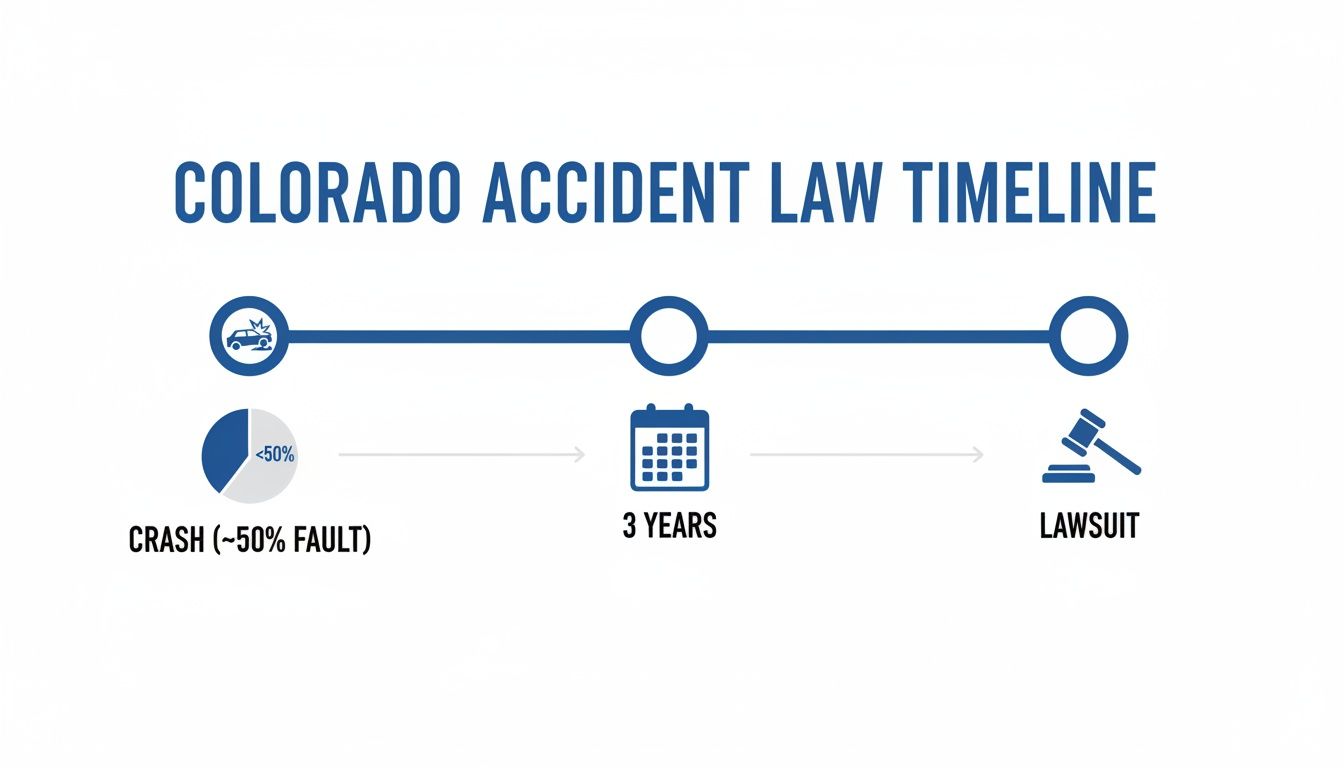
If the insurance company refuses to be reasonable, the final step is filing a lawsuit. This doesn't mean the case will go to trial, but it signals that patience has ended and serious action is underway. In Colorado, where traffic fatalities reached 628 in 2023 alone, and with roughly 16% of drivers uninsured, the stakes are often significant. When minimum liability coverage—$25,000 per person and $50,000 per accident under C.R.S. § 10-4-609—proves insufficient, a formal claim demonstrates resolve. Filing suit concentrates the insurance company's attention in ways settlement negotiations often cannot. The lawsuit becomes leverage, a tangible show of force that frequently motivates reasonable settlement discussions. Throughout this phase, patience backed by solid case preparation remains the injured party's greatest asset. Documentation, medical records, and expert analysis all strengthen the position when formal litigation becomes necessary.
Real Car Accident Settlement Examples
These are actual settlements from Colorado car accident cases:
Real Car Accident Settlements
Settlement Value vs. Available Coverage
Your case value and the amount you can recover may differ. Colorado requires only $25,000/$50,000 minimum liability coverage. If the at-fault driver carries minimum coverage, your recovery may be limited regardless of your actual damages—unless you have underinsured motorist (UIM) coverage or other sources apply.
Past results do not guarantee future outcomes. Each case is unique and results depend on specific facts and circumstances. Settlement amounts shown represent actual recoveries for clients but should not be considered a prediction of results in your case.
Your Greatest Weapon Is An Attorney Who Costs You Nothing Upfront
How are you supposed to afford a lawyer when you're already out of work and drowning in medical debt? It's a fair question—and the answer is the great equalizer of the legal system. In Colorado, where 628 traffic fatalities occurred in 2023 alone, car accident victims face mounting pressures. Medical bills pile up while lost wages drain savings. The situation becomes even more complex when the at-fault driver carries only minimum liability coverage of $25,000/$50,000 as required under C.R.S. § 10-4-609—or worse, when that driver is among the 16% of Colorado drivers operating uninsured. This is precisely why contingency fee arrangements exist. Personal injury attorneys handle cases on contingency, meaning they advance costs and receive payment only if the case settles or wins at trial. This structure removes the financial barrier between injured victims and quality legal representation, allowing accident survivors to focus on recovery rather than worrying about upfront attorney fees.

It's called the contingency fee model, and it levels the playing field between injured victims and multi-billion-dollar insurance corporations. The concept is straightforward: the attorney receives no payment unless the client receives compensation. The fee is simply a percentage of the final car accident settlement won on the client's behalf—nothing more, nothing less. This arrangement matters tremendously in Colorado, where traffic accidents claim lives and livelihoods daily. In 2023 alone, Colorado recorded 628 traffic fatalities. Additionally, approximately 16% of Colorado drivers operate without insurance, leaving responsible drivers vulnerable to uninsured motorist claims. While state law requires minimum liability coverage of $25,000 per person and $50,000 per accident under C.R.S. § 10-4-609, these limits often prove inadequate for serious injuries. The contingency fee model removes financial barriers that might otherwise prevent injured parties from pursuing legitimate claims. Clients pay nothing upfront, allowing them to focus entirely on recovery while their legal representation handles negotiations and litigation.
This isn't just a payment plan—it's a partnership built on aligned incentives. The bigger the recovery secured for the client, the better both parties perform. When an attorney works on contingency, their financial success depends entirely on winning the case and maximizing compensation. That alignment eliminates conflicts of interest and ensures aggressive representation from start to finish. In Colorado, where 628 traffic fatalities occurred in 2023, car accidents create serious stakes. Many accident victims face additional complications when the at-fault driver is uninsured—16% of Colorado drivers lack coverage. State law requires minimum liability limits of $25,000 per person and $50,000 per accident under C.R.S. § 10-4-609, but these minimums often fall short of actual damages. An attorney operating on contingency has every incentive to navigate these complexities, pursue maximum recovery, and hold responsible parties accountable. The client's victory becomes the attorney's victory, creating genuine partnership in pursuit of justice.
The Real Value of an Ally in Your Corner
An experienced attorney almost always adds far more value to your case than their fee. Legal representation protects accident victims from the traps insurers routinely set. Insurance companies follow a predictable playbook—recorded statements designed to contradict later testimony, lowball settlement offers, endless delays—and skilled advocates know exactly how to counter these tactics. Given that Colorado recorded 628 traffic fatalities in 2023 alone, and with 16% of Colorado drivers remaining uninsured, the stakes are genuinely high. Even cases involving minimum liability coverage—$25,000 per person and $50,000 per accident under C.R.S. § 10-4-609—require careful negotiation. An attorney understands claim valuation, knows how insurers calculate damages, and recognizes when offers fall short of what a case truly merits. Beyond settlement negotiations, legal counsel handles documentation, manages deadlines, and preserves evidence that casual claim-filers often overlook. The cost of representation typically pales against the difference between an insurer's first offer and what informed advocacy actually secures.
Firms like Conduit Law excel at negotiating the non-economic damage multipliers—often securing 2-3 times your medical bills for pain and suffering. This strategic approach can transform a $10,000 medical expense into a $30,000+ settlement, all without upfront fees. Consider a real case: a teacher rear-ended with herniated discs recovered $175,000 after incurring $50,000 in bills—a 3.5x multiplier achieved over 11 months. In Colorado's high-risk driving environment, where 628 traffic fatalities occurred in 2023 alone, this negotiation skill matters even more. With 16% of Colorado drivers uninsured and minimum liability coverage set at $25,000/$50,000 per C.R.S. § 10-4-609, many accident victims face inadequate recovery without skilled representation. An experienced attorney doesn't just process claims; they leverage knowledge of case valuation, insurance law, and negotiation tactics to maximize compensation for medical expenses, lost wages, and non-economic damages that truly reflect your suffering and recovery needs.
An attorney isn't an expense—it's the single best investment in financial recovery following a car accident. Colorado's roads claimed 628 lives in 2023, and countless more suffered serious injuries with lasting consequences. Beyond the human toll, accident victims face mounting medical bills, lost wages, and vehicle damage that quickly spiral beyond reach. This is where legal representation becomes invaluable. With 16% of Colorado drivers uninsured or underinsured, many accident victims discover their recovery options are severely limited. Colorado law requires minimum liability coverage of $25,000 per person and $50,000 per accident under C.R.S. § 10-4-609—often insufficient for serious injuries. An experienced attorney navigates insurance claims, identifies all available coverage sources, and pursues fair compensation. The alternative—handling claims alone—frequently results in settlements far below what victims deserve. Legal counsel recovers thousands beyond what unrepresented victims typically receive, transforming a perceived expense into genuine financial protection and peace of mind.
The Hidden Financial Battles We Fight for You
Beyond the main settlement, Colorado car accident victims face complex financial battles that extend far beyond initial compensation. Medical liens and subrogation claims represent significant hidden costs that require expert navigation. Healthcare providers and insurance companies routinely file liens against settlements to recover treatment expenses, and these claims can substantially reduce the final amount victims receive. With 16% of Colorado drivers uninsured, many accident victims pursue claims against their own underinsured motorist coverage, triggering additional subrogation disputes. Colorado law requires minimum liability coverage of $25,000 per person and $50,000 per accident under C.R.S. § 10-4-609, yet medical bills frequently exceed these thresholds. Skilled negotiation is essential to challenge inflated lien amounts and protect settlement funds. These behind-the-scenes financial negotiations demand thorough case management and understanding of Colorado's complex insurance regulations to ensure accident victims retain maximum compensation.
- Medical Liens: If your health insurance paid for your treatment, they have a legal right to get paid back out of your settlement. We negotiate those liens down to put more of the settlement money in your pocket.
- Subrogation: Same concept, but with your own car insurance company if they paid for things like MedPay coverage. Again, we step in to reduce their claim.
Insurance negotiations following a car accident involve complex calculations and strategic tactics that insurers rely on claimants misunderstanding. Colorado law requires minimum liability coverage of $25,000 per person and $50,000 per accident under C.R.S. § 10-4-609, yet these baseline limits often fall short of actual damages. The challenge intensifies when considering that 16% of Colorado drivers remain uninsured, complicating recovery options. With 628 traffic fatalities recorded in Colorado in 2023 alone, the stakes in accident claims are undeniably high. Insurance companies employ seasoned adjusters trained to minimize payouts through undervaluation tactics, disputed liability claims, and pressure to settle quickly. A personal injury lawyer navigates these hidden financial battles by conducting thorough investigations, calculating full damages—including future medical costs and lost wages—and negotiating aggressively on the claimant's behalf. Working on a contingency fee basis removes financial barriers to representation, ensuring legal advocacy remains accessible regardless of immediate resources.
Your Questions, Answered—No Legal Jargon Allowed
You've got questions. After a crash, your world is chaotic, and the insurance adjuster isn't going to give you straight answers. Let's cut through the noise. Colorado sees real consequences on its roads—628 traffic fatalities occurred in 2023 alone. The stakes are high, especially when dealing with uninsured drivers. According to the Insurance Research Council, 16% of Colorado drivers carry no insurance at all, which complicates claims significantly. Understanding Colorado's minimum liability requirements matters too. State law (C.R.S. § 10-4-609) requires drivers to carry at least $25,000 per person and $50,000 per accident in bodily injury liability coverage. These numbers exist for a reason: they're the baseline protection in a collision. When insurance companies and adjusters throw around technical terms and lowball offers, knowing what you're entitled to—and what the law actually requires—makes all the difference in protecting your rights and your recovery.
How Much Is My Car Accident Claim Actually Worth?
There's no magic formula for calculating car accident claim value. The true worth is a direct reflection of specific losses—nothing more, nothing less. Every claim breaks down into two critical components: economic damages and non-economic damages. Economic damages are the tangible, measurable costs: medical bills, vehicle repair expenses, and lost paychecks from time away from work. Non-economic damages represent the real, human cost of the injury—pain and suffering, emotional distress, and diminished quality of life. Colorado law requires all drivers to carry minimum liability coverage of $25,000 per person and $50,000 per accident, as outlined in C.R.S. § 10-4-609. However, given that 16% of Colorado drivers are uninsured, many accident victims face significant recovery challenges. With Colorado recording 628 traffic fatalities in 2023 alone, understanding claim valuation is essential for anyone navigating the aftermath of a serious collision.
While every case is unique, minor to moderate injuries often settle for $2,500 to $25,000, though actual recovery depends on multiple factors including medical expenses, lost wages, and property damage. Whiplash cases typically average between $8,000 and $24,000, depending heavily on the extent of medical care and length of recovery time. Colorado's minimum liability insurance requirements, established under C.R.S. § 10-4-609, mandate coverage of at least $25,000 per person and $50,000 per accident. However, these baseline limits may prove insufficient for serious injuries. Given that 16% of Colorado drivers carry no insurance, uninsured or underinsured motorist coverage becomes particularly valuable. The state's traffic safety data underscores the severity of accidents—Colorado recorded 628 traffic fatalities in 2023 alone, highlighting why comprehensive injury claims matter. Settlement value hinges on documented medical treatment, demonstrable lost income, pain and suffering, and the defendant's insurance policy limits. Cases involving catastrophic injuries or permanent disability typically exceed these ranges substantially.
How Long Will This Whole Thing Take?
Patience is the most powerful asset in any car accident claim. A straightforward case involving clear liability and minor injuries might wrap up in a few months, but complex claims often take over a year to resolve. Given Colorado's traffic landscape—which saw 628 fatalities in 2023 alone—accident claims can quickly become complicated. Additional delays arise when uninsured or underinsured drivers are involved; approximately 16% of Colorado drivers carry no insurance, which complicates recovery efforts. When damages exceed the minimum liability limits of $25,000/$50,000 per C.R.S. § 10-4-609, insurance companies frequently conduct more extensive investigations before settling. Medical records must be gathered, expert opinions obtained, and negotiations conducted with multiple parties. Understanding that thorough case development takes time helps accident victims maintain realistic expectations and avoid settling prematurely for insufficient compensation.
The clock is driven by:
- The Severity of Your Injuries: You should never settle until you've reached "maximum medical improvement."
- Disputes Over Fault: If the other driver denies responsibility, it takes time to prove what happened.
- The Insurer's Willingness to Negotiate: Some companies will drag their feet, hoping you'll get frustrated and take a lowball offer.
Should I Take the Insurance Company’s First Offer?
Almost never. Let me be clear: that first offer is a business tactic. It's a lowball number designed to see if you'll accept a quick settlement for far less than the claim is worth. Insurance companies know that many accident victims are stressed, injured, and desperate for immediate resolution. They count on that vulnerability. Colorado's minimum liability requirements, set at $25,000/$50,000 under C.R.S. § 10-4-609, represent the bare legal floor—not fair compensation. With 628 traffic fatalities recorded in Colorado in 2023, serious injuries are common, and medical costs quickly exceed those minimums. Additionally, uninsured drivers account for 16% of Colorado's roadways, complicating claims and increasing settlement pressure. Insurance adjusters are trained negotiators working to protect their company's bottom line, not the injured party's interests. An initial offer typically reflects only a fraction of actual damages, including medical expenses, lost wages, pain and suffering, and future care needs. Accepting that first number means forfeiting legitimate compensation.
That initial offer is a trap. It almost never reflects the true value of a claim, especially before future medical needs are fully understood. Insurance companies know that Colorado's minimum liability requirements—$25,000 per person and $50,000 per accident under C.R.S. § 10-4-609—create a floor, not a ceiling for legitimate damages. They also understand that many claimants simply don't know better. Accepting an early settlement means signing away all rights to any future compensation, even if injuries worsen or complications emerge months later. This becomes especially critical given that Colorado recorded 628 traffic fatalities in 2023, reflecting the serious nature of many accidents. Additionally, with 16% of Colorado drivers uninsured, many accident victims already face financial pressure that makes a quick payout seem appealing. However, rushing into settlement without full medical clarity and proper valuation of losses typically means leaving significant money on the table. Rejecting that initial offer protects the right to pursue fair compensation.
Can I Still Get a Settlement if I Was Partly at Fault?
Yes, absolutely. Colorado operates under a modified comparative fault rule, meaning fault is not black and white in car accidents. A driver can recover damages as long as they were less than 50% responsible for the crash. This rule applies even when both parties share blame for the collision. Under Colorado law (C.R.S. § 10-4-609), drivers must carry minimum liability coverage of $25,000 per person and $50,000 per accident. When an accident occurs, the final settlement award is simply reduced by the driver's percentage of fault. For example, if damages total $50,000 but the driver is found 30% at fault, they would receive $35,000. This modified comparative fault system protects partially responsible drivers while ensuring fair compensation. Given that 16% of Colorado drivers remain uninsured and the state recorded 628 traffic fatalities in 2023, understanding fault rules is critical for anyone involved in an accident.
Related Settlement Guides
Explore settlement values for specific accident and injury types:
- Rear-End Accident Settlements – Colorado's most common crash type
- T-Bone Accident Settlements – Side-impact collision values
- Whiplash Settlements – Soft tissue injury compensation
- Herniated Disc Settlements – Spinal disc injury claims
Disclaimer: This blog post is for informational purposes only and does not constitute legal advice. The information provided herein is not intended to create, and receipt of it does not constitute, an attorney-client relationship. You should consult with an attorney for advice regarding your individual situation.
Navigating a car accident claim in Colorado can feel overwhelming. The system is deliberately complex, with insurance requirements, liability determinations, and settlement negotiations happening simultaneously. Colorado law requires minimum liability coverage of $25,000 per person and $50,000 per accident under C.R.S. § 10-4-609, yet 16% of Colorado drivers carry no insurance at all. When uninsured or underinsured motorists are involved, the process becomes even more complicated. In 2023 alone, Colorado recorded 628 traffic fatalities, underscoring how serious these situations can be. The claims process involves medical documentation, police reports, insurance correspondence, and often legal strategy. No one should face this maze alone. Free consultations exist specifically for accident victims who need guidance without financial pressure. Understanding the claims process, state requirements, and available options is essential for protecting rights and securing fair compensation.

Written by
Elliot Singer, Esq.
Personal injury attorney at Conduit Law, dedicated to helping Colorado accident victims get the compensation they deserve.
Learn more about our team