Table of Contents
Free case qualifier
In a car or vehicle accident?
Answer a few quick questions about the crash and your injuries — we route your details straight to intake.
Start the qualifierIt starts with the sound of metal. One second you're driving through an intersection, the next your car is pushed sideways. There's no hood or trunk to absorb the impact, just a door between you and a vehicle that ran a red light. That's a T-bone crash, and side impacts are among the most serious collisions on Colorado roads. In the Insurance Institute for Highway Safety's Fatality Facts 2024 (posted June 2026), side impacts accounted for 22% of passenger vehicle occupant deaths nationwide, and 26% of deaths among people riding in cars. When an uninsured or underinsured driver causes a T-bone crash, recovery for medical bills, lost wages, and permanent injuries can take longer. Colorado's minimum required liability coverage is $25,000 per person and $50,000 per accident for bodily injury (C.R.S. § 42-7-103(14)), which often falls short when injuries are serious.
Denver intersection crashes often turn on signal timing, witness accounts, and medical proof, and our Denver car accident lawyers can help preserve that evidence before settlement discussions begin.
The injuries can be severe: traumatic brain injuries, spinal cord trauma, pelvic fractures. These crashes usually trace to another driver running a stop sign, ignoring a red light, or turning left without the right of way. Even the minimum policy limits often fall short of covering extensive treatment, rehabilitation, lost wages, and pain and suffering.
Because fault is often clear and injuries are often serious, a T-bone car accident settlement in Colorado needs to account for more than the bills you have today. It should reflect long-term medical care, lost wages, permanent disability, and pain and suffering. The physics of the impact, the medical records, and expert testimony together help establish what happened.
For broader context on Colorado accident settlements, see our comprehensive Car Accident Settlement Values in Colorado.
You Need Forensic Proof—Not a "He Said, She Said" Argument
Even a clear-cut case can become disputed. If the other driver ran a red light, the adjuster may suggest you were speeding. If they ignored a stop sign, the question may become whether you were paying attention. Forensic evidence, including accident reconstruction, traffic camera footage, vehicle damage analysis, and witness statements, turns a "he said, she said" disagreement into a factual record.
Want a quick estimate?
Use our free settlement calculator to see what your case might be worth in 60 seconds—no email required.
When a driver breaks a traffic law and causes a crash, that violation can be strong evidence of negligence. It is not, by itself, a guarantee of recovery. Insurers still review liability, causation, and damages closely, which is why accident reconstruction reports, vehicle data, medical records, and scene evidence matter.
This is how we do it.
- Traffic Camera Footage: We request and work to preserve video from traffic and nearby cameras before it is overwritten.
- Event Data Recorder (EDR) Data: We work to preserve and download the "black box" data from the at-fault car. It can show speed, braking, and throttle input in the seconds before impact.
- Witness Testimony: We find and interview witnesses early, before memories fade. A neutral third party who saw the other driver run the light is valuable.
A free consultation includes reviewing the police report for citations and other details that bear on fault. Evidence such as reconstruction, witness statements, traffic citations, and documented injuries is what separates a disputed account from a well-supported claim.
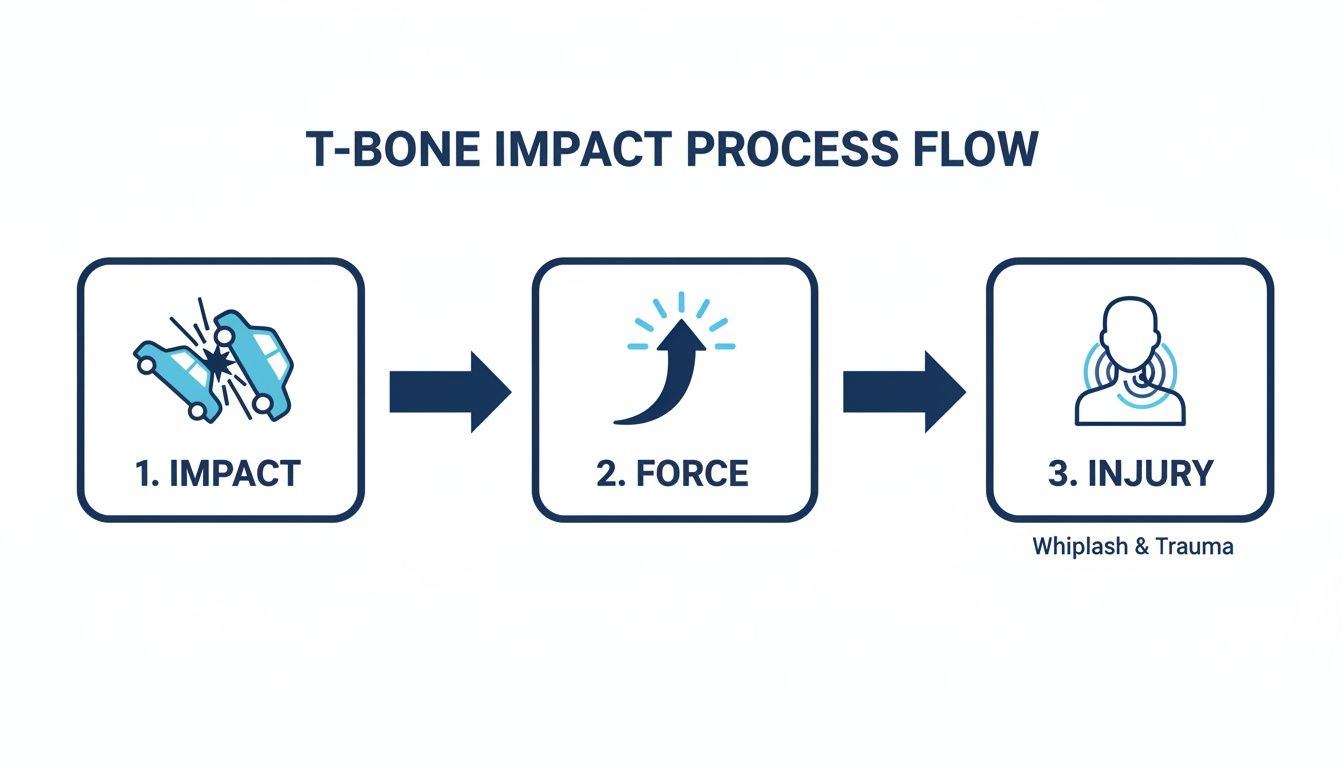
Who Is Liable in a T-Bone Car Accident?
Liability in a T-bone crash usually comes down to one question: who had the right-of-way? Colorado's traffic code answers that for the most common side-impact situations, and a violation of these rules is often the starting point for proving fault.
- Running a red light: Under C.R.S. § 42-4-604, traffic facing a steady red signal "shall stop." A driver turning right on red must first yield to traffic lawfully using the intersection, and a driver turning on a green light must still yield to other vehicles and to pedestrians lawfully within the intersection.
- Left turns: C.R.S. § 42-4-702 requires a driver turning left to "yield the right-of-way to any vehicle approaching from the opposite direction" that is within the intersection or close enough to be an immediate hazard. Many T-bone crashes begin as a left turn across oncoming traffic. Our guide to left-turn accidents in Colorado covers the same rule from a rider's perspective.
- Stop signs: Under C.R.S. § 42-4-703, a driver approaching a stop sign must stop and then "yield the right-of-way to any vehicle in the intersection" or close enough to be an immediate hazard.
Liability is not always one-sided. A driver with a green light can still be assigned a share of fault for speeding or not keeping a proper lookout, and two drivers may each claim the light was in their favor. Signal timing records, camera footage, vehicle data, and witness statements usually decide those disputes. Under Colorado's comparative negligence rule, any share of fault assigned to you reduces what you can recover, which is why the defense below matters so much.
Who pays can also depend on more than the driver. If the at-fault driver was working at the time, an employer's policy may be involved. If the at-fault driver has no insurance or too little, your own uninsured motorist or underinsured motorist coverage may apply.
The Settlement Must Match the Severity of the Injury
The value of a T-bone car accident settlement in Colorado is driven mainly by the seriousness of the injuries. Side impacts offer less crumple-zone protection than front or rear impacts, so occupants often take more of the force. A settlement should account for medical expenses, lost wages, and long-term disability, and when the at-fault driver is uninsured or underinsured, your own UM/UIM coverage may come into play.
A fair settlement accounts for two kinds of damages—the bills you can stack up and the human suffering you can't.
Economic damages are the measurable costs: medical bills, lost wages, vehicle repair or replacement, and ongoing treatment. A complete calculation includes both past expenses and future costs, such as lifetime medical care, rehabilitation, and lost earning capacity.
- Medical Bills: Every ambulance ride, surgery, hospital stay, and prescription—plus the cost of future care like physical therapy or pain management.
- Lost Wages: All the income you lost while recovering.
- Loss of Earning Capacity: If a Traumatic Brain Injury prevents you from returning to your career, we calculate the lifetime value of that lost future.
Non-economic damages cover the human cost: pain and suffering, emotional distress, loss of enjoyment of life, and diminished quality of life.
- Pain and Suffering: The daily, grinding physical agony.
- Loss of Enjoyment of Life: You can no longer ski/hike/play with your kids. Life is smaller now.
- Emotional Distress: The PTSD, anxiety, and fear that follow a violent crash.

Realistic T-Bone Settlement Ranges
Every case is different, and settlement amounts reflect the severity and circumstances of the injury. The ranges below are illustrative only. They are not results from our cases and are not a prediction for yours.
- Minor/Moderate: $25,000 - $75,000 for cases with concussions, soft tissue injuries, or simple fractures.
- Serious: $100,000 - $500,000+ for injuries requiring surgery, like a herniated disc or a more significant TBI.
- Catastrophic: $1 Million+ for cases involving paralysis, permanent brain damage, or other life-altering disabilities.
Real T-Bone Accident Settlement Examples
These are actual settlements from Colorado T-bone collision cases:
Real T-Bone / Side-Impact Settlements
Settlement Value vs. Available Coverage
Your case value and the amount you can recover may differ. Colorado requires only $25,000/$50,000 minimum liability coverage. If the at-fault driver carries minimum coverage, your recovery may be limited regardless of your actual damages—unless you have underinsured motorist (UIM) coverage or other sources apply.
Past results do not guarantee future outcomes. Each case is unique and results depend on specific facts and circumstances. Settlement amounts shown represent actual recoveries for clients but should not be considered a prediction of results in your case.
The Insurance Company’s Most Common Defense
Even when the other driver ran a red light, the insurer may argue that the injured person shares some of the blame. Knowing how that argument works is the first step toward answering it.
It's often called a lookout defense: the claim that the injured driver should have seen the other vehicle coming and avoided the collision. Whether that argument has any merit depends on the evidence, such as sight lines, timing, and speed.
Here's how it works: Under Colorado's modified comparative fault rule (C.R.S. § 13-21-111), any settlement or judgment is reduced by the percentage of fault assigned to the injured party. If an accident victim is found 10% responsible for the collision, their recovery is reduced by 10%.
And if the injured person is found 50% or more at fault, Colorado law bars recovery entirely. The statute allows recovery only if the injured person's negligence "was not as great as the negligence of the person against whom recovery is sought." That is why even small shifts in assigned fault can matter so much.
Fault in a multi-car pileup on I-70 can be genuinely unclear, but in a T-bone crash at a signal or stop sign it is often much clearer. Our job is to keep the facts straight so your share of fault reflects what actually happened.
You Must Act Now—Evidence Disappears Fast
The moments after a crash are chaotic. Your only job is to get medical care. But in the days that follow, evidence starts to disappear: skid marks fade, witnesses forget details, and surveillance footage gets overwritten. The sooner the scene is documented, witness statements are gathered, and physical evidence is preserved, the stronger the claim.
Crucial evidence, like traffic camera footage and the other car's Event Data Recorder (EDR) data, can be lost within days. Security footage is often overwritten on short cycles, and vehicle data can be lost once a car is repaired or salvaged. Preservation letters, scene photographs, and early EDR downloads help keep that evidence available.
You're recovering from a traumatic event. Negotiating with claims adjusters, gathering evidence, and tracking deadlines is a lot to carry while you heal. Having someone handle those pieces lets you focus on getting better.
Talking With a Denver T-Bone Car Accident Lawyer
Denver's grid of signalized intersections, along with corridors like Colfax, Federal, and Colorado Boulevard, produces a steady stream of side-impact crashes. If you were hit in one, a conversation with a lawyer early on is mostly about preservation and timing, not about filing a lawsuit right away.
- What to bring: the crash report number, photos of both vehicles and the intersection, the other driver's insurance information, names of any witnesses, and the medical records you have so far.
- What gets done first: preservation requests for camera footage and vehicle data, a review of the police report for citations and right-of-way findings, and a check of every available policy, including your own UM/UIM coverage.
- What to hold off on: recorded statements to the other driver's insurer and signing any settlement release before you understand the full extent of your injuries.
Deadlines apply even when fault looks obvious. Our Colorado personal injury statute of limitations guide explains the filing windows for motor vehicle claims. For local help, see our Denver car accident lawyer page.
Related Settlement Guides
Explore settlement values for related accident and injury types:
- Car Accident Injury Settlements – Neck, shoulder, and other injuries common in side impacts
- Rear-End Accident Settlements – Another common collision type
- Spinal Cord Injury Settlements – How catastrophic injuries are valued
- Colorado Car Accident Statistics – Crash trends across the state
Disclaimer: This blog post is for informational purposes only and does not constitute legal advice. The information provided is not a substitute for consulting with a qualified attorney. The results in past cases are not a guarantee of future outcomes. Each case is unique and must be evaluated on its own merits.
Call us. We’ll figure this out together.

Written by
Elliot Singer, Esq.
Personal injury attorney at Conduit Law, dedicated to helping Colorado accident victims get the compensation they deserve.
Learn more about our team