
Table of Contents
Free case qualifier
In a car or vehicle accident?
Answer a few quick questions about the crash and your injuries — we route your details straight to intake.
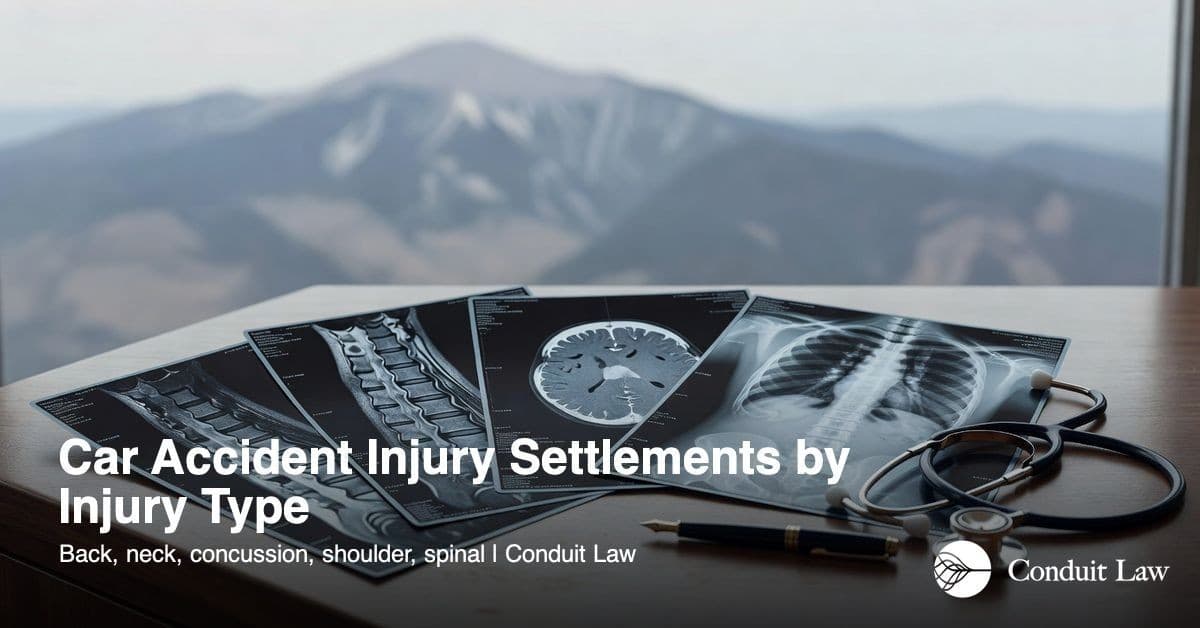
Start the qualifierThe settlement value of a Colorado motor vehicle accident claim depends more on which part of your body was hurt and how badly than on any single other factor. Insurance adjusters and attorneys evaluate back injuries, neck injuries, concussions, shoulder injuries, and spinal cord injuries as distinct claim types with distinct ranges. Understanding which injury type describes your case tells you what to expect from a settlement and how insurers will try to reduce it.
For help applying injury-settlement ranges to a Denver collision, our Denver car accident lawyers can review medical records, fault evidence, insurance coverage, and treatment progression.
This guide covers the settlement landscape for the most common motor vehicle accident injury types in Colorado:
- Back injuries — $20K to $500K+ (detailed section below)
- Neck injuries — $10K (whiplash) to $750K+ (cervical fusion with permanent deficits)
- Concussions and traumatic brain injuries — $25K (mild TBI) to $5M+ (severe TBI with cognitive impairment)
- Shoulder injuries — $15K (strain) to $300K+ (rotator cuff surgery with lost earning capacity)
- Spinal cord injuries — $500K to $10M+ (paralysis, quadriplegia, permanent disability)
The sections below cover back injuries in depth — the most common serious motor vehicle accident injury we see in Denver. Additional injury-type sections follow with typical ranges and the factors that matter most for each. All values reflect Colorado-specific factors: the 50% modified comparative fault bar under C.R.S. 13-21-111, the $25,000 per person / $50,000 per accident minimum liability coverage under C.R.S. § 10-4-609, and the 16% uninsured driver rate that frequently turns a clear-liability case into an underinsured coverage fight.
In-Depth: Back Injury Settlements in Colorado
Back injuries are among the most serious—and most valuable—car accident injuries. From muscle strains to herniated discs requiring fusion surgery, back injuries can permanently alter quality of life and earning capacity. The spine's complexity means that even seemingly minor trauma can cause significant long-term damage. Many victims experience chronic pain, mobility restrictions, and substantial medical expenses. In Colorado, where traffic fatalities reached 628 in 2023 according to CDOT data, serious accidents resulting in back injuries are not uncommon. The financial stakes are considerable, especially when minimum liability coverage under C.R.S. § 10-4-609 is only $25,000 per person and $50,000 per accident. With 16% of Colorado drivers uninsured, many accident victims face additional challenges recovering damages. Herniated discs, spinal fractures, and soft tissue injuries may require extended treatment, physical therapy, or surgical intervention. Understanding the full scope of damages—including past and future medical care, lost wages, and pain and suffering—is essential for proper compensation.
Understanding how Colorado car accident settlements function is essential for injury victims navigating the claims process. The gap between a case's actual value and the insurance coverage available often determines settlement outcomes. Colorado drivers are required to carry minimum liability coverage of $25,000 per person and $50,000 per accident under C.R.S. § 10-4-609, yet these limits frequently fall short of legitimate damages in serious cases. Adding complexity, approximately 16% of Colorado drivers operate without insurance, leaving victims with limited recovery options. This challenge becomes even more critical when considering that Colorado recorded 628 traffic fatalities in 2023, underscoring the severity of accidents that occur on state roads. Understanding settlement mechanics, insurance requirements, and coverage gaps helps injury victims develop realistic expectations and identify additional compensation sources beyond standard policies.
Average Back Injury Settlement Ranges
Settlement values vary dramatically based on injury type and treatment:
| Back Injury Type | Typical Settlement Range | Treatment Required |
|---|---|---|
| Lumbar Strain/Sprain | $10,000 - $40,000 | PT, chiropractic, medications |
| Bulging Disc (Non-Surgical) | $25,000 - $75,000 | PT, injections, conservative care |
| Herniated Disc (Non-Surgical) | $50,000 - $150,000 | Epidural injections, long-term PT |
| Herniated Disc (Surgery) | $100,000 - $300,000+ | Discectomy, laminectomy |
| Lumbar Fusion (1-2 Level) | $200,000 - $400,000+ | Spinal fusion surgery |
| Multi-Level Fusion | $350,000 - $750,000+ | Complex spinal reconstruction |
Spinal surgery cases consistently settle in six figures. The more levels fused, the higher the settlement.
Factors Affecting Back Injury Settlement Value
MRI and Imaging Evidence
Objective imaging showing disc herniations, bulges, nerve impingement, or stenosis provides concrete evidence that strengthens personal injury claims following motor vehicle accidents. Cases with clear MRI findings significantly outperform those relying solely on subjective pain complaints, as medical imaging offers measurable documentation of structural damage. In Colorado, where 628 traffic fatalities were recorded in 2023, the consequences of serious collisions underscore the importance of thorough diagnostic evaluation. Plaintiffs presenting detailed imaging evidence can more effectively demonstrate injury severity to insurance adjusters and courts. Under Colorado's mandatory liability coverage requirements under C.R.S. § 10-4-609, minimum limits of $25,000 per person and $50,000 per accident apply—amounts that often prove inadequate for cases involving documented spinal injuries. The 16% rate of uninsured Colorado drivers further complicates recovery, making strong medical documentation essential. Defense counsel struggles to dispute objective radiological findings, making MRI evidence a critical component of successful injury valuation and settlement negotiations.
Surgical vs. Conservative Treatment
Surgery dramatically increases settlement value in Colorado car accident cases. A lumbar fusion case is typically worth 3–5 times more than a conservatively treated herniated disc case. Even failed conservative treatment followed by surgery supports substantially higher settlement values. This disparity reflects the severity of the underlying injury and the documented medical necessity of surgical intervention. In Colorado, where traffic-related injuries claim hundreds of lives annually—628 fatalities were recorded in 2023—catastrophic injuries requiring surgery are increasingly common. Colorado's minimum liability coverage of $25,000 per person/$50,000 per accident (C.R.S. § 10-4-609) often proves inadequate for surgical cases, particularly when dealing with uninsured motorists, who represent approximately 16% of Colorado drivers. Insurance adjusters recognize that surgical intervention demonstrates injury severity and permanence, justifying elevated compensation to account for ongoing medical expenses, lost earning capacity, and diminished quality of life that conservative treatment alone cannot address.
Permanent Impairment
If a back injury from a car accident results in permanent lifting restrictions, chronic pain, or long-term disability, the settlement value increases substantially. Fusion surgery almost always results in some degree of permanent impairment, which courts and insurers recognize as significant, lifelong harm. Colorado law requires minimum liability coverage of $25,000 per person and $50,000 per accident under C.R.S. § 10-4-609, though permanent impairment cases frequently exceed these thresholds. Given that 16% of Colorado drivers remain uninsured, underinsured motorist coverage becomes critical for accident victims facing substantial medical bills and lost earning capacity. The severity of permanent restrictions—such as inability to lift, bend, or perform job duties—directly correlates with higher compensation. Medical evidence documenting the permanence of impairment, including imaging, surgical records, and vocational assessments, strengthens settlement negotiations considerably.
Impact on Work Capacity
Back injuries devastate workers in physical occupations, and car accidents are a leading cause of these debilitating injuries. When a collision leaves a worker unable to perform job duties, the consequences extend far beyond medical bills. Forced early retirement, lost wages, and the need for vocational retraining compound economic losses that should factor into claim value. Colorado drivers involved in accidents with uninsured or underinsured motorists face additional challenges—approximately 16% of Colorado drivers carry no insurance at all. Under Colorado law (C.R.S. § 10-4-609), minimum liability coverage is $25,000 per person and $50,000 per accident, which often proves insufficient for serious back injuries requiring ongoing treatment and lost earning capacity. Given that Colorado recorded 628 traffic fatalities in 2023, many collisions result in severe, life-altering injuries. The economic ripple effects—reduced lifetime earning potential, career disruption, and rehabilitation costs—significantly strengthen injury claims and warrant comprehensive damage calculations.
Age and Pre-Existing Conditions
Younger victims typically receive higher settlements because they'll live longer with the injury's consequences, resulting in greater lifetime medical expenses and lost earning potential. Pre-existing degenerative changes don't bar recovery—Colorado's "eggshell plaintiff" rule protects victims whose conditions were aggravated by accidents. Under this doctrine, defendants must take plaintiffs as they are, even if prior injuries or conditions made them more vulnerable to harm. This principle proves crucial in Colorado's accident landscape, where 628 traffic fatalities occurred in 2023. Additionally, approximately 16% of Colorado drivers carry no insurance, increasing the likelihood that injured parties must pursue claims against underinsured motorists. Colorado law requires minimum liability coverage of $25,000 per person and $50,000 per accident under C.R.S. § 10-4-609. Courts recognize that pre-existing conditions complicate settlement valuations but don't diminish responsibility. Juries understand that accident-related aggravation of prior injuries warrants compensation, ensuring victims receive fair recovery regardless of their medical history.
Real Back Injury Settlement Examples
These are actual settlements from Colorado car accident cases involving back injuries:
Real Motor Vehicle Accident Settlements
Settlement Value vs. Available Coverage
Your case value and the amount you can recover may differ. Colorado requires only $25,000/$50,000 minimum liability coverage. If the at-fault driver carries minimum coverage, your recovery may be limited regardless of your actual damages—unless you have underinsured motorist (UIM) coverage or other sources apply.
Past results do not guarantee future outcomes. Each case is unique and results depend on specific facts and circumstances. Settlement amounts shown represent actual recoveries for clients but should not be considered a prediction of results in your case.
Common Accident Types Causing Back Injuries
Back injuries commonly result from:
- Rear-end collisions – Sudden acceleration/deceleration forces on lumbar spine
- T-bone accidents – Lateral spinal loading, rotational forces
- Intersection crashes – High-speed impacts causing disc injuries
For cervical spine injuries specifically, see our herniated disc settlement guide.
The Insurance Company's Playbook
Expect these tactics:
- "Degenerative disc disease" – They'll blame your injury on age-related wear
- "Pre-existing condition" – They'll claim your back problems predate the accident
- "Low-speed impact" – They'll argue the crash wasn't severe enough
- "Surgery not medically necessary" – They'll question your treatment decisions
- "Malingering" – They'll hire surveillance investigators to film you
Estimate Your Back Injury Settlement
Use our free calculator to get an instant estimate based on your specific situation:
Settlements by Other Injury Types
Detailed guides for each injury type are in development. Until then, here is what to expect from each:
Neck Injury Settlements
Range: $10K–$750K+. Whiplash without objective imaging typically settles $8K–$25K. Cervical disc herniation with surgery settles $75K–$300K. Multi-level fusion with permanent deficit can exceed $500K. MRI evidence of nerve root compression is the single biggest value driver.
Concussion and Brain Injury Settlements
Range: $25K–$5M+. Mild concussion with full recovery settles $25K–$75K. Post-concussion syndrome persisting beyond 6 months pushes values to $150K–$500K. Moderate-to-severe TBI with documented cognitive impairment, neuropsychological deficits, or behavioral changes can reach $1M–$5M+. Neuropsychological testing is essential for case value.
Shoulder Injury Settlements
Range: $15K–$300K+. Soft-tissue strain without surgery settles $15K–$45K. Rotator cuff tear with arthroscopic repair settles $75K–$150K. Cases involving permanent impairment or lost earning capacity (tradespeople, manual laborers) push values to $200K–$300K+. Labral tear documentation via MRI arthrogram drives case value.
Spinal Cord Injury Settlements
Range: $500K–$10M+. Incomplete spinal cord injuries with partial recovery settle $500K–$2M. Paraplegia settles $2M–$5M. Quadriplegia settles $5M–$10M+. These cases are almost always limited by available insurance coverage — the injured party's own UM/UIM policy often becomes the primary recovery vehicle. Life care planning and vocational expert testimony are essential.
Settlements by Accident Type
Intersection accidents (T-bone, left-turn collisions) often produce severe injuries due to lateral impact — settlements trend 20–40% higher than rear-end crashes with comparable-severity injuries. Disputed liability at intersections often turns on traffic-camera footage and witness statements.
Multi-vehicle pile-ups involve multiple insurers and complex shared-fault determinations. Settlement timelines are longer but total recovery is often higher because multiple liability policies can be stacked.
Frequently Asked Questions
How much is a back injury from a car accident worth?
Colorado back injury settlements range from $10,000 for minor strains to $500,000 or more for injuries requiring multi-level spinal fusion. Surgical cases consistently settle in six figures. The settlement amount depends on injury severity, medical costs, lost wages, and the at-fault driver's insurance coverage. Colorado law requires minimum liability coverage of $25,000 per person and $50,000 per accident under C.R.S. § 10-4-609, though many accident victims pursue claims exceeding these limits. Notably, approximately 16% of Colorado drivers are uninsured, which can complicate recovery efforts. Given that Colorado recorded 628 traffic fatalities in 2023, serious back injuries from car accidents remain unfortunately common. Cases involving permanent nerve damage, chronic pain requiring ongoing treatment, or loss of earning capacity typically command higher settlements. An experienced personal injury attorney can evaluate medical records and employment history to determine fair compensation for back injuries sustained in motor vehicle accidents.
Does back surgery increase my settlement?
Yes, dramatically. Spinal surgery cases typically settle for 3-5x more than conservatively treated cases with similar underlying injuries.
What if I had back problems before the accident?
You can still recover for aggravation of pre-existing conditions. Many people have asymptomatic degenerative changes that become painful after trauma. The accident-related worsening is compensable. Colorado law recognizes that not all back injuries are new. Many individuals have underlying degenerative disc disease or arthritis that causes no symptoms until a car accident accelerates the damage. When a motor vehicle collision worsens a pre-existing condition, the responsible party remains liable for the additional harm caused. Under C.R.S. § 10-4-609, Colorado drivers must carry minimum liability coverage of $25,000 per person, yet 16% of state drivers are uninsured. This gap makes understanding compensation rights critical, particularly when pre-existing conditions complicate injury claims. The key legal principle is straightforward: defendants take their victims as they find them. If an accident exacerbates dormant back problems, medical evidence documenting the functional decline after the collision supports a legitimate claim. Treatment costs, increased pain, and lost wages stemming from accident-related aggravation are all recoverable damages.
How long does it take to settle a back injury case?
Back injury cases typically take 12–24 months to settle, though this timeline varies based on injury severity and case complexity. Surgical cases often extend beyond two years because Colorado law requires plaintiffs to reach maximum medical improvement before calculating full damages. This medical plateau determines the extent of permanent injury, ongoing treatment needs, and long-term disability. Given that Colorado recorded 628 traffic fatalities in 2023, serious back injuries remain common outcomes of motor vehicle accidents. Additionally, approximately 16% of Colorado drivers carry no insurance, which can complicate settlement negotiations and recovery timelines. Most Colorado drivers carry minimum liability coverage of $25,000 per person and $50,000 per accident, as required by C.R.S. § 10-4-609. When injuries exceed these minimums, cases may require underinsured motorist coverage claims, further extending resolution. Factors affecting settlement duration include medical documentation completeness, liability clarity, and insurance company responsiveness.
Disclaimer: This blog post is for informational purposes only and does not constitute legal advice. Settlement amounts depend on the specific facts of your case, injury severity, available insurance coverage, and many other factors. Past results do not guarantee future outcomes.
Suffered a back injury in a Colorado car accident? Call Conduit Law at (720) 432-7032 for a free consultation. We fight for maximum compensation for spinal injuries.

Written by
Elliot Singer, Esq.
Personal injury attorney at Conduit Law, dedicated to helping Colorado accident victims get the compensation they deserve.
Learn more about our team
![Average Car Accident Settlements Colorado [2026]](/_next/image?url=https%3A%2F%2Fleui45a2n5ivp3hb.public.blob.vercel-storage.com%2Fimages%2Fblog%2Fhero%2Fcar-accident-settlement-1777052866225.jpg&w=1536&q=75)