Table of Contents
You know the feeling. It's that white-knuckle grip on the steering wheel as you navigate the chaos of Wadsworth Boulevard at 3 PM on a Tuesday. The guy in the lifted truck treating the speed limit like a vague suggestion. The car that drifts into your lane, its driver hypnotized by the glow of a phone screen. It isn't a commute—it's a daily gauntlet. When a careless driver causes a collision, Colorado law provides a three-year window to pursue compensation under C.R.S. § 13-80-101. However, under the state's modified comparative negligence rule, C.R.S. § 13-21-111 allows recovery only if the injured party is less than 50% at fault. Non-economic damages—covering pain, suffering, and emotional distress—are capped at $1,500,000 as of 2025. Understanding these legal parameters matters, especially when injuries require extensive medical treatment or ongoing care. The statute of limitations clock starts immediately after an accident, making timely action crucial.
Then it happens. A screech of tires, a sickening crunch of metal, and a flash of broken glass. The world is instantly divided into two parts: the life before the crash, and the painful, confusing mess that follows. Medical bills pile up. Insurance companies send letters. Pain radiates through the body. And beneath it all looms an urgent question: What happens next? In Colorado, accident victims have three years from the date of injury to file a personal injury lawsuit, as established under C.R.S. § 13-80-101. However, Colorado's modified comparative negligence rule—codified in C.R.S. § 13-21-111—means that if an injured party is found more than 50% at fault, they cannot recover damages. For those eligible to recover, non-economic damages such as pain and suffering are capped at $1,500,000 as of 2025. Understanding these legal boundaries is essential for anyone navigating the complex aftermath of a serious accident.
The big-shot downtown Denver firms see your collision as a pin on a map. They don't understand the specific brand of mayhem that defines Lakewood's roads. You don't just need a lawyer. You need a Lakewood auto accident attorney who has seen the wreckage on these exact streets and knows the Jefferson County courthouse like the back of their hand. Local counsel matters because Colorado's legal landscape demands precision. Under C.R.S. § 13-80-101, there's a strict three-year statute of limitations to file a personal injury claim—miss that deadline and the case disappears forever. Beyond timing, Colorado's modified comparative negligence rule (C.R.S. § 13-21-111) means that if a plaintiff is found more than 50% at fault, recovery becomes impossible. Meanwhile, non-economic damages are capped at $1,500,000 as of 2025. An attorney deeply familiar with Lakewood's accident patterns, local court procedures, and these nuanced statutes can navigate these constraints effectively and protect every dollar of your claim.
This Isn’t Some Generic Accident—It’s a Jeffco Collision
Driving in Lakewood is its own unique sport. The sprawling, high-speed corridors of Wadsworth and West Colfax Avenue aren't just roads—they're battlegrounds. They are, statistically and anecdotally, where the worst collisions in the city happen. These crashes often result in serious injuries, substantial medical bills, and complex legal questions about fault and recovery. Colorado law recognizes these realities through specific protections for injured parties. Under the state's modified comparative negligence rule (C.R.S. § 13-21-111), an injured person can still recover damages even if partially at fault, provided their responsibility doesn't exceed 50 percent. However, time matters critically—Colorado imposes a three-year statute of limitations (C.R.S. § 13-80-101) for filing personal injury lawsuits. Additionally, non-economic damages such as pain and suffering are now capped at $1,500,000 as of 2025. Understanding these legal parameters is essential for anyone navigating a Lakewood collision claim and ensuring their rights are properly protected.
It's a perfect storm of dense commercial traffic, distracted drivers, and intersections that demand your full attention. When a crash on one of these Jeffco roads shatters your life, you need an advocate who knows this landscape intimately. Colorado law provides important protections for injury victims, but understanding them is critical. Under the modified comparative negligence rule (C.R.S. § 13-21-111), an injured person can still recover damages even if partially at fault—as long as their negligence doesn't exceed 50%. However, time matters. Colorado's three-year statute of limitations means claims must be filed within that window or be lost forever. Additionally, non-economic damages such as pain and suffering are capped at $1,500,000 as of 2025. These legal complexities require someone who understands both Jeffco's unique traffic patterns and Colorado's specific statutes governing personal injury claims.
Your case is a Jeffco case, plain and simple. It will be decided in the Jefferson County District Court in Golden, governed by Colorado's specific procedural rules and substantive law. This demands an attorney who comes with a home-field advantage—not some distant lawyer who needs a GPS to find the courthouse. Local counsel understand the nuances of Jeffco judges, court staff, and case management practices that can significantly impact outcomes. Additionally, Colorado's three-year statute of limitations under C.R.S. § 13-80-101 means timing is critical. Under Colorado's modified comparative negligence standard (C.R.S. § 13-21-111), recovery is possible even if an injured party is partially at fault, provided fault doesn't exceed 50%. Non-economic damages are capped at $1,500,000 as of 2025, a threshold that shapes settlement strategy. An attorney deeply familiar with Jefferson County's legal landscape navigates these complexities effectively, ensuring clients receive the representation their injury deserves.
This isn't about convenience. It’s about strategy.
- We Know the Corridors: We don’t just know of Wadsworth and Colfax; we’ve built entire cases around the predictable negligence that occurs there every single day.
- We Know the Court: Your fight is in the 1st Judicial District Court. You deserve a lawyer who practices there, who knows the local judges, and who understands the tendencies of the defense counsel hired by insurers.
- You Pay Nothing Upfront: This high level of local expertise and aggressive litigation comes on a contingency fee. You pay absolutely nothing unless we win your case. Zero.
The Trick to Proving Fault on Lakewood’s Most Dangerous Roads
Proving negligence on Lakewood's most dangerous roads requires far more than pointing fingers—it demands building an ironclad case grounded in solid evidence. Success hinges on developing deep, systematic familiarity with the traffic patterns and collision statistics that define the region's highest-risk intersections. Every detail matters: traffic light timing, weather conditions, visibility, and witness accounts all contribute to establishing fault. Under Colorado's modified comparative negligence standard (C.R.S. § 13-21-111), a plaintiff can recover damages only if the defendant bears more than 50% of fault. Meanwhile, the three-year statute of limitations under C.R.S. § 13-80-101 creates a critical deadline for filing claims. For significant injuries, non-economic damages are capped at $1,500,000 as of 2025. Attorneys must meticulously document vehicle damage, medical records, and expert analysis to withstand scrutiny. The complexity underscores why building a compelling negligence case demands comprehensive investigation and strategic evidence presentation.
This is where local knowledge becomes your most powerful weapon.
The Wadsworth/Colfax Danger Zone: A Specialist’s View
There's a reason drivers tense up at intersections like Wadsworth at West Colfax or Wadsworth at West 14th Avenue—these are proven danger zones. The same destructive patterns emerge repeatedly: distracted driving, aggressive speeding to beat yellow lights, and drivers who outright run reds. Each violation compounds the risk of serious injury. Under Colorado law (C.R.S. § 13-80-101), injured parties have three years from the accident date to file a personal injury claim, making timely action critical. Colorado's modified comparative negligence rule (C.R.S. § 13-21-111) allows recovery even if a plaintiff is partially at fault, provided their responsibility doesn't exceed 50%. For severe injuries, non-economic damages—covering pain, suffering, and lost quality of life—are capped at $1,500,000 as of 2025. Understanding these legal parameters helps accident victims navigate claims effectively and secure appropriate compensation for their injuries.
We don't just see a police report—we see the intersection in our minds. We immediately know the likely angles for surveillance video from nearby businesses, the timing of the traffic signals, and the line-of-sight issues that contribute to these catastrophic crashes. Proactive measures like installing a dash cam can provide undeniable proof, but our job is to find the proof when you can't. Under Colorado law (C.R.S. § 13-80-101), there's a three-year statute of limitations to file a personal injury claim, making early evidence collection critical. We investigate what others miss: security footage from surrounding properties, witness statements, and accident reconstruction analysis. Colorado's modified comparative negligence rule (C.R.S. § 13-21-111) means you can recover damages even if you're partially at fault—as long as you're not more than 50% responsible. Non-economic damages, including pain and suffering, are capped at $1,500,000 as of 2025. The difference between winning and losing often comes down to evidence gathered in those crucial first weeks.
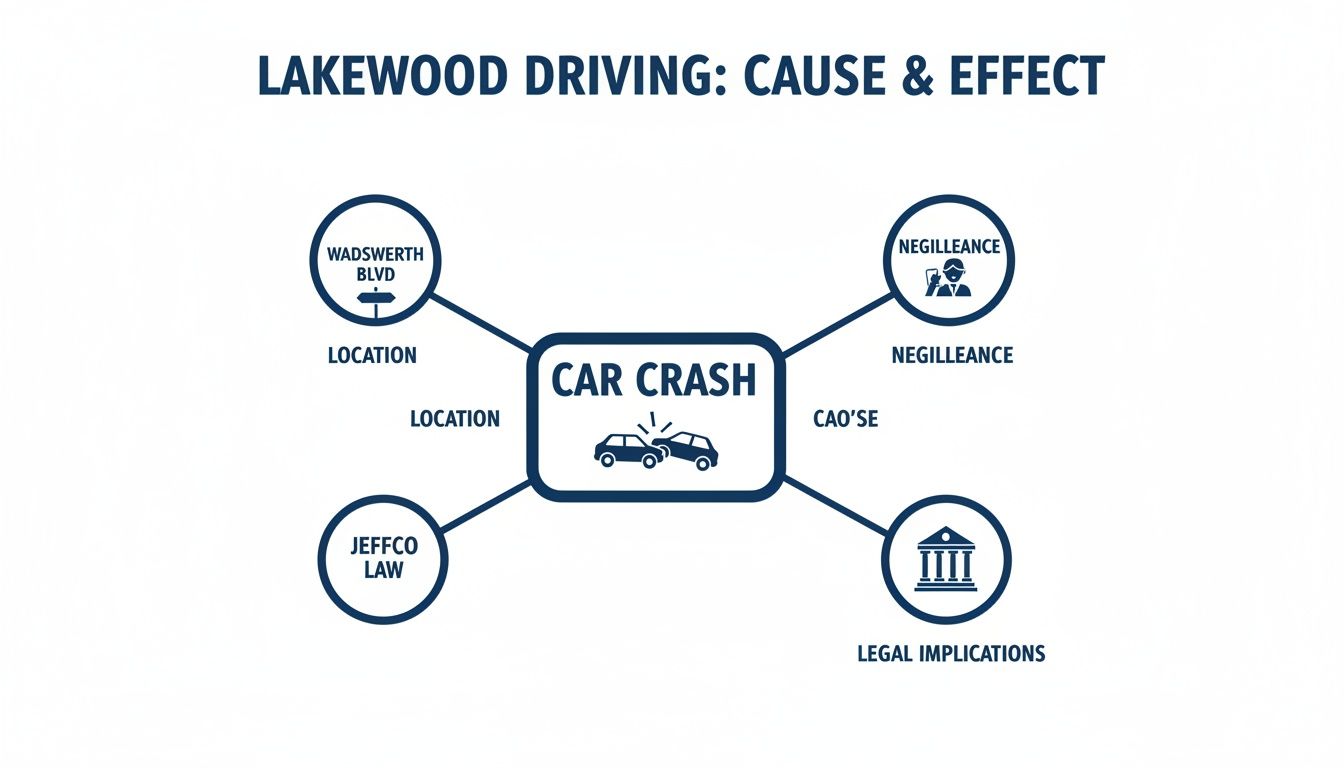
The diagram below breaks down the key elements in a typical Lakewood crash, from the high-risk location to the legal framework governing personal injury claims here in Jefferson County. Understanding these dynamics is critical for injury victims. Colorado law imposes a strict three-year statute of limitations under C.R.S. § 13-80-101, meaning claims must be filed within that window or lost forever. Additionally, Colorado follows modified comparative negligence rules under C.R.S. § 13-21-111, which bars recovery if a plaintiff bears 50% or more fault for the accident. Victims who succeed in their claims may recover economic damages plus non-economic damages—currently capped at $1,500,000 as of 2025. The Wadsworth and Colfax intersection corridor presents unique hazards that frequently generate disputes over liability and causation, making expert analysis essential for navigating both the physical dangers and the complex legal landscape.

Crashes occurring on high-traffic corridors like Wadsworth Boulevard reveal direct connections between specific driver negligence and the legal remedies available through Colorado's court system, particularly in Jefferson County. Under Colorado Revised Statutes § 13-80-101, injured parties have three years from the date of injury to file a personal injury claim—a critical deadline that requires prompt documentation and legal review. Colorado's modified comparative negligence rule (C.R.S. § 13-21-111) permits recovery even when a plaintiff bears some responsibility, provided their fault does not exceed 50 percent. This legal framework allows injured drivers and passengers to pursue compensation for medical expenses, lost wages, and pain and suffering. Non-economic damages are capped at $1,500,000 as of 2025. Understanding how negligent acts map onto these statutory protections is essential for maximizing recovery and protecting legal rights following Wadsworth-area collisions.
T-Bone Collisions Are Not an Accident—They’re a Violation
A T-bone—or broadside collision—is one of the most violent types of crashes. It happens when one driver blatantly violates another's right-of-way, often resulting in severe, life-altering injuries. These collisions are fundamentally preventable violations, not mere accidents. The T-bone car accident settlement Colorado law allows for is significant, potentially reaching substantial amounts, though non-economic damages are capped at $1,500,000 as of 2025. However, securing fair compensation requires proving clear fault. Colorado's modified comparative negligence statute (C.R.S. § 13-21-111) allows recovery only if the injured party is less than 50% responsible for the crash. Additionally, victims must file claims within Colorado's three-year statute of limitations (C.R.S. § 13-80-101) to preserve their legal rights. Understanding these legal requirements is essential when pursuing a T-bone collision claim, as procedural and liability complexities can significantly impact case outcomes and available compensation.
Insurance companies routinely attempt to obscure liability in t-bone collisions by suggesting the injured party was speeding or failed to take evasive action. These tactics are designed to shift blame and reduce settlement amounts. However, Colorado law provides protections through modified comparative negligence standards under C.R.S. § 13-21-111, which allows recovery even when a plaintiff bears some responsibility—as long as fault doesn't exceed 50%. Experienced personal injury attorneys counter insurance company arguments with concrete evidence including traffic light sequence data, eyewitness testimony, and vehicle black box recordings that establish the actual sequence of events. This evidence proves invaluable in demonstrating who had the right of way and when the violation occurred. Additionally, Colorado's three-year statute of limitations under C.R.S. § 13-80-101 provides adequate time to investigate thoroughly and build a comprehensive case. Non-economic damages are capped at $1,500,000 as of 2025, ensuring victims receive fair compensation for pain, suffering, and lost quality of life resulting from negligent driving behavior.
Fighting for Pedestrians and Cyclists
Lakewood's sprawling, multi-lane arteries present serious dangers for pedestrians and cyclists navigating daily traffic. When an auto-pedestrian crash occurs, drivers frequently claim that the victim "darted out" into traffic—a defense tactic designed to shift blame. However, Colorado's modified comparative negligence statute (C.R.S. § 13-21-111) prevents defendants from escaping liability if they bear more than 50% of the fault. This legal framework protects injured pedestrians and cyclists from unfair blame-shifting. Victims have three years from the date of injury to file a claim under Colorado's statute of limitations (C.R.S. § 13-80-101), providing adequate time to gather evidence and build a strong case. Non-economic damages—compensation for pain, suffering, and lost quality of life—are capped at $1,500,000 as of 2025. Understanding these legal protections is essential for anyone injured in Lakewood's high-traffic corridors.
That’s a lazy, self-serving excuse we are experts at demolishing. We immediately investigate:
- Lighting/Visibility Conditions: We document the exact environment to prove you were visible.
- Vehicle Speed Analysis: We pull data to show the driver was going too fast to react safely.
- Surveillance Footage: We canvas nearby businesses for video that tells the unbiased truth.
Even if a pedestrian or cyclist was outside a designated crosswalk, it doesn't give a driver a license to be negligent. Colorado courts recognize that shared fault situations require careful analysis. Under Colorado's modified comparative negligence rule (C.R.S. § 13-21-111), an injured person can still recover damages as long as their fault doesn't exceed 50 percent. Experienced personal injury attorneys know how to build compelling cases demonstrating that a driver's inattention, excessive speed, or failure to yield was the true cause of injuries—regardless of where the accident occurred. This legal strategy focuses on the driver's conduct rather than the injured party's location. With non-economic damages capped at $1,500,000 as of 2025, maximizing the claim's value becomes essential. Additionally, injured pedestrians and cyclists should act promptly, as Colorado enforces a three-year statute of limitations for personal injury lawsuits under C.R.S. § 13-80-101.
Your Insurance Company’s Playbook Is an Open Book to Us
A few days after the crash, the phone rings. It's a friendly-sounding adjuster from the other driver's insurance company. They ask how you are, say they just want to "get your side of the story," and maybe offer a quick check to help with bills. What they don't mention is their goal: lock in a statement before understanding the full extent of injuries or damages. Under Colorado law (C.R.S. § 13-80-101), there's a three-year statute of limitations to file a personal injury claim, but early statements can severely limit recovery. Colorado's modified comparative negligence rule (C.R.S. § 13-21-111) means that if the injured party is found more than 50% at fault, recovery is barred entirely. Additionally, non-economic damages such as pain and suffering are capped at $1,500,000 as of 2025. These nuances make early conversations with opposing insurers risky without proper legal guidance.
This isn't goodwill. It’s the opening move in a calculated game designed to pay you as little as possible.
Their business model is brutally simple: collect maximum premiums, pay minimum claims. Your well-being is not part of their profit-and-loss statement. Insurance companies deploy sophisticated strategies to minimize payouts, but Colorado law provides critical protections for injured claimants. Under C.R.S. § 13-80-101, victims have three years from the date of injury to file a personal injury lawsuit—a crucial deadline that preserves legal rights. Colorado's modified comparative negligence rule (C.R.S. § 13-21-111) allows recovery even if a claimant is up to 50% at fault, as long as the defendant bears greater responsibility. Additionally, non-economic damages—compensation for pain, suffering, and emotional distress—are capped at $1,500,000 as of 2025. An experienced Lakewood auto accident attorney understands these statutes inside and out, systematically dismantling insurance company delay tactics and lowball settlement offers. By leveraging Colorado's statutory framework, skilled legal advocates transform the playing field, ensuring injured parties receive fair compensation rather than corporate bottom-line protection.

The Three-Word Strategy They Live By: Delay, Deny, Defend
At the heart of everything they do is a simple mantra. We see it every single day.
- Delay: They lose your paperwork. They stop returning calls. They ask for the same document three times. They want to frustrate you into giving up or accepting a garbage offer out of sheer exhaustion.
- Deny: They deny liability with the flimsiest of excuses. Your injuries were pre-existing. The medical care wasn’t necessary. They will invent any reason to say no.
- Defend: If you refuse to back down, they threaten to drag the case through a long, expensive court battle, hoping to intimidate you into settling for pennies on the dollar.
This is their business. Insurance companies will delay, deny, and defend because every dollar they don't pay goes straight to their bottom line. It's predictable, infuriating, and precisely why personal injury attorneys exist. Under Colorado law (C.R.S. § 13-80-101), injured parties have three years from the date of injury to file a lawsuit—but insurers know that time creates leverage. The longer a claim sits, the more witnesses disappear, memories fade, and financial pressure mounts on claimants. Meanwhile, Colorado's modified comparative negligence rule (C.R.S. § 13-21-111) allows defendants to reduce damages if a plaintiff bears any fault up to 50 percent, giving insurers multiple angles to chip away at settlement value. Non-economic damages—pain, suffering, lost enjoyment of life—are capped at $1,500,000 as of 2025. Insurers weaponize these statutory limits and procedural rules systematically. Their playbook is worn smooth by repetition, but understanding their strategy is the first step toward fighting back effectively.
The moment representation begins, the dynamic shifts entirely. Our firm takes over all communication with the opposing party, cutting off their direct access to the injured party. This buffer is critical—insurance companies employ delay tactics, hoping claimants will accept lowball offers out of frustration. We anticipate their moves and systematically dismantle their strategy, building a case so compelling that fair compensation becomes their only logical choice. Under Colorado law (C.R.S. § 13-80-101), there's a three-year statute of limitations for personal injury claims, creating urgency without panic. We navigate Colorado's modified comparative negligence rules (C.R.S. § 13-21-111), where defendants cannot recover if they're more than 50% at fault. We also understand that non-economic damages are capped at $1,500,000 as of 2025, allowing us to set realistic expectations while maximizing every available avenue for recovery. This comprehensive approach transforms the negotiation landscape.
The Jeffco Court Advantage: Why a Local Specialist Wins
Here's the secret the big downtown firms won't tell you: where an accident happened matters tremendously. A Lakewood crash is a Jefferson County case, and that distinction changes everything about how the claim is handled, evaluated, and ultimately resolved. Jefferson County courts operate under specific procedural rules and have judges with particular patterns in personal injury cases. Local experience means understanding these nuances. Colorado's modified comparative negligence rule allows recovery as long as the injured party is not more than 50% at fault under C.R.S. § 13-21-111—but how that standard gets applied varies by courthouse and judge. Additionally, timing is critical. Colorado's three-year statute of limitations under C.R.S. § 13-80-101 means deadlines are firm. Non-economic damages are capped at $1,500,000 as of 2025, making strategic valuation essential. A Jefferson County specialist understands local settlement patterns, court tendencies, and how to maximize recovery within these constraints. That insider knowledge separates results.
You can bet the insurance company's lawyer knows the Jeffco terrain intimately. They live and breathe the local court system, understand the judges' tendencies, and navigate the procedural nuances with practiced ease. To win against that home-field advantage, an injured party needs an attorney who nullifies it by having deep roots in the same community. A local Jeffco specialist understands not just the courts, but the unique legal landscape governing personal injury claims in Colorado. Under C.R.S. § 13-80-101, claimants have a three-year statute of limitations to file suit—a critical deadline that requires local knowledge to manage effectively. Additionally, Colorado's modified comparative negligence rule bars recovery if a plaintiff is found more than 50% at fault (C.R.S. § 13-21-111). Non-economic damages are capped at $1,500,000 as of 2025. An attorney with established relationships and courtroom experience in Jefferson County can navigate these complexities while leveraging the credibility that comes from knowing—and being known by—the local legal community.
We Know the Jefferson County District Court
Your case will be heard in Golden at the Jefferson County District Court, part of the 1st Judicial District. This is home turf for our firm, and we understand the local court procedures, judges, and expectations that shape personal injury outcomes here. Jefferson County cases operate under Colorado's strict timelines and damage rules. Plaintiffs have three years from the date of injury to file suit under C.R.S. § 13-80-101, making prompt action essential. The court applies modified comparative negligence under C.R.S. § 13-21-111, meaning defendants can be held liable only if their fault exceeds 50%. Additionally, non-economic damages—compensation for pain, suffering, and emotional distress—are capped at $1,500,000 as of 2025. Navigating these statutory requirements while building a compelling case demands local expertise. The Jefferson County District Court has specific filing protocols, discovery standards, and judicial preferences that significantly influence case strategy and settlement negotiations.
We know the local court procedures, the filing clerks, and—most importantly—the judges. We know their tendencies on crucial rulings and how they interpret Colorado's modified comparative negligence standard, which bars recovery if a plaintiff is found more than 50% at fault under C.R.S. § 13-21-111. We've gone up against the same insurance-hired lawyers again and again, which means we know their tactics before they even try them. A lawyer from Denver walks in cold. We walk in with a detailed scouting report. Our work as a Westminster car crash lawyer for clients just up the road gives us an even broader perspective on Jeffco and Adams County courts. Understanding local nuances—like how judges apply the three-year statute of limitations under C.R.S. § 13-80-101, or the non-economic damages cap of $1,500,000 as of 2025—proves invaluable when building settlement strategies or preparing for trial.
Our Direct Line to Lakewood Police Department Investigators
Getting the official accident report from the Lakewood Police Department is priority number one. The investigative report serves as critical evidence for establishing liability and documenting injuries sustained. Our firm maintains a streamlined process for securing these reports and often communicates directly with investigating officers to clarify details and obtain supplementary information. Time is essential in personal injury cases—Colorado's statute of limitations allows three years from the date of injury to file a lawsuit (C.R.S. § 13-80-101). The accident report becomes instrumental when Colorado's modified comparative negligence rules apply, particularly the 50% fault bar established under C.R.S. § 13-21-111, which determines whether plaintiffs can recover damages. Additionally, understanding non-economic damages caps—currently set at $1,500,000 as of 2025—helps frame case value accurately. By obtaining and thoroughly analyzing the official police report early, attorneys can build stronger cases and ensure compliance with all statutory requirements governing personal injury claims in Colorado.
These officers have invaluable local knowledge that never makes it into the final report—details about a notoriously bad intersection or a history of similar crashes at that exact spot. That insight can be the key to proving a pattern of danger. Lakewood Police Department investigators understand which locations have systemic safety problems, information that becomes critical when building a personal injury claim. Under Colorado's modified comparative negligence standard (C.R.S. § 13-21-111), establishing that dangerous conditions existed at a specific location can help overcome the 50% fault bar. Direct access to investigating officers means learning about prior incidents, maintenance failures, or design defects that official reports may downplay. With Colorado's three-year statute of limitations (C.R.S. § 13-80-101) governing most personal injury cases, gathering this institutional knowledge early is essential. Combined with proper documentation of non-economic damages—capped at $1,500,000 as of 2025—this localized expertise strengthens both liability and damages arguments.
Uninsured/Underinsured? We Pivot and Attack
What happens when the at-fault driver has terrible insurance—or none at all? This is where many cases fall apart. But it does not mean recovery is impossible. Colorado law provides critical protections for injured parties facing uninsured or underinsured motorists. Under the state's modified comparative negligence rule (C.R.S. § 13-21-111), plaintiffs can still recover damages even if partially at fault, as long as their negligence does not exceed 50 percent. Additionally, Colorado's three-year statute of limitations (C.R.S. § 13-80-101) provides a reasonable window to pursue claims. Non-economic damages—covering pain, suffering, and emotional distress—are capped at $1,500,000 as of 2025, yet still represent significant compensation. Strategic alternatives exist, including uninsured motorist coverage claims, asset investigations, and judgment enforcement tactics. The absence of adequate insurance does not eliminate legal options; it simply requires more sophisticated case strategy and aggressive pursuit of available recovery mechanisms.
When the at-fault driver lacks adequate insurance coverage, skilled personal injury attorneys immediately pivot to the injured party's own insurance policy and pursue an Uninsured/Underinsured Motorist (UM/UIM) claim. This strategic shift often reveals an uncomfortable truth: the insurance company long trusted and paid for coverage suddenly becomes an adversary. Insurance carriers deploy the same cynical playbook used against third-party claims, aggressively devaluing legitimate UM/UIM claims despite their contractual obligation to act in good faith. Under Colorado law (C.R.S. § 13-21-111), modified comparative negligence rules allow recovery as long as the injured party is not more than 50% at fault. Additionally, non-economic damages are capped at $1,500,000 as of 2025. Claimants have three years under C.R.S. § 13-80-101 to file suit. Understanding these statutes and recognizing insurance company tactics is essential—experienced representation ensures UM/UIM claims receive the vigorous advocacy they demand.
As an experienced uninsured motorist lawyer Denver clients trust, the firm is expert in this fight. The legal team forces insurers to honor the policies their clients paid for by understanding Colorado's strict procedural rules and fighting aggressively on behalf of injured parties. Under Colorado Revised Statutes § 13-80-101, injured victims have three years from the date of injury to file a claim—a critical deadline that requires immediate action. Colorado's modified comparative negligence rule under C.R.S. § 13-21-111 allows recovery as long as the injured party is not more than 50% at fault, opening pathways to compensation even in complex accidents. Additionally, non-economic damages—including pain, suffering, and emotional distress—are capped at $1,500,000 as of 2025, making strategic case evaluation essential. By leveraging these statutes and procedural requirements, experienced legal counsel ensures that uninsured and underinsured motorist claims receive the aggressive representation necessary to maximize recovery within Colorado's legal framework.
- Establishing Coverage: We confirm your full benefits and file every notice perfectly.
- Proving Fault: We build the same ironclad case for negligence as we would against any other at-fault driver.
- Documenting Damages: We assemble a comprehensive demand package that details every penny of your losses.
Navigating uninsured and underinsured motorist claims requires deep knowledge of Colorado insurance law and the Jefferson County legal landscape. Colorado's modified comparative negligence rule—codified in C.R.S. § 13-21-111—means plaintiffs can recover damages only if they are 50% or less at fault, a critical threshold that demands careful case evaluation. Additionally, claimants must act within Colorado's three-year statute of limitations under C.R.S. § 13-80-101, making timing essential to preserving legal rights. Non-economic damages, including pain and suffering, are currently capped at $1,500,000 as of 2025, significantly affecting settlement strategies. These statutes and regulations intersect in complex ways that directly impact case value and negotiation leverage. Understanding how local courts interpret these rules, combined with knowledge of regional insurance practices, transforms case outcomes. It's why having a local specialist isn't just a benefit—it's the foundation of effective representation.
A Fair Settlement Covers Everything—Not Just the Bills
The insurance adjuster's first offer is a test. It's a lowball number designed to see if the injured party understands the true, full cost of what was taken from them. That initial proposal rarely accounts for the complete scope of damages—medical expenses are just the beginning. A fair settlement must encompass lost wages, ongoing treatment costs, pain and suffering, and permanent lifestyle changes. Under Colorado law (C.R.S. § 13-80-101), injured parties have three years to file a claim, but accepting an inadequate early offer forfeits the opportunity to pursue full compensation. Additionally, Colorado's modified comparative negligence standard allows recovery even if the injured party is partially at fault, provided their negligence doesn't exceed 50% (C.R.S. § 13-21-111). Non-economic damages—including emotional distress and loss of enjoyment—are capped at $1,500,000 as of 2025. Understanding these legal protections and the complete value of a claim ensures settlement negotiations reflect genuine losses rather than insurer convenience.
A fair settlement isn't just about the ER visit and the tow truck. It's a complete accounting of every loss suffered and will continue to be suffered. It's a number that reflects not just what has been paid, but the quality of life lost—including pain, suffering, emotional distress, and reduced enjoyment of daily activities. Colorado law recognizes these non-economic damages, which are capped at $1,500,000 as of 2025 under state statute. Beyond medical bills and vehicle repairs, a comprehensive settlement addresses lost wages, diminished earning capacity, ongoing treatment costs, and permanent disability or scarring. Colorado's modified comparative negligence rule under C.R.S. § 13-21-111 also matters: recovery is possible as long as the injured party is not more than 50% at fault. Additionally, injured parties have three years from the date of injury to file a claim under C.R.S. § 13-80-101, making timely action essential for protecting all recoverable damages.

We fight for two types of damages:
- Economic Damages: The tangible costs—all current and future medical bills, lost wages, and your diminished ability to earn a living over your lifetime.
- Non-Economic Damages: The human cost—compensation for your physical pain and suffering, the emotional distress and PTSD, and the theft of your ability to enjoy your life, your hobbies, and your passions.
A settlement that only covers medical bills and property damage is a profound injustice. True compensation must account for the pieces of life that can never be fully recovered—pain and suffering, lost wages, emotional trauma, and diminished quality of life. Under Colorado law (C.R.S. § 13-21-111), victims may recover non-economic damages, which are now capped at $1,500,000 as of 2025. These intangible losses represent the real human cost of an injury. Additionally, Colorado's three-year statute of limitations (C.R.S. § 13-80-101) means victims have a limited window to pursue claims, making prompt legal action essential. Colorado's modified comparative negligence rule allows recovery even if the injured party is partially at fault, provided they bear no more than 50% responsibility. A comprehensive settlement recognizes both economic losses and the permanent changes to daily life, relationships, and future opportunities that no invoice can capture.
Your Next Move is the Only One That Matters
Do not speak to the insurance company. Do not answer their questions. Do not give them a recorded statement. Every interaction is a trap designed to weaken the claim. Insurance adjusters are trained to extract admissions, minimize injuries, and create contradictions that undermine credibility. Even innocent statements can be twisted and used against the injured party later. Under Colorado law (C.R.S. § 13-80-101), there is a three-year statute of limitations to file a personal injury lawsuit. This provides a reasonable window to gather evidence and build a stronger case before pursuing legal action. Additionally, Colorado follows modified comparative negligence rules (C.R.S. § 13-21-111), meaning recovery is possible even if partially at fault, so long as the injured party is not more than 50% responsible. Non-economic damages—compensation for pain, suffering, and emotional distress—are capped at $1,500,000 as of 2025. Direct communication with the insurer jeopardizes these potential damages. An attorney should handle all negotiations and communications to protect the claim's full value.
Your only job is to focus on healing. Let us handle the fight.
We handle these cases on a contingency fee basis. That means clients pay nothing upfront—we only get paid if we secure a financial recovery. This removes any financial barrier to getting the elite, localized representation a case demands. While proactive measures like investing in high-quality backup cameras can help, they can't prevent every crash. When one happens, expert legal guidance becomes critical. Colorado law imposes strict deadlines and rules that directly impact case outcomes. Under C.R.S. § 13-80-101, the statute of limitations allows three years from the injury date to file a claim—missing this window forfeits all rights to recovery. Additionally, Colorado's modified comparative negligence rule under C.R.S. § 13-21-111 bars recovery if the injured party bears 50% or more fault. Non-economic damages (pain, suffering, emotional distress) are capped at $1,500,000 as of 2025. These nuances require strategic navigation. For a comprehensive overview of what to expect, our guide to the Colorado personal injury claim process provides essential insight into protecting rights and maximizing recovery potential.
This isn't a sales pitch. It’s a lifeline. I got you.
Disclaimer: This blog post is for informational purposes only and does not constitute legal advice. The information provided is not a substitute for consulting with an attorney. The law is complex and changes frequently, and the specifics of your situation can affect your legal rights. Contacting us does not create an attorney-client relationship.
This isn't a sales pitch. It’s a lifeline. Let's talk.
At Conduit Law, the first step is a free, no-pressure consultation to go over your case. Call us, text us, or fill out the form at https://conduit.law. We’re here to help.
Written by
Conduit Law
Personal injury attorney at Conduit Law, dedicated to helping Colorado accident victims get the compensation they deserve.
Learn more about our team