Table of Contents
Colorado uses modified comparative negligence: you can recover for an injury only if your share of fault is less than the other party's. Your damages drop by your percentage of fault. At 50% or more, you recover nothing. That is the 50% bar in C.R.S. § 13-21-111.[1]C.R.S. § 13-21-111. Negligence cases: comparative negligence as measure of damages. Colorado Revised Statutes 2024 (official printout, Office of Legislative Leg
Key Takeaways
- Colorado is a modified comparative-negligence state, not a pure comparative or contributory-negligence state.[1]
- You recover only if your negligence is not as great as the person you are suing; 50% or more bars the claim.[1]
- If you are under that bar, the court reduces the award by your percentage of fault.[1]
- Motor-vehicle injury and crash property-damage lawsuits generally must be filed within three years.[2]C.R.S. § 13-80-101(1)(n). Three-year limitation for motor-vehicle bodily injury and property-damage torts. https://leg.colorado.gov/sites/default/files/images/o
- Colorado is an at-fault (tort) state, so fault percentages decide both liability and the size of the check.[3]C.R.S. § 10-4-619. Coverage compulsory. Colorado motorists must carry a complying liability policy. https://leg.colorado.gov/sites/default/files/images/olls/crs
Is Colorado a comparative negligence state?
Yes. Colorado is a modified comparative negligence state. The statute's first line says contributory negligence "shall not bar recovery" if it "was not as great as the negligence of the person against whom recovery is sought," and that any damages "shall be diminished in proportion" to the injured person's share.[1] So partial fault reduces a claim instead of ending it, until your share reaches the other side's. Colorado is not a pure comparative state, where even a 90%-at-fault person can recover 10%. It is also not a contributory negligence state, where any fault at all bars recovery.
How Colorado comparative negligence works
A judge or jury assigns each party a percentage of fault that adds up to 100%. The statute then does two things. First, it asks whether the injured person's negligence was "not as great as" the negligence of the person they want to recover from. If it was equal or greater, the court enters judgment for the defendant.[1] Second, if the injured person is under that line, the award is reduced in proportion to their own percentage.[1]
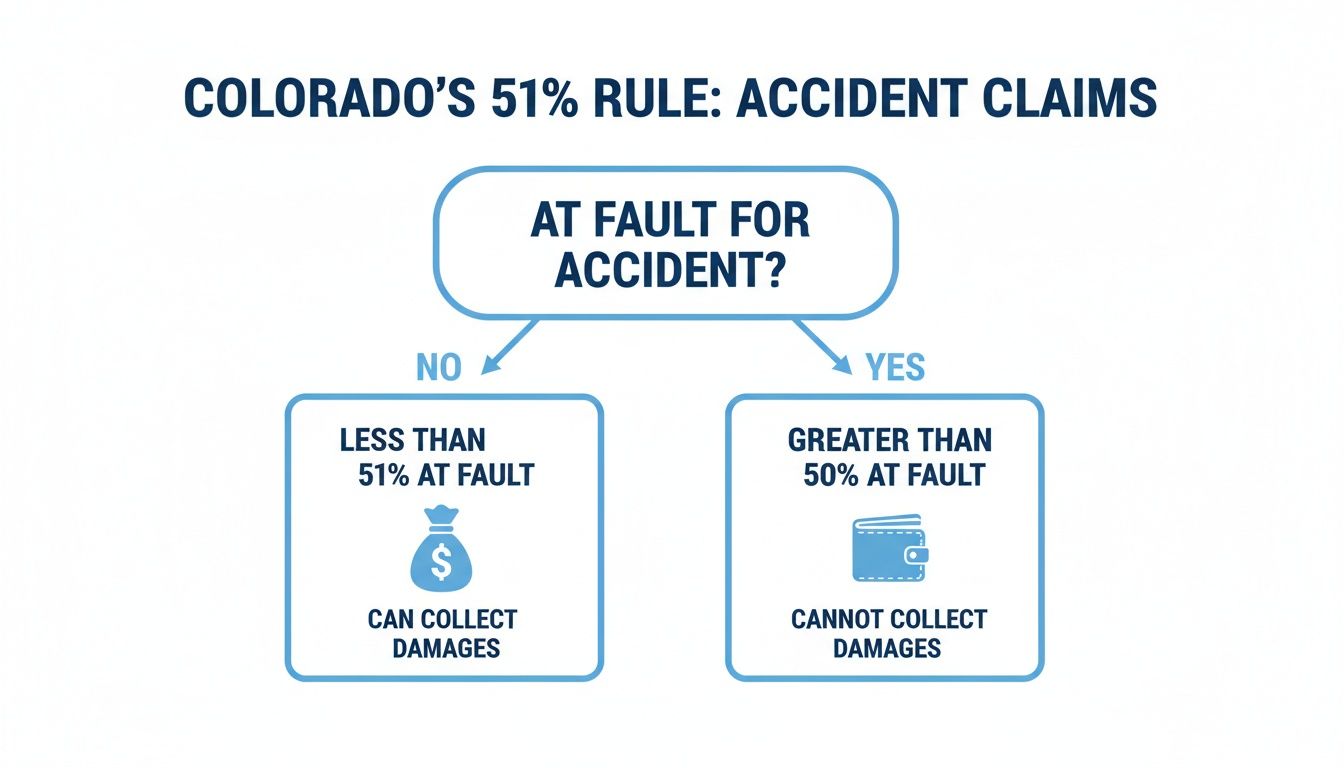
In a two-party crash, that line is easy to picture. The other driver has to be at 51% or more for you to recover. You can be at 49% and still collect 51% of your damages. You cannot be at 50% and collect half. That is the 50% bar: barred at 50% or more. You need the other side at 51% or more. Same rule, two ways to say it.
That is why Colorado is not a no-fault PIP state and not a "any fault kills the claim" state. Fault is the whole case. For the claim sequence, see the Colorado personal injury claim process.
The formula and the 50% bar
On a two-party claim, recoverable damages = total damages × (1 − your fault percentage), but only if your fault is 49% or less. At 50% the product is not 50% of the claim. It is $0.[1]
| Your fault | Other party's fault | Can you recover? | Payout on a $100,000 claim |
|---|---|---|---|
| 0% | 100% | Yes | $100,000 |
| 20% | 80% | Yes | $80,000 |
| 49% | 51% | Yes | $51,000 |
| 50% | 50% | No | $0 (equal fault bars the claim) |
| 51% | 49% | No | $0 |
Multi-defendant cases can look different because the statute compares you to "the person against whom recovery is sought," and nonparty fault can be allocated too. The two-party table is the teaching case, not a verdict predictor.
What C.R.S. § 13-21-111 says, subsection by subsection
The statute is short. It has three working subsections; (3.5) and (4) were repealed in 1986.[1]
- Subsection (1): the rule. Your own negligence does not bar recovery for death or injury to person or property if it "was not as great as" the negligence of the person you are recovering from. Damages are then cut in proportion to your share.[1]
- Subsection (2): the special verdict. The judge (in a bench trial) or the jury (in a jury trial) must state two things separately: the damages that would have been recoverable with no contributory negligence, and each party's negligence "expressed as a percentage."[1] The jury does not net the numbers itself.
- Subsection (3): the math and the bar. The court reduces the verdict by the injured person's percentage. If that percentage "is equal to or greater than" the negligence of the person against whom recovery is sought, "the court shall enter a judgment for the defendant."[1] That sentence is the 50% bar.
Two neighboring sections work alongside it. C.R.S. § 13-21-111.5 limits each defendant to its own percentage of fault in most cases, and lets the fact-finder assign fault to a nonparty when the defense files a designation within 90 days after the case starts (or the claimant settled with that nonparty).[5]C.R.S. §§ 13-21-111.5 (pro rata liability; nonparty designation) and 13-21-111.7 (assumption of risk considered in apportioning negligence). Colorado Revised St C.R.S. § 13-21-111.7 says assumption of risk is not a separate defense to win or lose; it "shall be considered by the trier of fact in apportioning negligence pursuant to section 13-21-111."[5] For how those percentages play out in specific crash types, see motorcycle vs. car accident fault and pedestrian crashes in Colorado.
Worked example
Hypothetical, for the math only. A Denver driver runs a stop sign and hits you. Your documented losses (medical bills, lost wages, and other damages) total $80,000. The evidence also shows you were going 8 mph over the limit. A jury could find the other driver 80% at fault and you 20%.
- Are you under the bar? Yes. 20% is less than 80%.[1]
- Reduction: $80,000 × 20% = $16,000.
- Recoverable amount: $80,000 − $16,000 = $64,000.
Change one finding and the cliff appears. If that same crash is scored 50/50, your negligence is as great as the other driver's. The statute then requires judgment for the defendant: $0, not $40,000.[1] That single percentage point is why fault evidence (scene photos, the crash report, witnesses, vehicle data) gets built early, while it still exists. Colorado crash volume and injury patterns are collected separately in Colorado car accident statistics.
What people get wrong
The myth: "If I'm 50% at fault I still get half." Some explainers, and older shorthand about a "51% cliff," treat 50% as a paying number. Colorado's text does not. Recovery is allowed only if your negligence "was not as great as" the other person's; if your share is "equal to or greater," the court enters judgment for the defendant.[1] In a two-party case, 49% pays (reduced). 50% does not.
The other common mix-up is the opposite: that any fault of yours kills the claim. That is old contributory negligence, which Colorado replaced. Partial fault reduces the number. It does not, by itself, zero the claim, unless you hit the bar.
Frequently Asked Questions
Is Colorado a comparative negligence state?
Yes, a modified one. You can recover if your fault is less than the other party's, with the award reduced by your share. At 50% or more, the court enters judgment for the defendant.[1]
What does C.R.S. § 13-21-111 cover?
It is Colorado's comparative negligence statute. It sets the 50% bar, requires a special verdict stating total damages and each party's percentage of negligence, and tells the court to reduce the award by the injured person's share.[1]
Can I still recover if I was partly at fault in Colorado?
Yes, if your fault is less than the other party's. The award is then reduced by your percentage. At 50% or more, C.R.S. § 13-21-111 bars recovery.[1]
Is Colorado a 50% bar or a 51% bar state?
A 50% bar. You need the other party at 51% or more in a typical two-party case. Equal fault (50/50) is a complete bar, not a half payout.[1]
Does comparative negligence apply to car crashes and other injuries?
Yes. The statute covers negligence causing death or injury to person or property.[1] Motor-vehicle cases usually have a three-year filing deadline; many other injury claims have two.[2][4]C.R.S. § 13-80-102. Two-year limitation for most other tort and wrongful-death actions. https://leg.colorado.gov/sites/default/files/images/olls/crs2024-title-1
How long do I have to file after a Colorado crash?
Generally three years for a motor-vehicle injury or crash-related property-damage tort.[2] Other claim types can be shorter. See Colorado's injury statute of limitations.
What if more than one driver caused the crash?
Percentages are split among the people (and sometimes designated nonparties) who share fault. Whether you clear the bar is still measured against the person you are recovering from.[1] Each defendant generally pays only its own percentage, and a nonparty must be designated within 90 days of filing to be assigned fault.[5] Multi-party math should be checked against the actual parties, not the two-driver table.
The Bottom Line
Colorado will still hear an injury claim when you were partly to blame, until your share hits 50%. Below that line, every point of fault is money off the award. Above it, the claim ends.[1] If you want the deadline and the steps in one place, start with the statute of limitations and the claim process. If you want a free consult on how fault may be assigned in your crash, start at free consultation. Related: underinsured motorist coverage in Colorado, who pays after an accident in Colorado, and rear-end collision settlements.
Article Sources
- C.R.S. § 13-21-111. Negligence cases: comparative negligence as measure of damages. Colorado Revised Statutes 2024 (official printout, Office of Legislative Legal Services). https://leg.colorado.gov/sites/default/files/images/olls/crs2024-title-13.pdf. Accessed October 20, 2026. ↩
- C.R.S. § 13-80-101(1)(n). Three-year limitation for motor-vehicle bodily injury and property-damage torts. https://leg.colorado.gov/sites/default/files/images/olls/crs2024-title-13.pdf. Accessed October 20, 2026. ↩
- C.R.S. § 10-4-619. Coverage compulsory. Colorado motorists must carry a complying liability policy. https://leg.colorado.gov/sites/default/files/images/olls/crs2024-title-10.pdf. Accessed October 20, 2026. ↩
- C.R.S. § 13-80-102. Two-year limitation for most other tort and wrongful-death actions. https://leg.colorado.gov/sites/default/files/images/olls/crs2024-title-13.pdf. Accessed October 20, 2026. ↩
- C.R.S. §§ 13-21-111.5 (pro rata liability; nonparty designation) and 13-21-111.7 (assumption of risk considered in apportioning negligence). Colorado Revised Statutes 2024. https://leg.colorado.gov/sites/default/files/images/olls/crs2024-title-13.pdf. Accessed October 20, 2026. ↩
Disclaimer: This article is for informational purposes only and does not constitute legal advice. Reading it does not create an attorney-client relationship. Fault percentages and deadlines turn on specific facts. Consult a qualified Colorado attorney about your situation.

Written by
Elliot Singer, Esq.
Personal injury attorney at Conduit Law, dedicated to helping Colorado accident victims get the compensation they deserve.
Learn more about our team