Table of Contents
Free case qualifier
In a car or vehicle accident?
Answer a few quick questions about the crash and your injuries — we route your details straight to intake.
Start the qualifierThe car accident injury claim process in Colorado runs through five steps: get treated and report the crash, document everything, calculate the full value of your losses, send a demand to the insurer, and negotiate a settlement, or file suit if needed. Most cases settle without trial. The two things that quietly decide the outcome: how well you document, and whether you act before the three-year deadline to file a car-accident lawsuit (C.R.S. § 13-80-101(1)(n)) runs out.
Here's the whole thing, plainly, so you know what's coming.
The Claim Process at a Glance
| Phase | What happens | Your job | Typical timing |
|---|---|---|---|
| 1. Scene & report | Call 911, get a police report, get medical help | Don't admit fault; photograph everything | Day of crash |
| 2. Treat & document | See doctors, follow the plan, keep records | No gaps in care; keep a pain journal | Weeks to months |
| 3. Value the claim | Tally medical bills, lost wages, pain and suffering | Wait for Maximum Medical Improvement (MMI) | After you've healed or plateaued |
| 4. Demand & negotiate | Lawyer sends a demand letter; offers go back and forth | Don't rush the first offer | Weeks to months |
| 5. Settle or sue | Settlement check, or file a lawsuit | Watch the 3-year filing deadline | Before C.R.S. § 13-80-101(1)(n) expires |
Need local help after a Denver crash? Our Denver car accident lawyers review fault, coverage, treatment, and settlement timing in a free consultation. Elliot Singer has recovered more than $50 million for clients over his career.
Step 1: The Scene — Three Jobs
A day or two later, the other driver's insurer may call to "check in" and "get your side of the story." That call is often a recorded statement, and what you say early, before you know the extent of your injuries, can be quoted later.
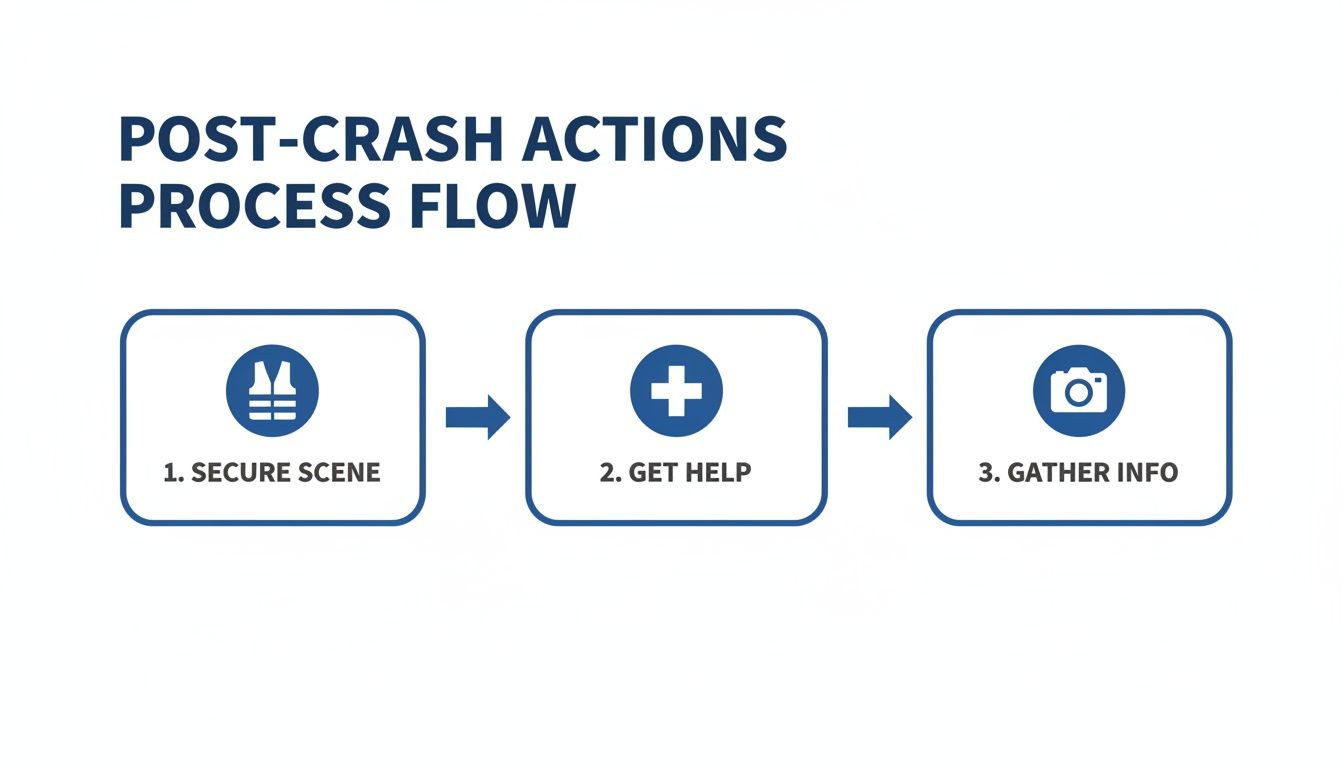
So at the scene, you have exactly three jobs:
- Secure the scene, then call 911. Move your car if you safely can, turn on hazards, prevent a second crash. A police report documents what happened, and paramedics create a record of your injuries.
- Watch your words. Never say "I'm fine" or "I'm sorry." Adrenaline can mask pain, and whiplash and concussions often take hours or days to show up.
- Document the scene. Use your phone to photograph car damage from every angle, skid marks, signs, your injuries. Grab the other driver's license and insurance card. Get names and numbers from witnesses.
Why this matters: when fault or coverage is contested, your photos and the police report are the most reliable record of what happened.
Step 2: Treat and Document
Your sleepless nights and the pain of putting on your shoes are real, but a claim needs a record of them. So build the record.
Every Doctor's Visit Is Evidence
Your medical records are the bedrock of the claim. Gaps matter: wait a week to see a doctor and the insurer may argue you weren't really hurt; miss physical therapy and it may say you weren't committed to recovery.
- Keep a medical file. A binder or folder with every doctor's summary, PT note, prescription receipt, and bill.
- Track every penny. Co-pays, mileage to appointments, crutches, medication. It adds up fast.
- Follow doctor's orders. Go to every appointment. If you must reschedule, call right away and note the reason.
Your Pain Journal Is Your Most Powerful Tool
This is the part everyone skips, and it's often the most valuable evidence you have. A few bullet points a day turns "pain and suffering" from a vague phrase into a concrete record:
- Pain scale (1-10): Where does it hurt? Sharp, dull, throbbing?
- Daily limits: What couldn't you do? "Couldn't lift my kid." "Had to ask for help opening a jar."
- Emotional toll: Anxiety, frustration, depression. "Had a panic attack in traffic."
- Life interrupted: "Skipped my son's soccer game." "Canceled a hike with friends."
Step 3: Calculate What the Claim Is Really Worth
A careful valuation starts from Colorado law and the real cost of the crash. Compensation ("damages") falls into two buckets:
- Economic damages: The receipt-based losses — past and future medical bills, lost wages, and reduced ability to earn a living if your injuries are permanent.
- Non-economic damages: The human cost — physical pain, emotional distress, and losing the ability to do the things that made you you.

How Value Is Estimated
Non-economic damages have no receipt, so they are estimated based on the severity and duration of the injury and its effect on daily life. What moves the number is documentation: strong medical records, imaging, and a pain journal turn a subjective claim into a defensible one.
Two Colorado Rules That Shape the Number
Two pieces of Colorado law affect what you can actually collect:
- Coverage limits. Colorado's minimum auto-liability limits are $25,000 per person and $50,000 per accident for bodily injury, plus $15,000 for property damage (MVFRA, C.R.S. § 42-7-103). Many drivers carry only the minimum, so when injuries are serious, uninsured/underinsured motorist coverage often matters. See our breakdown of Colorado auto insurance requirements.
- Shared fault. Colorado uses modified comparative negligence (C.R.S. § 13-21-111): your recovery is reduced by your share of fault, and you recover nothing if you're 50% or more at fault. That's why fault evidence matters so much.
Step 4: The Demand Letter and Negotiation
Once your treatment has plateaued and the file is built, your lawyer sends a demand letter: the facts, the evidence, and the dollar figure to resolve the claim. It signals that litigation is a real possibility if the offer isn't fair.
The first counteroffer is usually an opening move, not a final one. Be careful with an early "settlement" check, too: cashing it usually signs away your right to seek more, even if you need surgery a year later. Negotiation can take time. Most claims resolve here, in negotiation, without ever seeing a courtroom.
Step 5: Settle or File Suit
A "claim" is a request for payment. A "lawsuit" asks a court and jury to decide. Filing changes the process: discovery allows requests for documents and records, and depositions of the at-fault driver and witnesses under oath. A case prepared from day one as if it may go to trial is in a stronger position to settle.
But all of it is gated by one hard deadline. In Colorado, the statute of limitations to sue over a motor-vehicle injury is three years from the crash date. Negotiations don't stop the clock, so keep the deadline in view.
Mistakes That Wreck a Good Claim
- Posting on social media. Insurers may review public posts. A BBQ photo can be presented as "proof" you're not in pain. It's safest not to post until the case is over.
- Ignoring the clock. The three-year filing deadline is real. Waiting too long to document, gather witnesses, or call a lawyer can sink an otherwise solid claim.
- Gaps in medical treatment. A break in care can be used to argue you weren't hurt, or were reinjured elsewhere. Stick to the plan.
- Giving a recorded statement. "How are you today?" "I'm okay, thanks" becomes claimant states injuries not serious. It's usually best to politely decline.
Questions We Get All the Time
How Much Is My Claim Worth?
Honestly: it depends. A specific number in the first meeting is a guess. Value turns on the severity of your injuries, your medical bills, lost wages, property damage, and the human cost — and it can't be pinned down until you reach Maximum Medical Improvement (MMI), the point where healing has plateaued and future treatment needs are clear. Settling before MMI risks leaving future costs uncovered.
How Long Does the Process Take?
A straightforward case often takes several months; complex or litigated cases can stretch beyond a year. Thorough investigation, solid documentation, and real negotiation take time.
Do I Have to Go to Court?
Probably not — most car accident cases settle before trial. Preparing each case as if it may go to a jury helps it settle on fair terms.
How Do You Get Paid?
No fee unless we win. We work on contingency: our fee is 33.33% of the recovery if the case resolves before a lawsuit is filed and 40% once one is filed. We advance the case costs, and if there's no recovery you owe nothing, including those costs.
The insurance company has lawyers. It helps to have one too. We handle the claim so you can focus on healing.
Call (720) 432-7032 or fill out our online form for a free, no-obligation consultation.
Disclaimer: This post is for informational purposes only and is not legal advice or a substitute for consulting a qualified attorney. The specific facts of your case will determine the right course of action. No attorney-client relationship is formed by reading this post.

Written by
Elliot Singer, Esq.
Personal injury attorney at Conduit Law, dedicated to helping Colorado accident victims get the compensation they deserve.
Learn more about our team