Table of Contents
It happens between one breath and the next—a single moment that splits your life into a sharp “before” and a terrifying “after.”
Maybe it was a routine surgery where the anesthesia wasn’t monitored correctly. Maybe it was a car crash that seemed survivable, until a loved one’s heart stopped for just a few minutes too long. It could have been a near-drowning at a poorly supervised pool, or a delayed diagnosis in a chaotic Denver emergency room.
In those moments, the real enemy isn’t the visible trauma; it’s the silence. The four to five minutes when the brain’s power supply is cut. The city goes dark. Cell by cell, the intricate network holding a person's memories, personality, and future begins to shut down.
You’re left standing in a sterile hospital corridor, the fluorescent lights buzzing overhead, listening to a doctor use a term you've never heard before: "anoxic brain injury." It’s a diagnosis that feels both devastatingly precise and impossibly vague. It explains everything and nothing. This guide is for you—to demystify what an anoxic brain injury truly is, and to prepare you for the inevitable fight with an insurance company that’s already gearing up to deny you justice.
Here’s the Simple Truth an Insurance Company Hopes You Don’t Grasp
So, what is an anoxic brain injury? Forget the dense medical textbooks and the jargon doctors throw around in hospital hallways.
Think of it like this—your brain is a bustling, brilliant city, working 24/7. Oxygen is its only power source. A traumatic brain injury from a physical blow is like an earthquake shaking that city. An anoxic injury is different. It’s a total, instantaneous, system-wide blackout.
When the power cuts off, the city’s infrastructure—the billions of brain cells—begins to die. This isn’t a flicker or a brownout. It’s a catastrophic failure.
And unlike a bone that can mend or a cut that can heal, dead brain cells don’t come back. Ever. That is the simple, brutal truth that insurance companies hope you don’t fully understand when they start calling.
Your Brain's Power Grid Explained
Not all blackouts are the same. The specific way oxygen was cut off from your brain matters—both medically and legally. It helps us trace the failure back to its source—often, somebody's carelessness.
There are a few key ways this can happen:
- Anoxic Anoxia: This is when there’s simply no oxygen to breathe. Think carbon monoxide poisoning, suffocation, or a drowning incident where the lungs fill with water instead of air.
- Anemic Anoxia: The air has plenty of oxygen, but your blood can't carry it. This can be caused by severe blood loss after an accident or from certain poisons that cripple red blood cells.
- Stagnant Anoxia (Ischemic Hypoxia): This is the one we see most often. Oxygen is available and the blood can carry it, but the blood isn’t moving—a heart attack, stroke, or catastrophic drop in blood pressure during a botched medical procedure stops blood flow completely.
- Toxic Anoxia: This occurs when a poison/chemical interferes with the brain cells’ ability to use the oxygen that’s delivered to them. The power is reaching the city, but every building's circuit breaker has been destroyed.
To really get a handle on the devastation of an anoxic injury, it helps to understand the related conditions. Learning more by understanding hypoxia, its causes and symptoms can shed light on the nuances of oxygen deprivation injuries.
Anoxic vs. Hypoxic vs. Traumatic Brain Injury
It's easy to get these terms mixed up, but the differences are critical. Each type of injury has a distinct cause and a different pattern of damage, which directly impacts a person's prognosis and the kind of care they'll need for the rest of their life.
Here's a straightforward breakdown of how they compare.
| Injury Type | Primary Cause | Nature of Damage |
|---|---|---|
| Anoxic Brain Injury | Complete lack of oxygen supply to the brain. | Widespread, diffuse cell death across the brain. |
| Hypoxic Brain Injury | Severely reduced or restricted oxygen supply. | Damage can be widespread, but often less severe than anoxic. |
| Traumatic Brain Injury | External physical force or trauma to the head. | Focal (localized) or diffuse damage from impact, shaking, or penetration. |
Understanding these distinctions is the first step in building a clear picture of what happened. An insurer will try to muddy the waters, but the facts of the injury—how it happened and the specific type of damage it caused—are what matter.
The Unforgiving Timeline of Brain Cell Death
The speed of an anoxic brain injury is terrifying. Your brain consumes about 20% of your body's oxygen despite being only 2% of your body weight. It's an energy hog, and without its fuel, the system collapses fast.
Damage isn't a possibility; it's a certainty that unfolds second-by-second. Once the clock starts, it cannot be rewound.
- 0-1 Minute: Consciousness is lost almost immediately.
- 1-3 Minutes: Neurons begin to suffer damage. The areas most vulnerable—like the hippocampus (memory) and cerebellum (coordination)—are hit first.
- 3-5 Minutes: Widespread, permanent brain damage becomes highly likely. The cascade of cell death accelerates.
- 5+ Minutes: The chances of severe, lifelong disability or death increase dramatically.
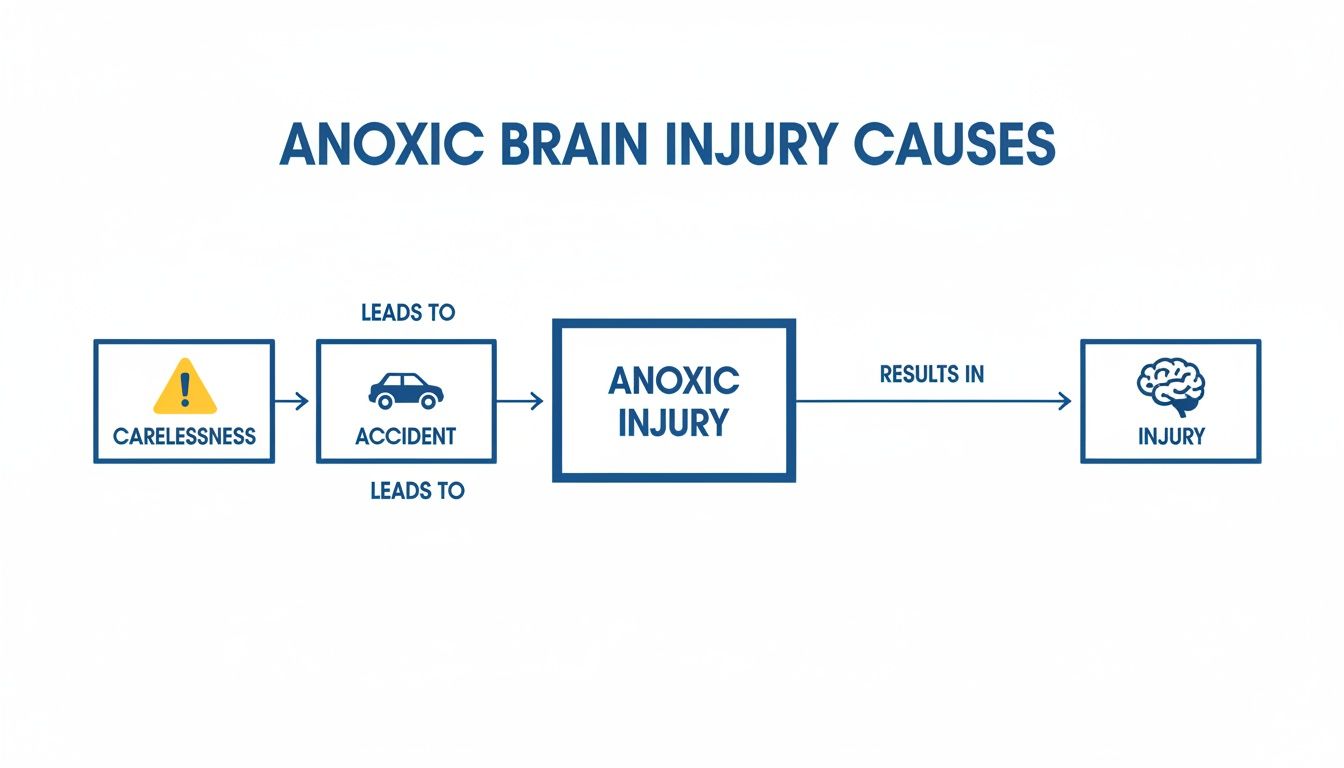
This chart shows just how easily a moment of negligence can spiral into a catastrophic injury.

This simple flow—from carelessness to accident to injury—is the exact chain of events an insurance company will try to break when denying your claim.
This type of brain injury, sometimes called a hypoxic-ischemic brain injury (HIBI), accounts for roughly 10-15% of all non-traumatic brain injuries. The most frequent cause is cardiac arrest—an event that strikes half a million Americans every year. Of those who survive, more than 40% face lasting functional disability. That’s a staggering number that underscores just how severe oxygen deprivation is.
Understanding the timeline and the type of injury is crucial because it directly connects to recovery potential. We've seen how these factors impact a family's journey, which you can learn more about in our guide to traumatic brain injury recovery time. It’s a long road—one an insurer will try to pretend doesn’t exist.
This Is How Someone Else’s Mistake Caused This Disaster
Anoxic brain injuries don't just happen. They are caused. They’re the catastrophic final act in a chain reaction that begins, far too often, with someone else’s carelessness.
This is where a medical diagnosis crashes into legal reality. Our job is to draw a straight, undeniable line from another party's negligent action—or failure to act—to the exact moment oxygen stopped flowing to the brain. We connect the dots. We prove fault.
Think of it like a bridge collapse. The anoxic injury is the horrifying plunge into the water. But to build a case, we have to find the first rusted bolt, the first ignored safety inspection—the first shortcut that made the disaster inevitable.

The Real-World Scenarios We See Every Day
These aren't freak accidents. They are the predictable outcomes of someone dropping the ball. The scenarios are depressingly common, and we’ve handled cases like these right here in Colorado.
- Surgical Errors: An anesthesiologist fails to properly monitor a patient. Oxygen levels plummet, an alarm goes off unnoticed, and for five minutes, the brain suffocates on the operating table.
- Birth Injuries: A doctor misses clear signs of fetal distress. They wait too long to order an emergency C-section, and the baby is deprived of oxygen during delivery, leading to lifelong conditions like cerebral palsy.
- Car Crashes: A drunk driver blows through a red light. The victim goes into cardiac arrest. Even though paramedics work heroically to restart their heart, those precious minutes without blood flow to the brain cause irreversible damage.
- Premises Liability: A toddler drowns in an apartment complex pool because the self-latching gate was broken. The property owner knew about the hazard for weeks but did nothing.
In every one of these cases, the anoxic brain injury wasn't a random act of fate. It was the foreseeable, preventable endpoint of someone's failure to uphold their basic duty of care.
Tracing the Chain of Causation
Legally, we have to prove that the defendant's negligence was the "proximate cause" of the injury. That’s a fancy term for showing that the harm was a direct and natural consequence of their actions.
For an anoxic brain injury case, that chain looks something like this:
- Duty of Care: The doctor/driver/property owner had a responsibility to act with reasonable care.
- Breach of Duty: They failed in that responsibility through a careless act or by failing to act.
- Causation: That specific failure directly led to an event (like cardiac arrest) that cut off the oxygen supply.
- Damages: The resulting anoxic brain injury caused profound, measurable harm.
This isn’t just legal theory; it’s a grim reality. Recent data shows there were 214,110 TBI-related hospitalizations in 2020 and 69,473 TBI-related deaths in 2021 in the U.S. alone. That’s more than 190 deaths every single day from events that can—and often do—lead to oxygen deprivation. You can learn more about these sobering TBI statistics and their impact.
An insurance company’s entire strategy is to break that chain of causation. They’ll argue the injury was caused by a pre-existing condition or that it was an unforeseeable complication. Our job is to make that connection unbreakable.
The Trick Insurance Companies Don’t Want You to Know
Once you understand how negligence led to this catastrophe, the real fight begins. This battle won’t be in a hospital room. It’ll be on the phone with an insurance adjuster whose only job is to protect their company’s bottom line.
They have a playbook. It’s a well-rehearsed script designed to prey on your grief, confusion, and utter exhaustion. An anoxic brain injury isn’t as visually obvious as a shattered bone, and they will use that ambiguity like a weapon.
They will do everything they can to muddy the waters. They’ll question the timeline, dig for pre-existing conditions they can blame, or argue that the long-term damage is an exaggeration. They are masters of creating doubt where none should exist.
Exposing Their Most Cynical Tactics
Adjusters are trained to sound empathetic while actively working to dismantle your claim. They’ll ask for recorded statements, hoping you’ll say something—anything—they can twist to their advantage. They will delay, deflect, and deny, counting on you to simply give up.
Here are some of the greatest hits from their cynical playbook:
- The Pre-Existing Condition Ploy: They'll scour medical records for any mention of asthma or high blood pressure. Their goal is to argue your loved one was a ticking time bomb and the anoxic event was a coincidence, not a direct result of their insured’s negligence.
- Minimizing the Damage: "He seems to be responding well, don't you think?" They will seize on any tiny sign of progress and try to frame it as proof of a full recovery, conveniently ignoring the devastating cognitive and physical deficits that are far less visible.
- The Delay Game: They will "investigate" for months. They will claim to lose paperwork. They will always be "waiting on a report from corporate." Every delay is a calculated move designed to wear you down, pushing you toward accepting a laughably low settlement out of desperation.
These tactics are infuriating, but they’re just the warm-up act.
The Foreseeability Fallacy
This is the one that gets my blood boiling. We’ve seen it a hundred times, and it is a pure, calculated, bad-faith argument designed to sever the link between the accident and the outcome.
The insurer will argue that the anoxic injury was not a foreseeable consequence of the initial negligent act.
Let that sink in. A drunk driver T-bones a car, causing the victim to go into cardiac arrest. The insurance company’s lawyer will stand up with a straight face and argue that while the crash was their client’s fault, a subsequent heart attack and resulting anoxic brain injury were "unforeseeable."
It’s absolute nonsense. It’s a legal sleight of hand designed to make you feel like your case is weak, hoping to convince you—and eventually, a jury—that the chain of causation is broken. They use this trick because the damages from an anoxic brain injury are astronomical. Erasing that connection is their golden ticket to paying you pennies on the dollar.
If you find yourself in this situation, knowing how to appeal a denied insurance claim is your first line of defense. They are counting on you being too overwhelmed to fight back. We’re counting on them underestimating you—and us.
This Is What It Costs to Have a Future Stolen
An anoxic brain injury isn't just a medical event. It’s a moment that rewrites a person’s life—and the lives of everyone who loves them. The real cost isn't something you can find in a stack of hospital bills. It’s measured in lost moments, erased futures, and the quiet, grinding reality of lifelong dependency.
This is the part the insurance adjuster conveniently ignores when they slide an insulting, lowball settlement offer across the table. They see a claim number. We see a human being whose world has been permanently fractured because of someone else's carelessness.

The Devastating Spectrum of Lifelong Consequences
When an adjuster talks about "maximum medical improvement," they're playing a cynical game. They want you to think about the injury in the past tense. But for families grappling with an anoxic brain injury, the consequences are a daily reality that stretches out for decades.
The outcomes fall along a devastating spectrum, and none of them are cheap.
- Severe Cognitive Deficits: The loss of short-term memory, the inability to process information, or the struggle to make simple decisions. It's a brilliant mind suddenly trapped in a fog.
- Profound Physical Disabilities: This can mean a permanent loss of motor control, paralysis, seizures, and the need for a wheelchair and round-the-clock physical help.
- Radical Personality Changes: This is often the hardest part. The person they knew can be gone, replaced by someone prone to agitation, depression, or a complete lack of emotional response.
- Loss of All Independence: The victim may require 24/7 supervision. They can no longer work, drive, or manage their own basic needs. Often, a spouse/parent is forced to quit their job to become a full-time, unpaid caregiver.
- Persistent Vegetative State: In the most severe cases, the brain's higher functions are permanently destroyed. The cost of maintaining someone in this state can easily run into the millions over a lifetime.
Beyond the Medical Bills
The financial devastation goes far beyond the initial hospitalization. What the insurance company's first offer will never account for are the real long-term costs.
The insurer’s goal is to pay for the "event." Our goal is to secure compensation for a "lifetime." The difference between those two words is everything.
Effective Neurorehabilitation can significantly impact the long-term outlook, but it comes at a cost. This includes things like:
- Home Modifications: Ramps, wider doorways, and accessible bathrooms.
- Specialized Equipment: Hospital beds, communication devices, and modified vehicles.
- Ongoing Therapies: Physical, occupational, and speech therapy that can continue for years.
- Lost Earning Capacity: This isn't just for the victim. It includes the income lost when family members must sacrifice their careers to provide care.
This is why insurers fall back on their most dishonest tactic: They argue the anoxic injury was not a foreseeable consequence of the initial negligent act. They use this legal fiction to try and erase all these future costs from the equation. Accepting their first offer isn't just a bad financial move; it's a catastrophic one.
Here Is Your Plan to Fight Back—Starting Today
The first few days after a diagnosis like this are pure chaos. You're swimming in a sea of medical jargon, gut-wrenching emotions, and a deep, gnawing fear for what comes next. It's easy to feel powerless, but you're not. This is the moment to take calm, deliberate action.
Think of this as your immediate game plan. It's how you start building a defensive wall around your family's rights. Follow these steps. They are designed to shield you from the traps the insurance company is already setting.
The Immediate Action Plan
What you do right now can fundamentally change the outcome of your case down the road.
Here is your five-point plan for what to do today:
Never—Ever—Give a Recorded Statement. An insurance adjuster's job is to minimize their payout, and they will use your own words against you. They'll call, sounding incredibly kind, and ask to record your conversation. Politely say no. You are under no legal obligation to give them a statement.
Gather Every Single Piece of Paper. Become the family archivist. Collect every medical bill, every hospital record, the police/incident report, and any letter you receive. This paper trail is the raw material we use to build a powerful case.
Document Everything in a Journal. Start a daily log, right now. Note every symptom, every doctor's visit, every slight change in condition, and every single way this injury is wrecking your family's daily life. A stack of bills can’t tell that story, but your journal can.
Preserve All Physical Evidence. If the injury happened because of a car crash/defective product/unsafe property, save everything. Don’t get the car repaired. Don't throw away the faulty item. Take dozens of photos and videos of the scene from every angle.
Contact an Experienced Colorado Brain Injury Lawyer Immediately. This is the most important step. The laws are complex, and the deadlines are unforgiving. Knowing how to choose a personal injury lawyer who truly understands the unique medicine and staggering costs of an anoxic brain injury case is absolutely essential.
This is how you begin to fight back. You are not alone in this—you just need the right guide.
Your Questions About Anoxic Brain Injury Claims, Answered
When your world gets turned upside down, you're going to have questions. You deserve straight answers, not a bunch of legal jargon or corporate runaround. Here are the direct, no-nonsense replies to the questions we hear most from families who are right where you are now.
How Long Do I Have to File a Lawsuit in Colorado?
This is the question with the most brutal answer. In Colorado, the clock is always ticking. The law that sets this deadline is called the statute of limitations, and for most personal injury cases—including those involving an anoxic brain injury—you generally have two years from the date the injury happened to file a lawsuit.
If the injury was caused by a car wreck, that window gets a little bigger, extending to three years.
But don't let that fool you. The law is a minefield of exceptions. For example, if a government agency was responsible, you might only have 182 days just to give them formal notice of your claim. Miss that deadline, and your right to sue is gone forever. This is not a detail you can afford to get wrong.
What Is a Case Like This Actually Worth?
There's no simple formula, and any lawyer who throws out a huge number in a free consultation is selling you a fantasy. The real value of a case is built piece by piece, based on the specific, hard realities of what your family has lost.
We figure out the value by adding up two different kinds of damages:
Economic Damages: This is the cold, hard math. It covers every medical bill, the cost of all future care—like therapies, home modifications, or 24-hour supervision—and all lost income, past and future.
Non-Economic Damages: This is the profound human cost. It’s the value put on the pain, the suffering, the emotional trauma, the loss of enjoyment of life, and the loss of companionship. It’s about putting a number on a future that was stolen.
Building this part of the case is where the real fight happens—and it's where having an experienced attorney makes all the difference.
Can We Still Have a Case if It Was an Accident?
Yes. In fact, almost every single personal injury case is based on an "accident." The legal system doesn't require someone to have wanted to cause harm. It only requires them to have been negligent—which is just a legal term for being careless, reckless, or simply failing to act with reasonable caution.
The surgeon didn't mean for the patient’s oxygen to drop. The driver didn't intend to run the red light. The property manager didn't want the child to drown.
It doesn’t matter. Their carelessness created the conditions for a disaster, and under the law, they are responsible for the fallout. "I didn't mean to" is an excuse, not a legal defense. Hopefully, these answers give you the clarity you need.
DISCLAIMER: This blog post does not constitute legal advice and does not create an attorney-client relationship.
You’re facing an impossible situation, but you don’t have to face it alone. The insurance company has a team of lawyers working around the clock to protect their bottom line. It’s time you had someone working only for you. At Conduit Law | Accident Attorneys, we handle the fight so you can focus on your family. Let’s talk about what happened. I got you. https://conduit.law
Written by
Conduit Law
Personal injury attorney at Conduit Law, dedicated to helping Colorado accident victims get the compensation they deserve.
Learn more about our team