Table of Contents
Free case qualifier
Hurt and not sure of your options?
Answer a few quick questions about your injury and we route your details straight to intake.
Start the qualifierPicture a common situation. A software engineer is T-boned at an intersection in Cherry Creek. He walks away from the crash seemingly unscathed. The ER runs imaging, gives him the all-clear, and sends him home. Initial imaging can appear normal even when a brain injury has occurred, and symptoms like cognitive changes, headaches, and mood changes can emerge days or weeks after impact. That is why early medical evaluation, and early legal guidance, can matter.
But he never really came home.
The man who returned was irritable, forgetful, lost in a fog. He couldn't code anymore. He couldn't remember his kids' birthdays. His wife told doctors, "His brain scan is normal, but his life has changed. I don't understand."
This is the invisible side of a traumatic brain injury. The damage isn't always something a machine can see. It shows up in memory, attention, mood, and the ability to work, think, and connect with family. A "normal" scan is often the first thing raised to question a brain injury claim, so the claim has to be documented in other ways.
That's where a traumatic brain injury lawyer in Denver comes in. The work goes beyond the accident itself. It means documenting how the injury has changed a person's life and future, including lifetime medical care, lost earning capacity, and quality of life, and connecting each of those losses to the evidence.
Evidence Beyond the MRI

A clean standard MRI does not mean an injury isn't real. Diffuse axonal injury and other changes at the cellular level often don't show on standard scans. Neurocognitive testing, advanced imaging where appropriate, and medical expert testimony can help show what a standard MRI misses.
Proving the functional, cognitive, and emotional effects of a brain injury usually means combining objective testing with the account of the people who know the injured person best. Expert testimony, neuropsychological testing, vocational assessments, and day-in-the-life documentation work together to show how the injury has reshaped daily life.
- The Neuropsychologist: This is often the cornerstone. We work with Denver-area neuropsychologists who conduct hours of objective testing. They measure memory, attention, processing speed, and executive function, and their report gives the claim measurable data.
- The Lay Witness: Your spouse, your boss, your best friend can describe the "before and after" of your life, showing not just what you've lost, but who you were before. Their testimony gives the expert data its human context.
- Advanced Imaging: When appropriate, advanced imaging techniques like Diffusion Tensor Imaging (DTI) or PET scans can sometimes show damage to the brain's "wiring" that standard scans miss. This can matter in a high-impact case like a T-bone car accident settlement in Colorado.
Three Common Defenses in Brain Injury Claims
Brain injury claims tend to draw the same questions: whether the injury is real, whether something else explains the symptoms, and whether the injury can be serious without a loss of consciousness. Each can be answered with medical evidence and expert testimony.
Defense 1: "The Symptoms Are Exaggerated." (Malingering)
One of the most common questions raised is whether the injured person is exaggerating symptoms. It can be painful to hear. TBI symptoms such as cognitive difficulties, headaches, memory loss, and emotional changes are measurable, and the answer is careful testing and qualified expert testimony.
Neuropsychological testing includes embedded Symptom Validity Tests (SVTs), designed to detect inconsistent effort. When a qualified neuropsychologist testifies that the data is valid and the deficits are genuine, the question of effort is addressed with evidence rather than argument.
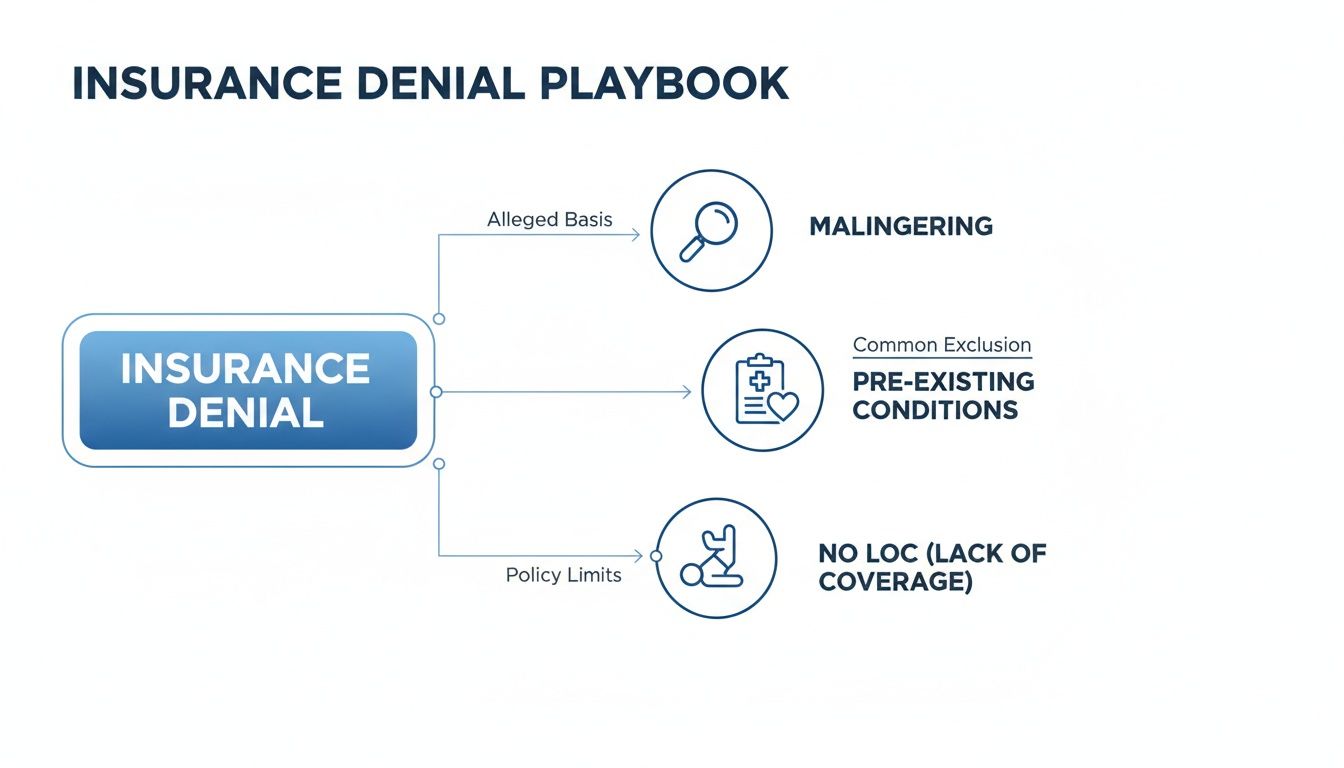
Defense 2: "It Was a Pre-Existing Condition."
Medical records are often reviewed for any history, such as anxiety from a decade ago or a bout of depression in college, that might be offered as the real reason someone can't focus or manage their emotions. A documented history of anxiety doesn't erase a brain injury's distinct symptoms.
Colorado follows the eggshell plaintiff rule: a defendant takes the injured person as found and is responsible for the injury or aggravation the crash caused, even if a pre-existing condition made that person more vulnerable. The defendant is not responsible for unrelated conditions that would have existed anyway, and the claim still must prove causation. Careful medical evidence is what separates the two.
Defense 3: "You Didn't Lose Consciousness."
Many serious traumatic brain injuries, including diffuse axonal injuries from the brain shifting inside the skull, occur without any loss of consciousness. The absence of a blackout does not rule out a significant injury.
Expert testimony on how these injuries occur helps explain to a jury why loss of consciousness is not a prerequisite for a serious brain injury, supported by medical literature, testing, and treating specialists.
Valuing a TBI Case Means Looking Decades Ahead

A traumatic brain injury claim isn't only about past medical bills. It's about funding the years ahead: ongoing care, lost earning capacity, and quality of life. In a general Colorado injury case, economic damages such as medical care and lost earnings are not capped. Noneconomic damages are capped at $1,500,000 for claims that accrue on or after January 1, 2025, and actions filed during 2025, but damages for physical impairment or disfigurement are not capped (C.R.S. § 13-21-102.5).
The calculation usually rests on two pillars:
- Diminished Earning Capacity: This is often the largest economic figure. A vocational specialist or economist can calculate the income lost over a career by comparing the pre-injury trajectory to the post-injury reality.
- The Life Care Plan: A Life Care Planner creates a detailed, evidence-based plan for future needs, quantifying the lifetime cost of therapies, medication, in-home assistance, future procedures, and psychological support.
Catastrophic claims, much like a spinal cord injury settlement in Colorado, are about long-term security. A structured settlement can spread payments over time so money is available when it is needed, rather than relying on a single lump sum.
Coordinating the Legal and Medical Sides
A TBI case depends on legal work and medical expertise moving together. Neuropsychologists, life care planners, and rehabilitation providers each add a piece of the record, and the legal claim has to reflect all of it.
We help keep the medical and legal sides aligned. Whether the injury came from a crash, a fall, or another incident, the medical record and the legal claim need to tell the same story. Coordinating that from early on turns scattered records and expert opinions into a clear account of the injury's severity and impact.
An early settlement offer may arrive before the full extent of a brain injury is known. A traumatic brain injury can evolve, and its full scope may not be clear for months. Once a settlement release is signed, it usually ends the claim and prevents reopening it for later-discovered symptoms, so it is worth understanding the long-term picture before deciding.
In the most tragic cases, where a traumatic brain injury proves fatal, the case may become a wrongful death claim. As wrongful death attorneys in Denver, we handle those claims, including wrongful death settlement distribution in Colorado, so families can focus on each other.
Recovering from a traumatic brain injury is a long road, and no one should walk it alone. The first conversation is free, confidential, and focused on answers about medical care options, insurance coverage, and potential legal remedies.
Disclaimer: The information contained in this blog post is for general informational purposes only and does not constitute legal advice. The law is complex and changes frequently. You should consult with a qualified attorney for advice regarding your individual situation. The use of this website does not create an attorney-client relationship.
I'm Elliot Singer. If your family is facing the aftermath of a traumatic brain injury, call my firm. The consultation is free, confidential, and there's no pressure, just answers. We can help coordinate the medical evidence and insurance questions so your family can focus on recovery.

Written by
Elliot Singer, Esq.
Personal injury attorney at Conduit Law, dedicated to helping Colorado accident victims get the compensation they deserve.
Learn more about our team