Table of Contents
Spoliation of evidence is what happens when proof relevant to your injury case gets destroyed, altered, or hidden — whether on purpose or through careless neglect. It matters because your case is only as strong as the evidence behind it. When the dashcam footage, maintenance logs, or security video that would show what happened is gone, the claim becomes harder to prove. Courts have tools for evidence that should have been kept, and acting fast to lock down proof is one of the most important things you can do after an injury.
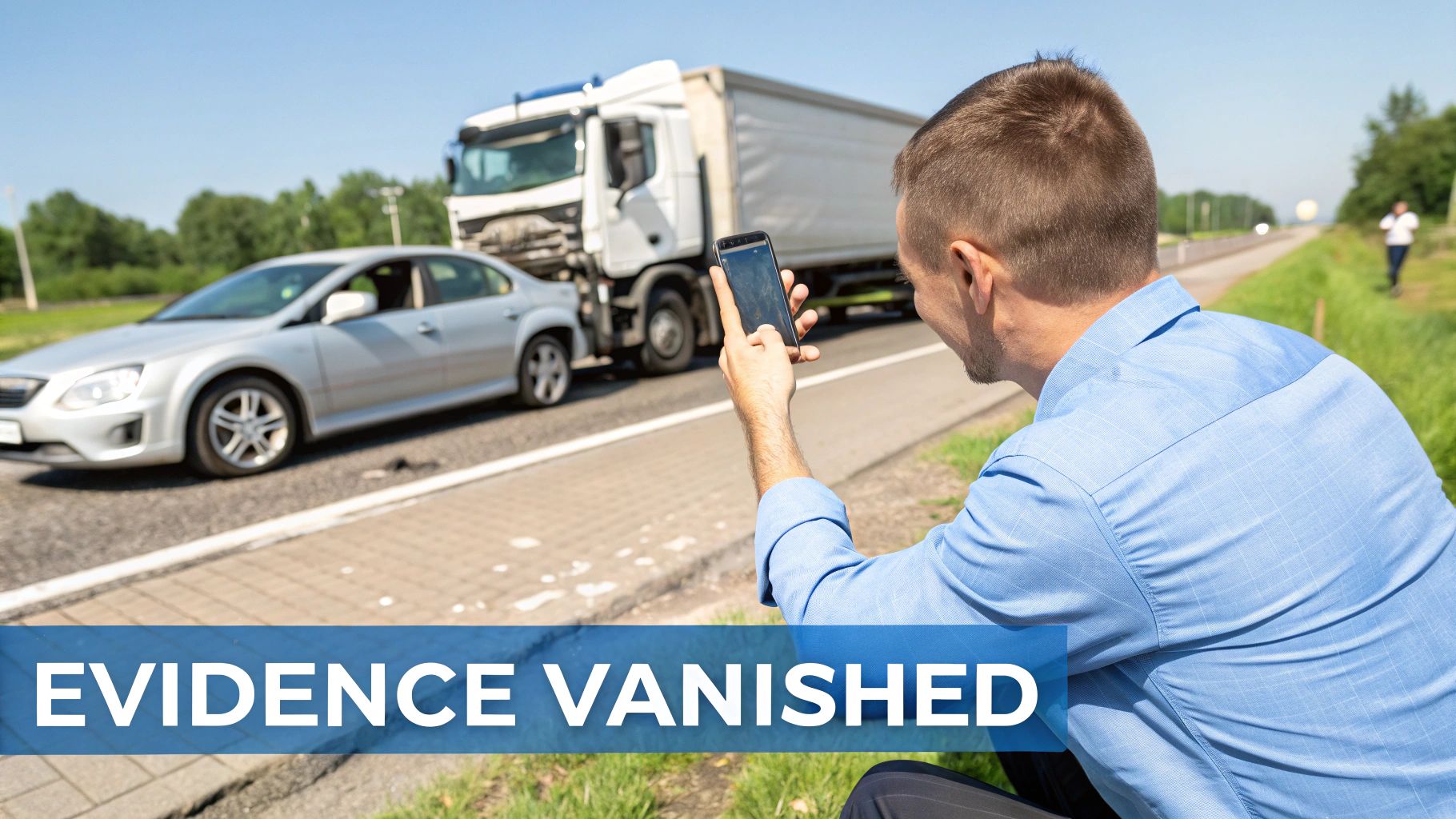
Picture a hypothetical crash. A semi swerves into your lane on I-70. The truck's dashcam footage would show exactly what happened, so a request goes out. Weeks later, the response comes back: "Regrettably, the requested footage was lost during a routine data purge."
Just like that, the proof is gone. That's spoliation.
What Spoliation Actually Is
In plain terms, spoliation is any action — or any deliberate failure to act — that results in relevant evidence being destroyed, altered, or made unavailable for a case.
It is rarely dramatic. More often it's quiet and bureaucratic: a "routine" data purge that wipes out emails discussing a safety hazard, security footage that gets overwritten every 24 hours by default, a driver's logbook that goes missing during an office move. It makes no difference whether someone dragged a file to the trash themselves or let an automated system delete it. If there was a duty to keep it and the evidence is gone, that's spoliation.
The "Duty to Preserve"
As a general matter, the duty to preserve evidence attaches once a party knows — or reasonably should know — that the evidence may be relevant to litigation that is reasonably foreseeable. Colorado courts have recognized that this obligation can begin even before a lawsuit is filed; the Colorado Supreme Court addressed pre-litigation preservation in Keaten (2025). The exact trigger always turns on the specific facts, but the takeaway is simple: a party can't wait until a complaint lands to stop deleting, discarding, or overwriting relevant material.
That duty covers far more than most people expect:
- Physical objects: the wrecked semi, the defective ladder, the broken sidewalk tile that caused your fall.
- Paper records: driver logs, maintenance records, internal incident reports, employee files.
- Electronic data: emails, text messages, surveillance footage, GPS data, and vehicle "black box" recorders.
Today, much of the proof is digital. It lives across servers, hard drives, and the cloud, and it can be deleted or overwritten quickly. Electronically stored information, from emails to surveillance footage, is now at the center of most modern spoliation disputes.
Why Evidence Goes Missing
Sometimes evidence really is lost by accident. Sometimes retention settings or ordinary business routines erase it before anyone thinks to stop them. Sorting out what happened can take time and some digital forensics.
The explanations tend to sound familiar:
| What You May Hear | Why It Matters |
|---|---|
| "The slip-and-fall footage was automatically recorded over after 24 hours." | Many systems overwrite video on a short cycle, which is why an early preservation request matters. |
| "The driver's logbooks were misplaced during an office move." | Logs can show whether a driver was within his legal hours. |
| "The internal emails were deleted in a routine data purge." | Once litigation is reasonably foreseeable, routine deletion may need to be suspended. |
Whatever the reason, losing evidence can carry consequences for the party that had a duty to keep it.
What Happens When Evidence Is Destroyed
When evidence is destroyed in violation of the duty to preserve, judges have a range of remedies, called sanctions, to address the conduct and the unfairness it created. There's no single bright-line rule for when each one applies; a court weighs the surrounding circumstances and the harm to the other side, and the more serious the misconduct, the harsher the remedy available.
The specific remedy usually depends on how bad the conduct was — simple negligence, gross negligence, or intentional bad faith — and on how much the missing evidence actually hurts your ability to prove your case. The most common sanctions include:
Potential Sanctions for Spoliation
| Sanction | What It Means for Your Case | When It's Typically Used |
|---|---|---|
| Monetary fines | The other side may have to pay the legal costs of proving they destroyed evidence. | Often considered where the loss added cost or delay. |
| Evidence preclusion | They're barred from making arguments the destroyed evidence could have refuted — e.g., if they trashed the maintenance logs, they can't claim the truck was well maintained. | Can be used when the loss affects a key issue. |
| Adverse inference | The judge tells the jury it can assume the missing evidence would have been bad for the side that lost it. | Considered when the missing evidence was important; courts weigh the conduct and the prejudice. |
| Default judgment | The court strikes the defendant's case entirely and rules for you — the most extreme penalty. | Rare; reserved for the most serious cases. |
The adverse-inference instruction can matter a great deal, because it lets a jury fill the gap left by the missing evidence.
One caution worth keeping in mind: winning a spoliation sanction is difficult. Courts generally demand a strong showing before they'll punish a party, which is exactly why locking down evidence early beats disputing its disappearance later.
Was It Destroyed by Accident?
Accidental loss is a common explanation. Even careless, non-malicious destruction can support sanctions in some cases, because the court is also looking at the unfairness the loss created. If careless handling takes away the ability to prove what happened, a judge may be able to step in.
How to Protect Your Evidence
You can't leave evidence preservation to chance. Evidence degrades fast: digital data overwrites on a schedule, physical objects get moved or repaired, and witness memories fade within days. The clock starts the moment you're injured.
Here's the essential checklist:
- Send a preservation letter — immediately. This is a formal legal notice, usually sent by your attorney, demanding that the at-fault party and their insurer preserve all relevant evidence. It puts them on record so they can't later claim the loss was innocent.
- Document everything yourself. Become your own investigator. Use your phone — take photos and video of the scene, your injuries, the vehicle damage, anything that might matter. You can't have too much.
- Identify every source of evidence. Think beyond the obvious. Nearby businesses with security cameras? Bystanders who recorded the aftermath? A "black box" data recorder in the truck that hit you? Make a list.
- Act without delay. Every other step depends on speed. Engaging an attorney quickly means preservation letters go out and investigators get dispatched before the evidence can quietly disappear.
Think creatively about where proof hides. In a slip-and-fall at a big-box store, the video of the fall rarely tells the whole story — but the store's inspection logs, employee schedules, maintenance records, and prior incident reports can reveal a pattern of negligence that's far more powerful than a single clip. Those internal records are worth asking for early.
Why Experience Matters Here
Proving evidence was destroyed often means reviewing data-retention policies, taking testimony from IT staff, and working with forensic experts. It takes a lawyer who knows how to:
- Draft a clear, specific preservation letter.
- Use discovery to obtain internal policies and communications.
- Depose corporate representatives and IT staff.
- Work with forensic experts to recover deleted data or prove protocols were violated.
- Write a brief that convinces a skeptical judge sanctions are warranted.
Common Questions
Can I sue someone just for destroying evidence?
Usually, spoliation is handled through sanctions inside the underlying injury case rather than as a separate lawsuit. Whether any independent claim for destroying evidence is even available is narrow and fact-specific, so the practical move is to raise spoliation within the existing case. An attorney can tell you which path fits your situation.
How quickly do I need to act?
As soon as you can. Companies often run automated deletion policies that can permanently erase emails, texts, or security footage in days or even hours. Getting a preservation letter in their hands is the single most important first step to stop that clock.
What kinds of things count as evidence?
Just about anything relevant to proving what happened. Lawyers aren't only hunting for one smoking-gun document — the cumulative weight of many pieces usually builds the strongest case:
- Emails and internal company memos
- Text messages and voicemails
- Photos and video from any source
- GPS and telematics data from commercial trucks
- Vehicle "black box" data recorders
- Maintenance logs and inspection reports
- Driver qualification files and other personnel records
- The physical items themselves — the wrecked truck, the defective product
Once the duty to preserve applies, it can reach all of it.
Talk to a Colorado Injury Lawyer
If you suspect evidence in your injury case is being destroyed, mishandled, or quietly allowed to disappear, the sooner you act, the more proof we can lock down. Learn more about how we handle these cases on our Denver personal injury page, then reach out for a free consultation.
Call Conduit Law at (720) 432-7032 for a free, no-pressure case review.
Disclaimer: This post is for informational purposes only and is not legal advice. Reading it does not create an attorney-client relationship. Every case is different — consult a qualified attorney about your specific situation.

Written by
Elliot Singer, Esq.
Personal injury attorney at Conduit Law, dedicated to helping Colorado accident victims get the compensation they deserve.
Learn more about our team