

Table of Contents
Free case qualifier
In a car or vehicle accident?
Answer a few quick questions about the crash and your injuries — we route your details straight to intake.
Start the qualifierThe call comes at a time you’ll never forget. A state trooper on the other end of the line—something about a crash on I-25. Your world stops spinning. The moments that follow are a blur of shock and a grief so profound it feels physical.
Legal action is the last thing on your mind. You’re just trying to breathe.
But there is something worth understanding early. After a fatal truck crash, the trucking company and its insurer usually begin their own investigation right away. Much of the evidence that explains what happened is held by the company, and some of it is time-sensitive. Trucking cases are governed by federal safety rules as well as Colorado law, and the first priority is preserving the evidence needed to hold the company, not just the driver, accountable.
Commercial trucks carry far more insurance than ordinary cars. Federal rules require most interstate freight carriers to carry at least $750,000 in liability coverage, though even that can fall short in a catastrophic case.
Evidence Is Time-Sensitive
That phone call isn’t just a notification. It’s the start of a short window.
Some of the most important evidence in a truck crash is electronic: electronic logging device (ELD) records, GPS data, and engine diagnostics. Some of it can be overwritten or discarded in the ordinary course of business if no one asks for it to be kept. That is why preservation requests need to go out quickly.
Our first step, as soon as possible after you call, is to send a preservation letter (often called a spoliation letter) to the trucking company and its insurer. It puts them on written notice to keep every relevant record. Colorado courts can impose sanctions, including an adverse inference, when relevant evidence is lost, and the duty to preserve can sometimes arise before a lawsuit is filed when litigation is reasonably foreseeable. A timely letter creates a clear record that the company knew the evidence mattered.
The letter covers dash cam footage, maintenance records, and electronic logging device data, and it signals from day one that the claim is being prepared carefully.
The letter asks the company to preserve what we need to build the case:
- Black Box/EDR Data: It records speed, braking, and steering in the final seconds before impact.
- Electronic Log Device (ELD) Data: It can show whether the driver complied with federal Hours of Service (HOS) rules or was driving fatigued.
- Driver Qualification Files: Past safety violations, drug test results, and training records.
- The Truck Itself: We ask that the vehicle be kept so our own accident reconstruction experts can perform a forensic inspection.
Securing the evidence is step one. Step two is working with independent forensic experts to combine that digital data with the physical evidence from the I-25 crash scene—skid marks, vehicle resting positions, debris fields, and electronic control module recordings. The result is a second-by-second timeline of the crash. Driver logs and electronic logging device data are often central to establishing negligence.
The Claim Often Reaches the Trucking Company, Not Just the Driver
In most truck cases, the claim is not only about the driver.
The driver may have made a mistake. But the company that hired him, trained him (or failed to train him), and put him behind the wheel of an 80,000-pound truck on I-25 often carries responsibility too. The company's commercial insurance, not the driver's personal coverage, is usually the meaningful source of recovery for a family.
There are two main ways to hold the company responsible.
Vicarious Liability (Respondeat Superior) This Latin term means "let the master answer." Under Colorado law, an employer can be held responsible for an employee's negligence committed within the scope of employment. In a trucking case, that usually means the company answers for its driver's negligence on the job, which brings the company's commercial insurance into the claim.
Direct Corporate Negligence focuses on the company's own decisions. A trucking company can be responsible for its own conduct, such as negligent hiring, training, or supervision, inadequate maintenance schedules, unrealistic delivery deadlines that encourage speeding, or pressure on drivers to ignore federal hours-of-service rules.
- Negligent Hiring/Training: Hiring a driver with a history of safety violations/DUIs.
- Improper Maintenance: Skipping or falsifying brake inspections, or running worn tires to save money.
- Pressure to Violate HOS rules: Pushing drivers to stay on the road while dangerously fatigued to meet a deadline.
Responsibility in commercial truck crashes can extend beyond the driver to cargo loaders, maintenance contractors, dispatchers, and manufacturers of defective parts. This matters especially in multi-vehicle crashes on the I-25 corridor. We look for every responsible party so a family is not limited to the driver's personal assets, which are rarely enough to cover a catastrophic loss.
How Federal Trucking Rules Apply
Commercial trucking is one of the most heavily regulated industries in America. The Federal Motor Carrier Safety Administration (FMCSA) regulations set operating standards for carriers and drivers, covering vehicle maintenance, driver qualifications, drug testing, and rest requirements.
These rules govern everything from brake maintenance to how many consecutive hours a driver can legally be on the road. When a carrier or driver breaks them, the violation can be important evidence in an injury or wrongful death claim.
These rules are not just red tape. They set the standard the company was expected to meet.
FMCSA regulations exist to prevent crashes like this one. When a trucking company violates a safety rule, whether hours-of-service limits, maintenance requirements, or safe driving practices, and that violation contributes to a crash, it can be strong evidence of negligence under Colorado law.
The investigation is built around finding these violations, whether the crash happened in the high-speed stretches near Pueblo or the congestion around the Denver Tech Center. Documenting each departure from federal and state requirements helps answer the liability question with evidence rather than argument.
We review the evidence preserved through the preservation letter for falsified maintenance logs, hours-of-service violations, or a driver who should not have been hired. When maintenance records are falsified or driver qualifications ignored, those are not minor oversights, and the records tell that story.
No One Can Put a Price on a Life, but the Law Recognizes the Loss
How do you put a number on a life? You don’t.
But the law provides a way to measure financial responsibility. A Colorado wrongful death claim allows surviving family members to recover for what their loved one's death took from them, including lost support and companionship. Who may bring the claim, and when, is set by Colorado's wrongful death statute (C.R.S. § 13-21-201). Wrongful death claims generally must be filed within two years, with a four-year period in some cases involving vehicular homicide where the driver also left the scene.
This isn’t just about funeral bills. It’s about rebuilding a lifetime of support.
Economic Damages This is often the heart of the claim. Forensic economists calculate the total lifetime financial loss, including lost income and benefits the person would have provided. Catastrophic losses can exceed even a commercial carrier's policy limits, which is why identifying every source of coverage matters.
- Lost future income, with promotions and inflation.
- Lost health insurance, retirement benefits, and pensions.
- The dollar value of lost household services—childcare, home management, etc.
Future losses are easy to understate if they are not carefully documented. We document them.
Non-economic damages compensate for the human cost: grief, loss of companionship, and the future a family expected to share. For wrongful death claims that accrue on or after January 1, 2025, and actions filed during 2025, Colorado caps non-economic damages at $2,125,000 (C.R.S. § 13-21-203). No amount fully measures what was lost, but these damages recognize it.

Punitive (exemplary) damages are available in Colorado only in limited cases involving fraud, malice, or willful and wanton conduct, such as knowingly sending a truck out with faulty brakes. They generally cannot exceed the actual damages awarded, and they cannot be requested at the start of a case; they can be added later after a showing to the court (C.R.S. § 13-21-102).
How a recovery is divided depends on who brings the claim under Colorado's wrongful death statute, and that should be worked out carefully with your attorney. Our guide on wrongful death settlement amounts and distributions explains more.
Your Job Is to Grieve. Our Job Is to Handle the Case.
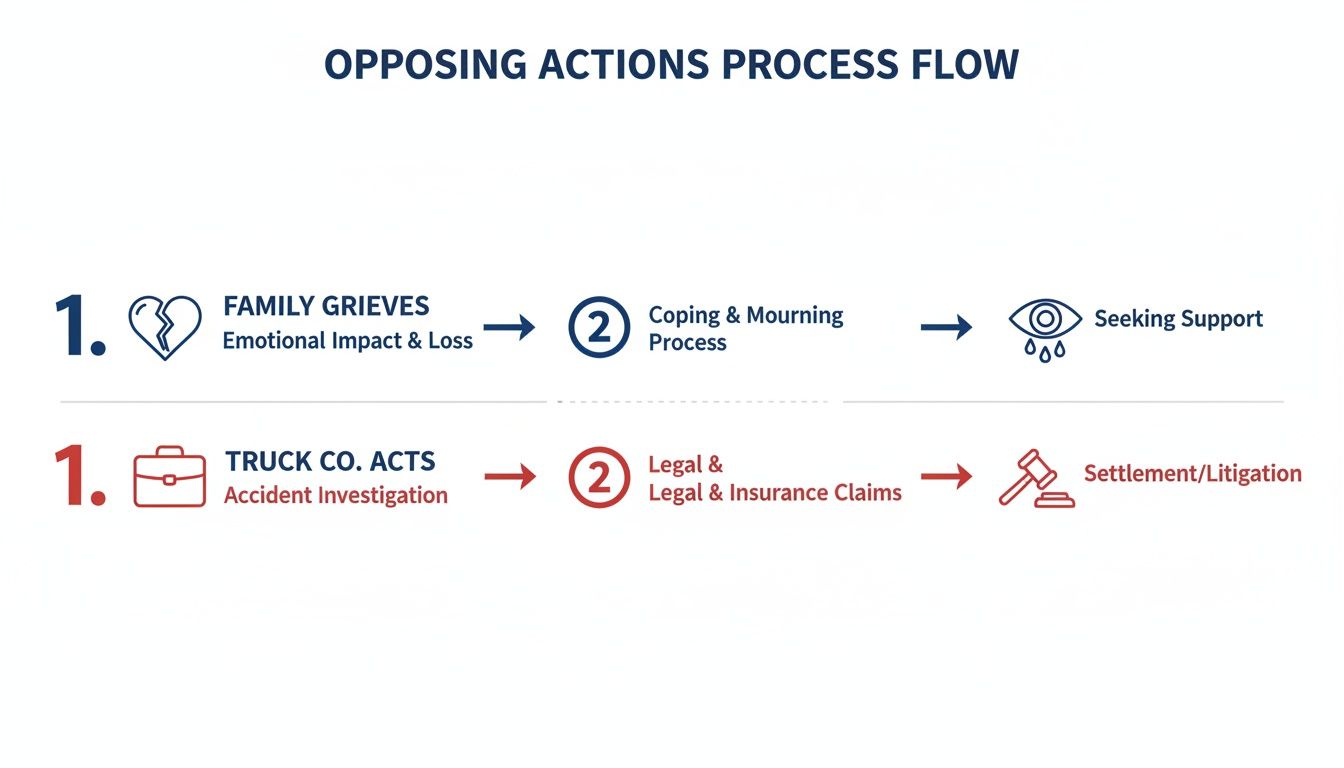
The trucking company's investigation usually starts right after the crash. While you are grieving, you should not have to manage insurance negotiations and liability disputes on your own.
The most important early step is preserving the evidence.
That’s where we come in.
A preservation letter sent early protects logbooks, maintenance records, and hours-of-service documentation, and it creates a record that the company was on notice to keep them.
After a large truck crash, investigators will want statements and insurance adjusters will ask questions. Federal trucking regulations and commercial insurance make these cases complex. Handling the investigation, depositions, and negotiations is our work, so your focus can stay on your family.
Truck crashes bring medical bills, lost income, and grief all at once. Many have preventable causes, such as driver fatigue, mechanical failure, or company decisions. These cases call for knowledge of trucking regulations, accident reconstruction, and insurance law, and that is the work we do.
Make one call. We’ll handle the rest.
The information provided in this article does not, and is not intended to, constitute legal advice; instead, all information, content, and materials available on this site are for general informational purposes only.
At Conduit Law, consultations are free and confidential. You can reach us 24/7 by phone or secure online message. We review the details of the crash, gather evidence, and pursue full compensation from every responsible party. There is never a fee unless we win.

Written by
Elliot Singer, Esq.
Personal injury attorney at Conduit Law, dedicated to helping Colorado accident victims get the compensation they deserve.
Learn more about our team