Table of Contents
When a grieving family asks what a typical wrongful death settlement is, there's no easy, one-size-fits-all answer. While many Colorado cases resolve between $500,000 and over $1 million, communicating the reasoning behind that number is critical for client trust and case management. Under Colorado's Wrongful Death Act (C.R.S. § 13-21-201), families have a two-year statute of limitations to file claims (C.R.S. § 13-80-102), making prompt legal action essential. Additionally, Colorado law imposes a cap of $2,125,000 as of 2025 on non-economic damages in wrongful death cases (C.R.S. § 13-21-203). The challenge isn't simply calculating damages; it's establishing a repeatable, systemized process to ensure every valuation accounts for economic losses, loss of companionship, and future earnings potential. A defensible settlement strategy requires thorough documentation and clear explanation of how each component was determined, ultimately strengthening client relationships and case outcomes.
This guide outlines a framework for standardizing how personal injury firms approach wrongful death settlement amounts, turning a complex, emotional process into a structured, efficient workflow. Under Colorado's Wrongful Death Act (C.R.S. § 13-21-201), settlements must account for specific legal parameters, including a statutory cap of $2,125,000 as of 2025 (C.R.S. § 13-21-203). Additionally, claims are subject to a critical 2-year statute of limitations (C.R.S. § 13-80-102), making timely case management essential. By implementing standardized systems for evaluating damages, calculating loss of earnings, and assessing non-economic factors, firms can navigate these constraints more effectively. Such structured approaches save valuable attorney time, improve client communication during vulnerable periods, and build a stronger foundation for settlement negotiations. Consistency in methodology also reduces errors and demonstrates professionalism when presenting cases to opposing counsel or insurance carriers.
The Challenge: Inconsistent and Time-Consuming Valuations

For many personal injury firms, valuing a wrongful death claim is an inefficient, bespoke process. Attorneys and paralegals spend countless non-billable hours reinventing the wheel for each new case, manually gathering documents, and struggling to build a clear narrative for adjusters and clients. Under Colorado's Wrongful Death Act (C.R.S. § 13-21-201), these claims carry significant stakes—with a statutory cap of $2,125,000 as of 2025 (C.R.S. § 13-21-203)—yet firms lack standardized frameworks for consistent valuation. Adding urgency, the 2-year statute of limitations (C.R.S. § 13-80-102) leaves little room for error or delay. This ad-hoc approach creates substantial operational drag, from duplicative research to inconsistent claim evaluations across cases. The resulting inefficiency introduces compounding risks: missed settlement opportunities, client communication gaps, and diminished leverage during negotiations. Without systematic processes, even experienced firms struggle to maximize case value while meeting strict Colorado timelines.
Without a standardized system, your firm faces several pain points:
- Wasted Attorney Time: Senior attorneys get bogged down in administrative data collection instead of focusing on high-value legal strategy.
- Inconsistent Valuations: Different attorneys might weigh factors differently, leading to inconsistent settlement demands and unpredictable outcomes.
- Poor Client Communication: It's difficult to explain the valuation process to a grieving family when it's not clearly documented, leading to confusion and anxiety.
- Negotiation Weakness: A valuation built on a shaky, disorganized foundation is easier for insurance adjusters to pick apart.
The core problem isn't a lack of legal expertise; it's a lack of operational systems. A final settlement figure isn't arbitrary. It's built piece by piece, and wrongful death firms need a repeatable process to ensure every element is meticulously evaluated and documented. Under Colorado's Wrongful Death Act (C.R.S. § 13-21-201), recoverable damages are subject to a statutory cap of $2,125,000 as of 2025, making precise valuation even more critical. With only a 2-year statute of limitations (C.R.S. § 13-80-102) to work within, there's minimal room for error or delay. Each component—medical expenses, lost wages, pain and suffering, and loss of companionship—must be systematically tracked and substantiated. Without documented procedures for calculating these elements, valuations become inconsistent, time-consuming, and vulnerable to challenge. A structured methodology ensures compliance with Colorado law while maximizing recovery within statutory limits and protecting against costly mistakes.
The Solution: A Framework for Systemizing Damage Calculations
The solution is to move from an artisanal approach to a systemized workflow. By implementing automated checklists, document templates, and clear protocols, legal teams can ensure every wrongful death valuation is comprehensive, consistent, and efficient. Under Colorado's Wrongful Death Act (C.R.S. § 13-21-201), damages must account for lost earnings, companionship, and pain and suffering—calculations that demand precision given the statutory cap of $2,125,000 as of 2025 (C.R.S. § 13-21-203). With only a 2-year statute of limitations (C.R.S. § 13-80-102) to file claims, operational rigor becomes critical. Standardized valuation frameworks eliminate duplicative work, reduce human error, and accelerate case assessment. This operational efficiency frees experienced legal talent from administrative burdens, allowing them to focus on strategic advocacy, nuanced case strategy, and client relationships—the high-value work that distinguishes exceptional representation in wrongful death matters.
Let's be clear: no amount of money can ever replace a human life. But families deserve a clear path forward, and Colorado law provides one. Under the Wrongful Death Act (C.R.S. § 13-21-201), surviving family members have the right to pursue compensation for their loss. A structured calculation system ensures families and their representatives can confidently understand how damages will be calculated and how the responsible party will be held accountable. Colorado recognizes specific recoverable damages in wrongful death cases, though compensation is capped at $2,125,000 as of 2025 under C.R.S. § 13-21-203. These damages account for lost wages, medical expenses, funeral costs, and the loss of companionship. Time is critical—Colorado's statute of limitations allows just two years from the date of death to file a wrongful death claim under C.R.S. § 13-80-102. A systematic approach to damage calculation ensures families understand their rights, their recovery potential, and the accountability mechanisms available to them during this difficult process.
A final settlement figure in wrongful death cases is the sum of several distinct categories of losses, each requiring careful attention under Colorado law. The framework should be built around gathering and calculating three core pillars methodically for every case. Under the Wrongful Death Act (C.R.S. § 13-21-201), damages may include lost wages, medical expenses incurred before death, and the decedent's pain and suffering. Additionally, surviving family members can recover for loss of companionship, guidance, and financial support. However, Colorado imposes a statutory cap on non-economic damages of $2,125,000 as of 2025 (C.R.S. § 13-21-203). Time is critical: claimants face a strict 2-year statute of limitations from the date of death (C.R.S. § 13-80-102). A systematic approach to documenting economic losses, quantifying non-economic harm, and understanding statutory limitations ensures comprehensive damage calculations that withstand scrutiny and maximize recovery for bereaved families.
The Three Pillars of Wrongful Death Damages
The math behind a wrongful death settlement rests on three core pillars: economic damages, non-economic damages, and, in certain situations, punitive damages. Under Colorado's Wrongful Death Act (C.R.S. § 13-21-201), a robust system ensures comprehensive assessment of each category before combining them into the final settlement demand. Economic damages include quantifiable losses such as medical expenses, funeral costs, and lost wages the deceased would have earned. Non-economic damages compensate for intangible suffering, including loss of companionship, emotional pain, and diminished quality of life. Punitive damages may apply when the defendant's conduct was particularly egregious. However, Colorado law imposes a statutory cap of $2,125,000 as of 2025 on non-economic damages in wrongful death cases (C.R.S. § 13-21-203). Additionally, families have a strict 2-year statute of limitations from the date of death to file a wrongful death claim (C.R.S. § 13-80-102). Methodical evaluation of each pillar ensures maximum recovery within these legal parameters.
- Economic Damages: These are the tangible financial losses your client’s family has suffered and will continue to suffer.
- Non-Economic Damages: This is where you account for the profound, intangible human cost of the loss.
- Punitive Damages: These are about punishing the defendant for truly egregious behavior.
Building a system around these three components is the first step to standardizing how your firm and insurance companies arrive at a settlement figure. It ensures every aspect of the client's loss is seen, valued, and accounted for. Under Colorado's Wrongful Death Act (C.R.S. § 13-21-201), this systematic approach becomes even more critical, as damages are capped at $2,125,000 as of 2025 (C.R.S. § 13-21-203). Additionally, families pursuing wrongful death claims must act within a strict 2-year statute of limitations (C.R.S. § 13-80-102), making organized valuation procedures essential. A well-structured framework prevents overlooking compensable losses—such as lost wages, medical expenses, funeral costs, and loss of companionship—while ensuring calculations align with statutory requirements. This methodical approach not only strengthens settlement negotiations but also protects clients by demonstrating that their losses have been thoroughly evaluated and properly documented according to Colorado law.
Action Steps: 3 Systems to Implement for Better Valuations
Implementing structured systems for wrongful death valuations strengthens case outcomes and protects against costly delays. Colorado law establishes clear parameters for these claims under the Wrongful Death Act (C.R.S. § 13-21-201), including a strict 2-year statute of limitations (C.R.S. § 13-80-102) that demands efficient case management. As of 2025, Colorado caps wrongful death damages at $2,125,000 under C.R.S. § 13-21-203, making strategic valuation essential for maximizing recoverable compensation. Three practical systems—a standardized damages worksheet, a comparative case database, and a timeline tracking protocol—streamline the valuation process significantly. A damages worksheet ensures consistent documentation of economic losses, medical expenses, and non-economic factors across all cases. A comparative case database allows attorneys to reference similar Colorado wrongful death settlements and verdicts, establishing realistic benchmarks. A timeline tracking system maintains compliance with statutory deadlines while preventing settlement opportunities from slipping through administrative gaps. Together, these systems reduce valuation time, minimize errors, and deliver stronger client outcomes within Colorado's regulatory framework.
1. Create a "Damages Discovery" Checklist and Intake Workflow
The first step is to standardize data collection across wrongful death cases. Instead of relying on attorney memory or inconsistent note-taking, firms should build a dynamic checklist in their case management software that automatically triggers tasks for the entire team. This systematic approach is critical given Colorado's 2-year statute of limitations under C.R.S. § 13-80-102, which creates a compressed timeline for investigation and claim development. A comprehensive intake workflow should capture essential case data from day one, including family composition, dependency calculations, and medical records. The checklist must account for Colorado's wrongful death framework under C.R.S. § 13-21-201, ensuring compliance with applicable requirements. Additionally, practitioners should note the current wrongful death cap of $2,125,000 as of 2025 under C.R.S. § 13-21-203 when evaluating case value. Automating these collection processes reduces human error, ensures consistency across cases, and helps teams meet critical deadlines while gathering the detailed information necessary to maximize recovery within statutory limits.
This workflow should prompt staff to request and organize key documents from the moment a case is signed:
- Financial Records: Tax returns, pay stubs, W-2s, and benefits statements (health insurance, 401(k)).
- Expert Engagement: A pre-vetted list of forensic accountants and economists, with templated engagement letters ready to go.
- Expense Tracking: A centralized system for logging all medical bills, funeral costs, and other out-of-pocket expenses.
Automating this initial discovery phase ensures no financial detail is missed and frees up your attorneys from administrative follow-up.
2. Develop a "Human Cost" Evidence-Gathering Protocol
Non-economic damages address the profound losses that don't come with a receipt—the emotional devastation, loss of companionship, and shattered family bonds. This part of a settlement is inherently subjective and heavily disputed by insurance companies and defense attorneys. In wrongful death cases governed by Colorado's Wrongful Death Act (C.R.S. § 13-21-201), these intangible losses become critically important because the deceased cannot recover economic damages themselves. Colorado law caps wrongful death settlements at $2,125,000 as of 2025 under C.R.S. § 13-21-203, making the documentation of non-economic damages essential to maximizing recovery. Developing a systematic "human cost" evidence-gathering protocol—including testimony from family members, medical records, photographs, and expert psychological evaluations—builds a powerful, undeniable case. Families pursuing wrongful death claims should note the 2-year statute of limitations under C.R.S. § 13-80-102, making prompt action essential to preserve evidence and witness recollections.
Create a protocol that includes:
- Client Story Questionnaires: Send automated forms to family members with structured questions designed to elicit powerful stories and anecdotes about their loved one.
- Media Collection System: Use a shared, secure portal for clients to easily upload family photos, home videos, and other media.
- Witness Outreach Templates: Prepare templated emails and call scripts for paralegals to use when contacting friends and relatives for impact statements.
This systematic approach ensures consistent documentation that builds a vivid, human picture of the decedent's role in the family, showing the insurance company exactly who was lost, not just what they earned. Under Colorado's Wrongful Death Act (C.R.S. § 13-21-201), recoverable damages extend beyond lost wages to encompass the full human and emotional cost of losing a loved one. Evidence gathered through this protocol demonstrates the decedent's unique contributions—as a parent, spouse, sibling, or caregiver—establishing the genuine impact on surviving family members' daily lives. This documentation proves particularly valuable given Colorado's statutory cap of $2,125,000 on wrongful death damages as of 2025 (C.R.S. § 13-21-203), making every piece of compelling evidence essential to maximizing recovery. Since the 2-year statute of limitations applies (C.R.S. § 13-80-102), prompt and thorough evidence collection becomes critical in establishing the full scope of the family's losses before the deadline expires.
3. Build a "Punitive Damages" Evaluation Rubric
Punitive damages are reserved for cases involving outrageous or malicious behavior and serve a dual purpose: punishing the defendant and deterring similar reckless or intentional conduct in the future. Unlike compensatory damages, which reimburse actual losses, punitive damages go beyond making the family whole. However, they aren't awarded in every wrongful death case, making it essential to develop a systematic evaluation process to identify when they become a viable option. Under Colorado's Wrongful Death Act (C.R.S. § 13-21-201), families have the right to pursue damages when a person's death results from another's negligence or misconduct. Importantly, Colorado law caps wrongful death damages at $2,125,000 as of 2025 (C.R.S. § 13-21-203), a threshold that underscores the importance of properly evaluating all available damage categories. Additionally, plaintiffs must act within the two-year statute of limitations (C.R.S. § 13-80-102) to preserve their legal rights. A structured rubric helps determine whether the defendant's conduct meets the high threshold for punitive damages eligibility.
Develop a simple internal rubric or scorecard to evaluate defendant conduct against key criteria:
- Was there evidence of intoxication (DUI)?
- Did the defendant have a history of similar negligence (e.g., multiple safety violations)?
- Did a corporation knowingly hide a product defect?
- Was the conduct a violation of established safety regulations (e.g., trucking hours-of-service rules)?
This rubric allows your team to quickly assess whether a case has the potential for punitive damages, ensuring you don't leave significant value on the table during negotiations. It provides a structured framework for a high-level strategic decision. Under Colorado's Wrongful Death Act (C.R.S. § 13-21-201), certain cases may qualify for enhanced damages when a defendant's conduct is particularly egregious. However, it's critical to note that Colorado imposes a wrongful death damages cap of $2,125,000 as of 2025 (C.R.S. § 13-21-203), which affects overall recovery limits. Additionally, claimants have a strict 2-year statute of limitations to file (C.R.S. § 13-80-102), making early case evaluation essential. By systematically evaluating factors such as defendant conduct severity, intentionality, and breach of duty, this rubric helps identify which wrongful death cases warrant aggressive pursuit of punitive damages and which require alternative settlement strategies.
Understanding the Three Types of Damages in a Claim
To really get a handle on wrongful death settlement amounts, the calculation must be broken down into core components. The final number isn't arbitrary; it's a carefully constructed sum of three distinct types of damages, each serving a specific purpose in acknowledging what the family has lost. Colorado law, specifically the Wrongful Death Act (C.R.S. § 13-21-201), establishes the framework for these recoverable damages. It's important to understand that Colorado imposes a statutory cap on wrongful death settlements of $2,125,000 as of 2025 (C.R.S. § 13-21-203). Additionally, families pursuing wrongful death claims must act within a strict 2-year statute of limitations from the date of death (C.R.S. § 13-80-102). Understanding how each damage category—economic losses, non-economic losses, and sometimes punitive damages—contributes to the total settlement is essential for realistic expectations and effective case evaluation.
These three categories—economic, non-economic, and punitive damages—are the building blocks of any wrongful death claim under Colorado's Wrongful Death Act (C.R.S. § 13-21-201). Economic damages compensate for tangible losses like medical expenses, funeral costs, and lost income. Non-economic damages address intangible harms such as pain and suffering, loss of companionship, and emotional distress. Punitive damages, awarded in cases of gross negligence or intentional misconduct, serve to punish defendants and deter future wrongful conduct. Each category is calculated and argued separately before combining them into a comprehensive settlement demand. However, Colorado law imposes a statutory cap of $2,125,000 on non-economic and punitive damages combined as of 2025 (C.R.S. § 13-21-203). Additionally, families have a 2-year statute of limitations to file a wrongful death claim (C.R.S. § 13-80-102), making timely action essential.
This infographic gives a quick visual breakdown of how these pieces fit together.
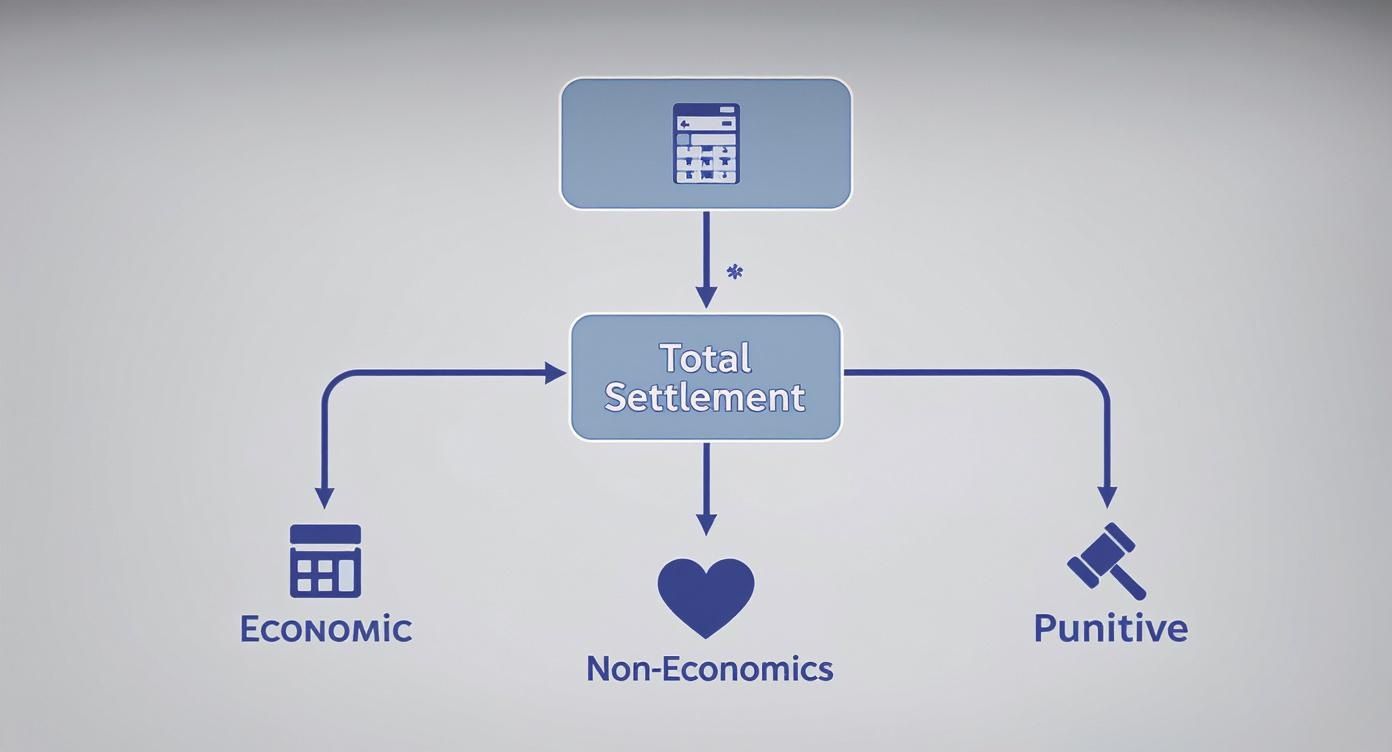
A settlement in a wrongful death claim is fundamentally a mix of three distinct components. Economic damages address the tangible financial losses—medical expenses, funeral costs, and lost income the deceased would have earned. Non-economic damages recognize the profound human cost: the loss of companionship, guidance, and emotional support that family members will never recover. In the most severe cases, punitive damages serve as a penalty for unforgivable or reckless behavior that caused the death. Under Colorado's Wrongful Death Act (C.R.S. § 13-21-201), the total recovery is capped at $2,125,000 as of 2025 (C.R.S. § 13-21-203). It's crucial to understand that pursuing a wrongful death claim operates under a strict 2-year statute of limitations (C.R.S. § 13-80-102), meaning families must act promptly to preserve their legal rights and secure fair compensation for their irreplaceable loss.
Economic Damages: The Tangible Financial Loss
Economic damages are the most straightforward part of a wrongful death claim. They represent the measurable, on-paper financial losses a family has already faced and will continue to face because their loved one is gone. Think of this as the balance sheet of the claim, where every single dollar of lost financial support is accounted for. Under Colorado's Wrongful Death Act (C.R.S. § 13-21-201), surviving family members can recover these tangible losses. Economic damages typically include lost wages, lost benefits, lost inheritance potential, and ongoing household expenses the deceased would have provided. Medical and funeral expenses also fall into this category. However, Colorado law caps non-economic damages at $2,125,000 as of 2025 (C.R.S. § 13-21-203). It's critical to act quickly—Colorado's statute of limitations allows just two years from the date of death to file a wrongful death claim (C.R.S. § 13-80-102), making prompt legal consultation essential for protecting a family's financial recovery.
But calculating this goes way beyond just replacing a lost paycheck. It involves a detailed, forward-looking projection of every financial contribution the deceased would have made to the family for the rest of their life. Under Colorado's Wrongful Death Act (C.R.S. § 13-21-201), courts must account for the victim's earning capacity, work history, age, and life expectancy to determine total economic damages. This calculation includes lost wages, benefits, and contributions to household expenses the deceased would have provided. However, Colorado law caps wrongful death damages at $2,125,000 as of 2025 (C.R.S. § 13-21-203). Families pursuing these claims must act quickly—Colorado's statute of limitations allows only two years from the date of death to file (C.R.S. § 13-80-102). Expert economists and vocational specialists often testify to establish accurate projections, ensuring that awards genuinely reflect the financial loss families will endure.
Hypothetical Scenario: Calculating Economic Loss
Let's imagine a 40-year-old marketing professional who was the primary breadwinner for their family, leaving behind a spouse and two young kids. To figure out the economic damages, an attorney would bring in a forensic economist to map out their financial future. This expert analyzes lost wages, benefits, and earning potential over the person's remaining work life. Under Colorado's Wrongful Death Act (C.R.S. § 13-21-201), surviving family members can recover these economic losses. However, Colorado law caps wrongful death damages at $2,125,000 as of 2025 (C.R.S. § 13-21-203). It's crucial to act quickly—Colorado imposes a strict 2-year statute of limitations for wrongful death claims (C.R.S. § 13-80-102). The forensic economist's detailed calculations become critical evidence, demonstrating how the family's financial security was permanently altered by the loss of the breadwinner's income and future contributions.
- The expert would look at their current salary, recent pay bumps, and industry salary trends to project their lifetime earning potential, factoring in likely promotions and bonuses down the road.
- They would then add the value of benefits like employer-provided health insurance and 401(k) matching contributions over the next 25+ years.
- Finally, they would add up all the immediate, out-of-pocket costs, like the final medical bills and funeral expenses.
The end result is a detailed, data-driven number that shows the true size of the financial hole left in the family's life. Under Colorado's Wrongful Death Act (C.R.S. § 13-21-201), this calculation encompasses all economic losses the deceased would have contributed to the family—lost wages, benefits, medical expenses, and support services. These figures are meticulously documented and projected across the victim's remaining life expectancy. However, it's important to note that Colorado imposes a statutory cap on wrongful death damages of $2,125,000 as of 2025 (C.R.S. § 13-21-203). Additionally, families must act within a strict two-year statute of limitations (C.R.S. § 13-80-102) to file a wrongful death claim. This comprehensive financial assessment provides clarity on the actual economic impact and helps guide families through the complex process of seeking appropriate compensation for their irreplaceable loss.
Non-Economic Damages: The Human Cost of Absence
While economic damages cover the ledger, non-economic damages tackle the profound, immeasurable human cost. This is the legal system's attempt to put a value on the love, companionship, guidance, and emotional support that was stolen from your family. Under Colorado's Wrongful Death Act (C.R.S. § 13-21-201), surviving family members can pursue compensation for this irreplaceable loss. These damages address the pain and suffering experienced by those left behind—the missed milestones, lost advice, and emotional void created by the death. Colorado law recognizes that some injuries cannot be quantified on a balance sheet. However, it's important to note that wrongful death claims in Colorado are subject to a statutory cap of $2,125,000 as of 2025 (C.R.S. § 13-21-203). Additionally, families have only two years from the date of death to file a wrongful death claim (C.R.S. § 13-80-102), making prompt legal action essential to preserve these rights.
Because these losses are intangible, this is often the most heavily debated part of a settlement negotiation. Building a powerful case here requires more than just numbers—it demands that we tell a compelling human story. Non-economic damages in wrongful death cases encompass the profound grief, emotional suffering, and loss of companionship experienced by surviving family members. Under Colorado's Wrongful Death Act (C.R.S. § 13-21-201), these damages recognize the immeasurable value of the relationship that was severed. However, Colorado law imposes a statutory cap on wrongful death awards of $2,125,000 as of 2025 (C.R.S. § 13-21-203), making the narrative surrounding loss especially critical. Courts must understand not just the financial impact, but the emotional void left behind. Additionally, families have a limited window to pursue these claims, with a two-year statute of limitations (C.R.S. § 13-80-102) from the date of death. Effectively communicating the depth of suffering and life's diminished quality becomes essential to maximizing recovery within these legal constraints.
This is where we show who your loved one was, not just what they earned. We paint a vivid picture of their role in the family—as a spouse, a parent, a mentor—to demonstrate the depth of the void they've left behind. Under Colorado's Wrongful Death Act (C.R.S. § 13-21-201), families can recover non-economic damages that reflect this profound loss of companionship, guidance, and emotional support. These damages acknowledge the intangible suffering that no paycheck can measure. Colorado law recognizes that the absence of a parent's guidance, a spouse's partnership, or a mentor's wisdom creates a lasting impact on survivors' lives. While Colorado caps wrongful death damages at $2,125,000 as of 2025 (C.R.S. § 13-21-203), non-economic damages remain a critical component of justice. Importantly, families have a 2-year statute of limitations (C.R.S. § 13-80-102) to pursue these claims, making timely action essential for preserving their right to compensation.
An attorney builds this part of the case by gathering powerful, personal evidence, such as:
- Family photos and home videos that capture moments of joy, celebration, and simple, everyday life.
- Testimony from friends and relatives who can speak to the unique bond the deceased shared with their family members.
- Personal stories and anecdotes that illustrate the loss of guidance—like a parent who will now miss their child's graduation or wedding.
This evidence helps an insurance adjuster or jury understand that the greatest loss in a wrongful death case isn't financial—it's the permanent absence of a person who can never be replaced. Under Colorado's Wrongful Death Act (C.R.S. § 13-21-201), families can pursue compensation for non-economic damages that reflect this irreplaceable human loss. These damages recognize the emotional devastation, lost companionship, and profound grief that money cannot truly remedy. While Colorado law caps wrongful death awards at $2,125,000 as of 2025 (C.R.S. § 13-21-203), this ceiling underscores society's acknowledgment that no sum can restore what was lost. Families pursuing wrongful death claims must act promptly, as Colorado's statute of limitations requires claims be filed within two years (C.R.S. § 13-80-102). Compelling evidence of the deceased's unique role in family life—their character, relationships, and contributions—helps courts and juries comprehend the unmeasurable void left behind.
Punitive Damages: Punishing Extreme Negligence
The final category, punitive damages, operates under a fundamentally different principle than compensatory awards. Rather than reimbursing surviving family members for financial losses, punitive damages serve an exclusively punitive function: to penalize the defendant for outrageous, reckless, or malicious conduct and to deter similar behavior throughout society. Under Colorado's Wrongful Death Act (C.R.S. § 13-21-201), punitive damages may be pursued when a defendant's actions demonstrate extreme negligence or intentional misconduct that caused a person's death. It's important to note that Colorado law imposes a statutory cap on wrongful death damages of $2,125,000 as of 2025 (C.R.S. § 13-21-203), which applies to both compensatory and punitive awards combined. Additionally, families pursuing wrongful death claims must act within a strict two-year statute of limitations from the date of death (C.R.S. § 13-80-102). These punitive awards remain relatively rare but represent a critical mechanism for holding grossly negligent parties accountable.
These damages are reserved for the worst-of-the-worst cases where the defendant's actions showed a shocking and conscious disregard for human safety. In wrongful death cases governed by Colorado's Wrongful Death Act (C.R.S. § 13-21-201), punitive damages serve as a critical mechanism for justice when a defendant's conduct was particularly egregious. They aren't awarded in every case, but they are a powerful tool for holding defendants accountable when the situation calls for it. Under Colorado law, wrongful death damages—including any punitive component—are capped at $2,125,000 as of 2025 (C.R.S. § 13-21-203). It's important to note that families pursuing these claims must act within the 2-year statute of limitations set forth in C.R.S. § 13-80-102. When a defendant's reckless or intentional conduct leads to someone's death, punitive damages can provide meaningful accountability beyond compensatory relief.
To even be on the table, the defendant's conduct must go far beyond simple carelessness. We're talking about situations like:
- A drunk driver with a history of DUIs who causes a fatal crash.
- A company that knew its product had a deadly defect but sold it anyway to protect its bottom line.
- A trucking company that forced its drivers to violate federal safety rules, leading to a deadly wreck.
In these scenarios, punitive damages send a loud and clear message: this kind of behavior is absolutely unacceptable and will come with severe financial consequences. Under Colorado's Wrongful Death Act (C.R.S. § 13-21-201), courts may award punitive damages when a defendant's conduct demonstrates such reckless disregard for human life that it warrants punishment beyond compensatory relief. These damages serve a dual purpose—holding wrongdoers accountable while deterring similar misconduct throughout the community. It's important to note that Colorado law caps wrongful death damages at $2,125,000 as of 2025 (C.R.S. § 13-21-203), a limit that applies to the total recovery in these cases. Families pursuing wrongful death claims should be aware of the 2-year statute of limitations (C.R.S. § 13-80-102), which sets a strict deadline for filing. When extreme negligence or intentional acts cause a fatality, punitive damages reflect society's strong disapproval and ensure meaningful consequences for the most egregious conduct.
To help clarify how these three distinct categories work, here's a simple breakdown:
Comparison of Damages in Wrongful Death Cases
| Type of Damage | Purpose | Examples |
|---|---|---|
| Economic | To compensate for measurable financial losses. | Lost wages, loss of future inheritance, medical bills, funeral costs, loss of benefits (health insurance, 401k). |
| Non-Economic | To compensate for intangible, human losses. | Loss of companionship, sorrow and grief, loss of parental guidance, loss of consortium (spousal relationship). |
| Punitive | To punish the defendant for extreme negligence and deter future misconduct. | A drunk driver with multiple prior DUIs, a manufacturer hiding a known product defect, an employer forcing unsafe work practices. |
Each type of damage plays a critical role in wrongful death claims under Colorado's Wrongful Death Act (C.R.S. § 13-21-201). Economic damages address tangible financial losses, while non-economic damages recognize the emotional and relational harm suffered by surviving family members. Punitive damages, when applicable, serve to deter particularly reckless or malicious conduct. By pursuing all three categories where appropriate, families can secure settlements that comprehensively address their needs. However, it's important to understand that Colorado law caps non-economic and punitive damages at $2,125,000 as of 2025 (C.R.S. § 13-21-203). Additionally, the statute of limitations for wrongful death claims is two years from the date of death (C.R.S. § 13-80-102), making timely action essential. A thorough damages strategy ensures compensation not only covers immediate financial obligations but also honors the profound and lasting impact of losing a loved one.
Real-World Example: Conduit Legal’s Experience

At our personal injury firm, we managed a high volume of catastrophic injury cases, including wrongful death claims governed by Colorado's Wrongful Death Act (C.R.S. § 13-21-201). Early on, we struggled with the same inconsistencies many firms face. Our valuation process was driven by individual attorney experience, which created bottlenecks and made it difficult to train new associates on complex damage calculations. This approach proved problematic given the stakes involved—wrongful death cases in Colorado are subject to a statutory cap of $2,125,000 as of 2025 under C.R.S. § 13-21-203, and families must file within a strict 2-year statute of limitations per C.R.S. § 13-80-102. Without standardized valuation protocols, we risked both inefficiency and missed opportunities to maximize recoveries for grieving families within these critical constraints.
We implemented a system centered in our case management software to streamline wrongful death claim evaluation. The firm built an automated Wrongful Death Valuation workflow that triggered for every new case, ensuring consistent and timely assessment from intake forward. This automation proves critical given Colorado's strict parameters governing these cases: wrongful death claims fall under C.R.S. § 13-21-201, with a statutory damages cap of $2,125,000 as of 2025 under C.R.S. § 13-21-203. Additionally, claimants face a 2-year statute of limitations per C.R.S. § 13-80-102, making rapid case evaluation essential. The automated workflow immediately calculated case valuation ranges based on these statutory limits and other key factors, flagging cases requiring expedited handling. This systematic approach eliminated manual calculation errors and ensured no case fell through administrative cracks during the critical early stages.
- The Result: Our support staff could immediately begin compiling the economic damages file without constant attorney oversight. The "Human Cost" questionnaire was sent to the family within 48 hours of signing, giving them a structured way to share their story while the memories were fresh. Our attorneys only needed to step in for strategic review and expert engagement.
- The Impact: We reduced the time spent on initial valuation by over 50%, allowing our lawyers to focus on legal strategy and negotiation. Client communication improved because we could show them our process, and our settlement demands became more consistent and defensible. This system was a key factor in our ability to scale the firm's litigation department effectively.
The principle of proving negligence remains equally critical in wrongful death cases, where families seek justice and compensation for the loss of a loved one. Under Colorado's Wrongful Death Act (C.R.S. § 13-21-201), surviving family members can pursue claims when negligence or wrongful conduct causes a person's death. It's important to understand that Colorado imposes a statutory cap on wrongful death damages of $2,125,000 as of 2025, per C.R.S. § 13-21-203. Additionally, families must act within the 2-year statute of limitations established under C.R.S. § 13-80-102 to file a claim. This same negligence framework applies across various injury contexts, from slip and fall incidents to catastrophic injuries. Colorado's state-specific legal framework requires careful navigation of these timelines and damage limitations, making professional guidance essential for families pursuing wrongful death claims.
Settlement vs. Trial: Which Path is Right for You?
After filing a wrongful death claim under Colorado's Wrongful Death Act (C.R.S. § 13-21-201), families face a critical decision point. One path leads to a negotiated settlement with the defendant or their insurance company; the other proceeds to a courtroom trial. This isn't about choosing the "better" path—it's about making a strategic decision aligned with the case's unique circumstances and the family's priorities. Colorado law caps wrongful death damages at $2,125,000 as of 2025 (C.R.S. § 13-21-203), establishing an important ceiling for potential recovery. Additionally, the two-year statute of limitations (C.R.S. § 13-80-102) creates time pressure that influences settlement negotiations. Each option carries distinct advantages: settlements offer certainty and faster resolution, while trials provide the opportunity for potentially larger verdicts. Understanding the strengths and weaknesses of the specific claim is essential before selecting a direction.
Each option has its own set of very real pros and cons, and understanding them is crucial given Colorado's wrongful death framework under C.R.S. § 13-21-201. A settlement brings speed, privacy, and a guaranteed outcome—valuable certainties when families are grieving. A trial, on the other hand, offers the potential for a much larger award but comes with significant risk and uncertainty. It's important to note that Colorado's wrongful death damages are capped at $2,125,000 as of 2025 under C.R.S. § 13-21-203, which affects the ceiling for both settlements and verdicts. Additionally, families have a 2-year statute of limitations to file under C.R.S. § 13-80-102, making timing another critical factor. Grasping this trade-off between the security of settlement and the possibilities of trial is the first step toward having a clear-headed, productive conversation with an attorney about the right strategy for the family's circumstances and needs.
Why Most Cases End in a Negotiated Settlement
The reality is that the overwhelming majority of wrongful death claims—well over 95%—are resolved through a settlement rather than trial. They never see the inside of a courtroom, and there are very good reasons for that. A settlement is essentially a private contract between the deceased's family and the at-fault party (or, more often, their insurance company) that brings the legal fight to a definitive end. Under Colorado's Wrongful Death Act (C.R.S. § 13-21-201), families have specific legal rights to pursue compensation for their loss. However, settlements offer predictability and closure without the uncertainty of litigation. It's important to note that Colorado law imposes a noneconomic damages cap of $2,125,000 as of 2025 (C.R.S. § 13-21-203), which can influence settlement negotiations. Additionally, families must act within the 2-year statute of limitations (C.R.S. § 13-80-102) to preserve their claims. These factors often motivate both sides to reach an agreement rather than proceed to trial.
This approach offers some powerful advantages:
- Speed and Efficiency: A full-blown trial can drag on for years, mired in procedural delays and packed court calendars. A settlement can often be finalized in months, getting your family the financial support you need much, much sooner.
- Privacy and Control: Court proceedings are public. Every document filed, every word spoken, is part of the public record. A settlement keeps your family’s private pain private, sparing you the trauma of testifying and reliving your loss in front of strangers.
- A Guaranteed Outcome: A trial is always a gamble. No matter how strong your case looks on paper, you can never predict what a jury will decide. A settlement takes that gamble off the table. It provides a concrete, agreed-upon amount of compensation you can count on.
With a settlement, your family remains in the driver's seat throughout the resolution process. You and your attorney control the negotiations and retain the final say on accepting any offer, ensuring the outcome prioritizes your family's best interests. Under Colorado's Wrongful Death Act (C.R.S. § 13-21-201), families have the right to pursue compensation for losses resulting from a loved one's death caused by another's negligence or wrongdoing. Colorado law caps wrongful death damages at $2,125,000 as of 2025 (C.R.S. § 13-21-203), making settlement negotiations particularly important to maximize recovery within these limits. Additionally, families must act within a strict two-year statute of limitations (C.R.S. § 13-80-102) to file a wrongful death claim. By negotiating a settlement rather than proceeding to trial, families gain certainty, control, and the ability to avoid prolonged litigation while securing fair compensation for their loss.
That sense of control is priceless during such a profoundly difficult time. It gives families the power to close this painful chapter and begin healing without the added stress and unpredictability of a trial. Under Colorado's Wrongful Death Act (C.R.S. § 13-21-201), the law recognizes the profound losses families endure and establishes a framework for recovery. While Colorado does impose a statutory cap of $2,125,000 on wrongful death damages as of 2025, a well-constructed settlement can still provide substantial compensation that reflects the true value of what has been lost. The goal is always to build such a strong case that the other side has no choice but to make a fair offer. With only a two-year statute of limitations (C.R.S. § 13-80-102) to pursue a claim, securing a favorable settlement efficiently becomes critical. This approach allows grieving families to honor their loved one's memory while regaining certainty and closure during their most vulnerable moments.
When Taking a Case to Trial Makes Sense
While a settlement is usually the goal, it's not always possible or right. Sometimes, going to trial is the only logical next step. This happens when an insurance company or defendant simply refuses to be reasonable and offer a settlement that even comes close to covering the family's immense losses. Under Colorado's Wrongful Death Act (C.R.S. § 13-21-201), families have the right to pursue compensation for their loss. However, it's important to understand that Colorado law caps non-economic damages in wrongful death cases at $2,125,000 as of 2025 (C.R.S. § 13-21-203). Additionally, families must act within a strict 2-year statute of limitations to file a claim (C.R.S. § 13-80-102). When defendants refuse fair settlement offers that adequately address medical expenses, lost income, and the profound emotional impact of losing a loved one, trial becomes necessary. A jury may be more willing to award the full compensation the family deserves than an unreasonable defendant or insurer.
A skilled wrongful death attorney prepares every single case as if it's heading to trial from day one. This isn't just standard practice; it sends a powerful message to the other side that the firm is serious and fully prepared to let a jury decide the outcome. This trial-ready approach is especially critical in wrongful death claims under Colorado's Wrongful Death Act (C.R.S. § 13-21-201), where families are fighting for justice and fair compensation. Under C.R.S. § 13-80-102, families have only two years from the date of death to file a wrongful death lawsuit—a strict deadline that demands immediate action and thorough case preparation. Additionally, Colorado law caps wrongful death damages at $2,125,000 as of 2025, making strategic litigation decisions even more important. When an attorney demonstrates unwavering commitment to trial from the initial case evaluation, insurance companies and opposing counsel recognize that settlement negotiations must be serious, fair, and reflective of the case's true value.
Going to trial might be the best move if:
- The Insurance Company Won’t Budge: It’s common for insurers to make a lowball offer and refuse to negotiate in good faith, ignoring the clear evidence of fault and the true scale of your family's damages.
- The Other Party Denies Responsibility: If the defendant refuses to admit they caused your loved one’s death, a trial may be the only way to hold them accountable in the eyes of the law.
- The Potential Verdict Is Substantially Higher: In cases of extreme negligence or malicious conduct, a jury has the power to award a much larger verdict—including punitive damages meant to punish the defendant—than could ever be reached in a settlement.
Choosing to go to trial is a calculated decision. It means weighing the potential for a greater financial recovery against the heavy emotional and financial toll of a long, public court battle. Your attorney's job is to give you a clear, honest assessment of the risks and rewards, giving you the information you need to make the final call with confidence. No matter which path is chosen, the objective never changes: securing the maximum compensation the law allows for your family's profound loss.
Systemizing how a firm calculates wrongful death settlement amounts doesn't just improve efficiency; it builds client trust and strengthens the negotiating position. By implementing repeatable workflows for discovery and evidence gathering under Colorado's Wrongful Death Act (C.R.S. § 13-21-201), attorneys can save hours of precious time, deliver more consistent outcomes, and scale their litigation practice sustainably. Understanding Colorado's statutory framework is essential. The state imposes a wrongful death damages cap of $2,125,000 as of 2025 under C.R.S. § 13-21-203, which directly impacts settlement strategy and case valuation. Additionally, families have only a 2-year statute of limitations from the date of death to file under C.R.S. § 13-80-102, making prompt case intake and organization critical. Standardized processes for calculating economic damages, projected lifetime earnings, and non-economic loss create predictable frameworks. This consistency allows firms to manage caseloads more effectively while ensuring clients understand how their case value was determined, ultimately strengthening settlement negotiations and trial readiness.
Start your free 20-minute automation audit and discover how to save hours every week without adding staff.
Written by
Conduit Law
Personal injury attorney at Conduit Law, dedicated to helping Colorado accident victims get the compensation they deserve.
Learn more about our team