

Table of Contents
Are Landlords Responsible for Snow Removal in Colorado?
Often, yes. In Colorado, a landlord or property manager is generally responsible for snow and ice in common areas it controls—shared walkways, stairways, building entrances, parking lots, and exterior paths. The case is usually clearest when (1) the lease assigns snow removal to the landlord, or (2) the landlord's own action or neglect created the ice hazard, like a dripping downspout or a melting-and-refreezing snow pile. Tenants are usually responsible only for areas under their exclusive control, such as a private balcony, patio, or fenced yard. These claims are governed by Colorado's Premises Liability Act (C.R.S. § 13-21-115), and a landlord can qualify as a "landowner" under that statute. A lease that assigns some upkeep to a tenant does not automatically erase a landlord's duties to injured third parties.
Landlord vs. Tenant: Who Clears What
- Landlord typically handles: common walkways, stairs, building entrances, parking lots, shared exterior paths, and any spot where the landlord's own action (or inaction) created the ice.
- Tenant typically handles: private balconies and patios, single-family rentals with no maintenance clause, and any area the lease specifically assigns to them.
- Both should: document hazards in writing the moment they appear—timestamped photos and dated emails protect everyone if someone gets hurt.
A slip on the ice happens in a second, but a broken wrist or fractured leg can sideline you for months. It's easy to write it off as "just winter in Colorado," and sometimes that's true. But when the fall traces back to a duty your landlord didn't meet, you may have a claim.
Two Ways a Landlord Can Be on the Hook
Holding a landlord accountable isn't about blaming the weather. Two situations come up most often: a duty the lease put on them, or an icy hazard their own carelessness created.
1. The Lease Spells Out the Duty

Your lease isn't just a rental contract—it's a list of promises your landlord made in writing. If it says the landlord or management company is responsible for snow removal, that clause is your starting point. A failure to clear the ice isn't just an oversight at that point; it's a breach of a duty they agreed to. Dig out your lease and read the maintenance section closely. A few questions worth answering:
- Did they clear the snow in a reasonable time?
- Did they actually fix the hazard, or just sprinkle salt on a sheet of ice and walk away?
- Is this a recurring pattern of neglect on that same spot?
Under the Colorado Premises Liability Act, a tenant using common areas may be treated as an "invitee"—the category owed the highest duty of care, meaning the landlord must protect against dangers they know about or reasonably should know about. A patch of ice that forms on the main walkway after every storm isn't an unforeseeable act of God; it's a predictable hazard. Snow and ice are not a categorical no-liability defense in Colorado—whether a landlord is responsible turns on the visitor's status, what the landlord knew or should have known, and how much control it had over the condition.
2. The Landlord Created an "Unnatural" Ice Hazard
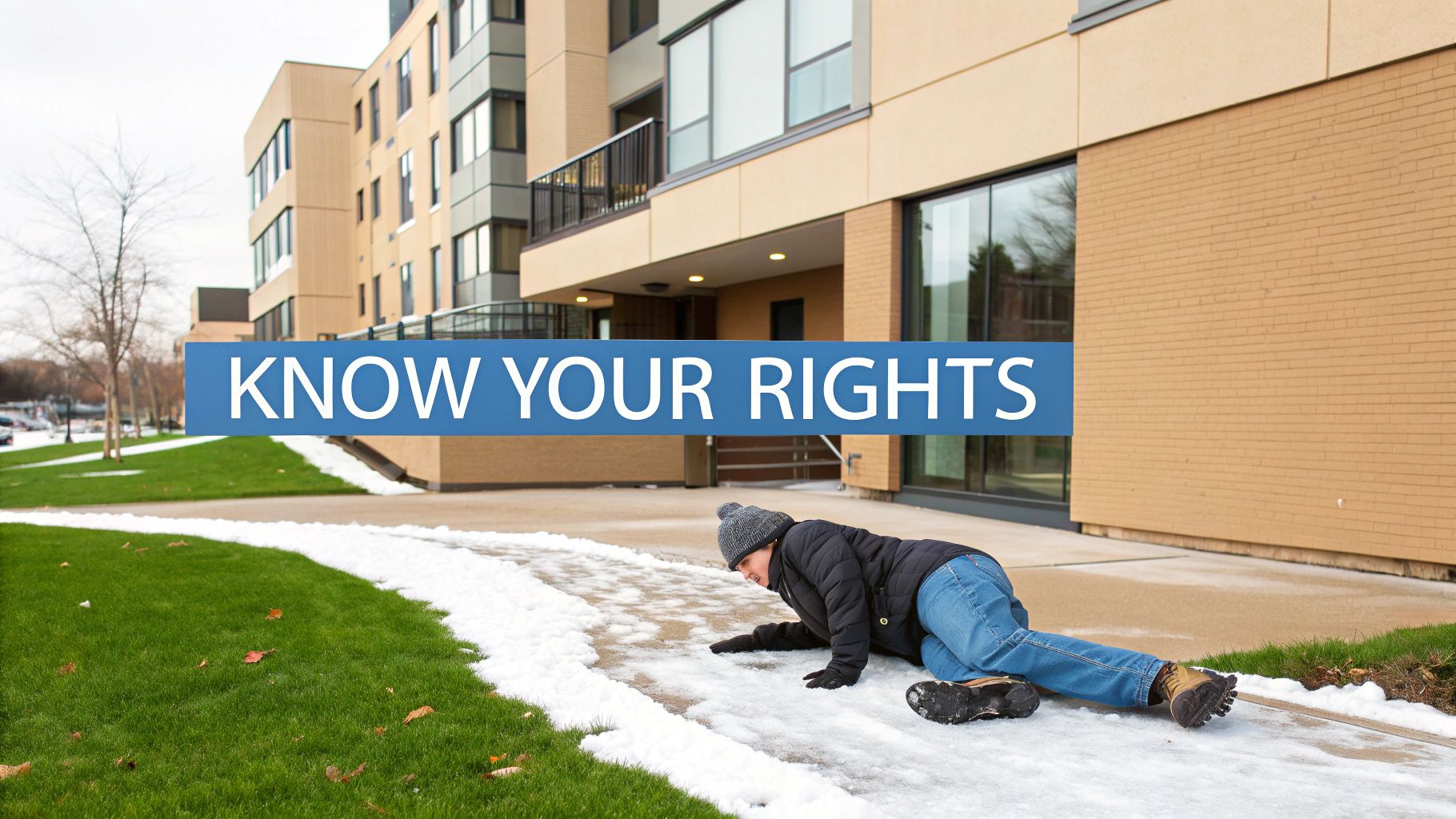
You may hear that a property owner isn't responsible for snow that simply fell from the sky, sometimes called "natural accumulation." In Colorado that is not a categorical bar; responsibility under the Premises Liability Act turns on the visitor's status, what the landlord knew or should have known, and control. A claim is especially strong when the ice is an unnatural accumulation: ice that wouldn't exist without the landlord's carelessness. Two classic examples:
- The faulty downspout: a gutter that drips water onto the main walkway after every storm, refreezing into a recurring sheet of black ice.
- The negligent snow pile: a crew stacking shoveled snow on a slope so it melts during the day and refreezes overnight into a slick right where people walk.
In both cases, the property created a hazard worse than the original snowfall. Proving it usually means tracing the ice back to its source—the downspout, the leaky pipe, the sloped pavement—and showing the landlord's choices caused it.
What to Do Right After a Fall on the Ice
Get medical care first—always. Once you're safe, your phone is your most powerful tool. Cleanup crews arrive with shovels and salt fast, and the evidence disappears with the ice.
1. Document the cause, not just the ice
Don't only photograph the ice you slipped on—capture what made it. Is a downspout dripping onto the walkway? Get video of the drip and the ice below it. Is a melting snow pile sending runoff that refreezes? Photograph the pile and the slick. Visual proof of the source, with timestamps and weather conditions, is what shows an unnatural accumulation rather than ordinary snowfall.
2. Report the injury in writing
Notify your landlord or management company by email or text—not just a phone call. A written report creates a timestamped record and establishes that the property owner knew about the condition. Stick to objective facts, with no apologies or admissions of fault. For example: "I slipped and fell on ice outside Building C at 10 a.m. today and injured my right knee and left wrist." Note the exact location, time, and conditions.
3. Find your witnesses
Did a neighbor help you up? Get their name and number. Ask other tenants whether they've complained about that same icy spot before. A witness who can confirm the hazard was a chronic, known problem is valuable—it shows the owner knew or should have known.
How Shared Fault Comes Up
After you report, the landlord's insurer will likely ask how the fall happened. Fault matters because Colorado uses modified comparative negligence (C.R.S. § 13-21-111): an injured person can still recover damages as long as they are not 50% or more at fault, but the recovery is reduced by their share—and at 50% or more, it disappears. Expect questions like:
- "What kind of shoes were you wearing?"
- "Were you carrying anything?"
- "Were you on your phone?"
Answer honestly and stick to what you know. What usually decides these cases is evidence: the lease clause, the photos of the unnatural accumulation, the witness statements, and any local snow-removal ordinance the landlord violated. Many Colorado cities have ordinances requiring property owners to clear adjacent sidewalks within a set time after a snowfall, though the timeframe and which properties are covered vary by municipality—an attorney can confirm the rule that applies to your location.
A Note on Timing
For an ordinary premises-liability injury like a slip and fall, Colorado generally gives an injured person two years from the date of the injury to file a personal injury lawsuit (C.R.S. § 13-80-102). That sounds like plenty of time, but evidence in snow-and-ice cases melts—literally. Photos, work orders, and witness memories are far stronger when gathered in the first days, not the final months.
If you were hurt by snow or ice at a Colorado rental, we'll look at your lease, the conditions, and whether the duty fell on the landlord, and tell you honestly whether you have a case. Call (720) 432-7032 for a free, no-obligation consultation.
Schedule Your Free Case Review
Disclaimer: This post is for general informational purposes only and is not legal advice. No reader should act or refrain from acting based on it without seeking advice from counsel in the relevant jurisdiction.

Written by
Elliot Singer, Esq.
Personal injury attorney at Conduit Law, dedicated to helping Colorado accident victims get the compensation they deserve.
Learn more about our team

