Conduit Law - Colorado Personal Injury AttorneysAccident Attorneys
Car Accidents9 min read

Uber Accident Passenger Rights Colorado: The $1M Policy

Explore Uber accident passenger rights Colorado and learn how to protect your claim, access Uber's $1M policy, and get the compensation you deserve.

December 22, 2025By Conduit Law
#Uber Accident Passenger Rights Colorado, Rideshare Accident Lawyer, Colorado Injury Claims, Uber Insurance Policy, UM/UIM Coverage
Uber Accident Passenger Rights Colorado: The $1M Policy
Table of Contents

The app told you the Toyota Camry was three minutes away. You hopped in the back, popped in your earbuds, and trusted a stranger to get you across town safely. Rideshare services have transformed urban transportation, but accidents happen. When negligence causes injury, Colorado law provides remedies—though understanding them requires knowledge of state-specific protections. Under Colorado's modified comparative negligence rule (C.R.S. § 13-21-111), injured parties can recover damages even if partially at fault, provided their negligence doesn't exceed 50 percent. Non-economic damages, including pain and suffering, are capped at $1,500,000 as of 2025. Equally important is timing: Colorado enforces a three-year statute of limitations (C.R.S. § 13-80-101) for personal injury claims, meaning victims must file suit within that window or lose their legal right to recover. The intersection of rideshare liability, comparative fault, and statutory deadlines requires experienced legal guidance to protect your rights.

Then came the sickening crunch of metal—the world spinning sideways before a violent, sudden stop. Now the ears are ringing, the shoulder is on fire, and some chipper insurance adjuster is already leaving a voicemail. The immediate aftermath of a car accident brings shock, pain, and confusion. But clarity matters, especially in Colorado, where injury victims have three years from the date of injury to file a personal injury lawsuit under C.R.S. § 13-80-101. Colorado also follows modified comparative negligence rules under C.R.S. § 13-21-111, meaning an injured party can recover damages even if partially at fault—as long as their negligence does not exceed 50%. Additionally, non-economic damages such as pain and suffering are currently capped at $1,500,000 as of 2025. Understanding these legal frameworks is essential for protecting rights and ensuring fair compensation in the weeks and months following an accident.

Let's cut through the chaos. As a passenger, Uber accident passenger rights in Colorado are incredibly strong—because the law sees the passenger as the one truly innocent party in the wreckage. Passengers are 0% at fault, and that single fact unlocks a multi-million-dollar commercial insurance policy designed for this exact nightmare. Under Colorado's modified comparative negligence standard (C.R.S. § 13-21-111), passengers can recover damages even if the at-fault driver shares responsibility, as long as that driver bears more than 50% of the fault. This protection extends beyond economic losses like medical bills and lost wages. Non-economic damages—covering pain, suffering, and emotional trauma—are capped at $1,500,000 as of 2025 (C.R.S. § 13-21-102.5). Additionally, Colorado's three-year statute of limitations (C.R.S. § 13-80-101) provides ample time to file a claim. Passengers injured in rideshare accidents occupy a uniquely protected legal position with substantial recovery opportunities.

Your Power Is Being the Innocent Passenger

Let's get one thing straight—the passenger did nothing wrong. Being along for the ride puts an injured passenger in the most powerful legal position imaginable after a crash. Colorado law recognizes this distinct advantage through its modified comparative negligence doctrine, codified in C.R.S. § 13-21-111, which allows recovery as long as the plaintiff is not more than 50% at fault. Since passengers typically bear no responsibility for vehicle operation, they almost always fall well below this threshold. This legal advantage combines with Colorado's generous three-year statute of limitations under C.R.S. § 13-80-101, providing ample time to build a strong case. Additionally, non-economic damages—covering pain, suffering, and emotional distress—are currently capped at $1,500,000 as of 2025. These protections create substantial leverage in negotiations with insurance companies and defendants, as the liability picture is often crystal clear.

While the drivers and their insurance companies gear up to blame each other, innocent passengers stand apart. This isn't just a small advantage—it's a massive tactical upper hand. As a non-driver, the passenger bears no responsibility for the collision itself, which fundamentally changes the legal landscape. Colorado's modified comparative negligence rule (C.R.S. § 13-21-111) allows recovery even if a plaintiff is partially at fault, but only if fault doesn't exceed 50%. However, passengers typically face no such barrier. The claim becomes straightforward: establish that one or both drivers caused the accident, and liability shifts accordingly. Additionally, Colorado law provides a three-year statute of limitations to file suit (C.R.S. § 13-80-101), offering adequate time for thorough investigation and negotiation. Non-economic damages, including pain and suffering, are capped at $1,500,000 as of 2025, yet this remains substantial compensation for serious injuries. This cleaner liability position gives innocent passengers genuine leverage in settlement discussions and courtroom strategy.

It gives you the right to pursue compensation from the Uber driver's policy, the other driver's policy, and Uber's mandatory safety-net coverage. This isn't a flimsy personal auto plan—it's the substantial corporate policies Uber is legally required to carry. Under Colorado law, innocent passengers have a critical advantage: they can recover damages even if they bear some responsibility for the accident, provided their fault doesn't exceed 50% under the state's modified comparative negligence standard (C.R.S. § 13-21-111). This means multiple insurance sources are available to maximize recovery. Non-economic damages—covering pain, suffering, and emotional distress—can reach up to $1,500,000 as of 2025. Additionally, Colorado's three-year statute of limitations (C.R.S. § 13-80-101) provides a reasonable window to pursue claims. Injured passengers should understand that Uber's corporate liability coverage exists specifically to protect those harmed during rides, making it a powerful resource in building a comprehensive claim against all responsible parties.

The Trick Is Unlocking Uber’s $1 Million Commercial Policy

Uber's insurance system is a deliberately confusing three-tier maze designed to limit payouts and frustrate injured victims into abandoning valid claims. Understanding this structure is critical because Colorado law provides meaningful protections—but only if pursued within the three-year statute of limitations under C.R.S. § 13-80-101. Under Colorado's modified comparative negligence standard (C.R.S. § 13-21-111), an injured party can recover damages even if partially at fault, provided their negligence doesn't exceed 50 percent. The key is unlocking Uber's $1 million commercial insurance policy, which covers bodily injury claims when the driver is actively engaged in Uber services. However, Uber deliberately obscures this coverage through confusing tier assignments—driver personal insurance, Uber's coverage gap policy, and finally the commercial policy. Non-economic damages in Colorado are capped at $1,500,000 as of 2025, making strategic navigation of Uber's insurance tiers essential for maximizing legitimate recovery.

Good news for you—as a passenger, you get to skip the maze entirely.

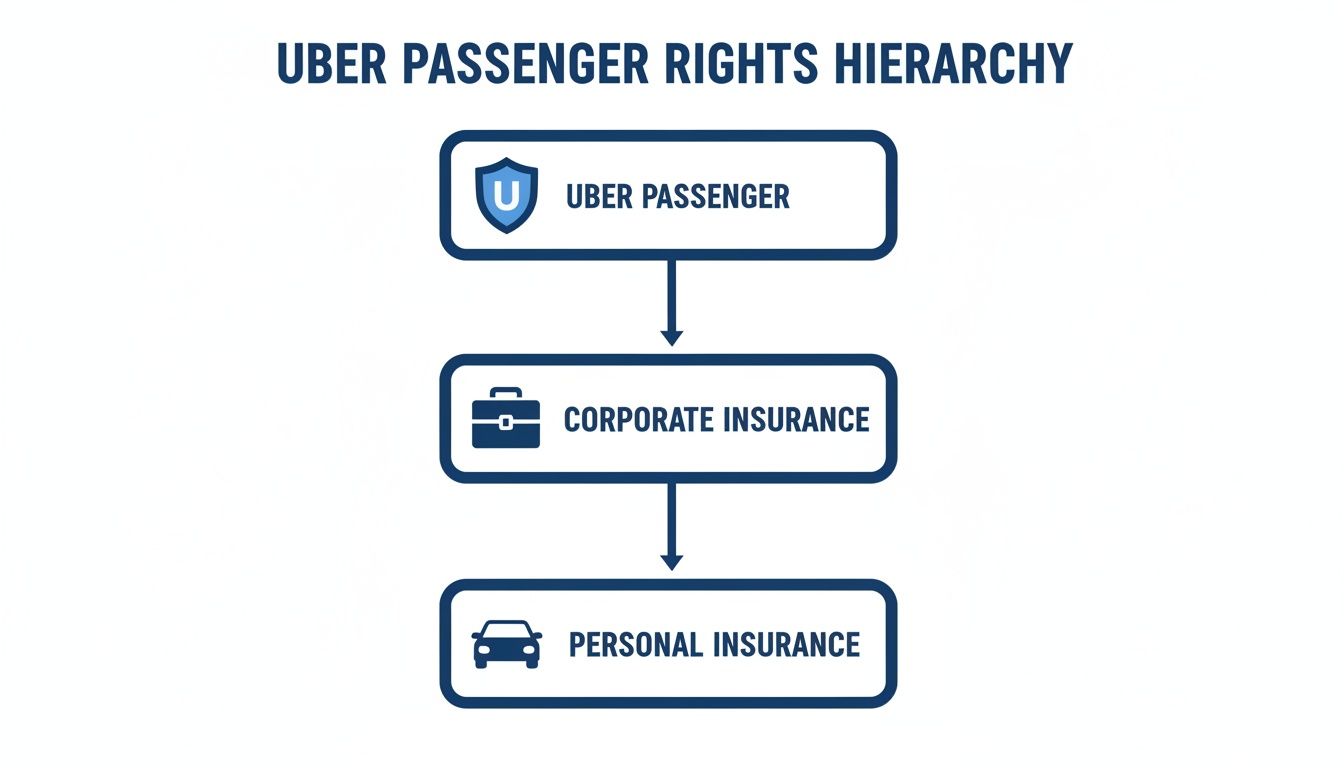
Your claim goes straight to the top. This simple hierarchy is your golden ticket, placing you directly under the protection of Uber's massive corporate policy and letting you bypass the driver's tiny personal insurance. When pursuing compensation, Colorado law provides a three-year statute of limitations under C.R.S. § 13-80-101 to file a personal injury lawsuit. Uber maintains a $1 million commercial policy that covers passenger injuries during active rides, creating a substantially larger recovery pool than any individual driver's policy. Under Colorado's modified comparative negligence standard outlined in C.R.S. § 13-21-111, injured passengers can recover damages even if partially at fault, provided their negligence doesn't exceed 50%. Non-economic damages—including pain and suffering—are capped at $1,500,000 as of 2025, establishing a clear ceiling for compensation. Understanding this corporate liability structure and Colorado's statutory framework is essential for maximizing your claim value and ensuring you pursue recovery against the party with actual resources to pay.

Diagram illustrating the Uber passenger rights hierarchy, showing corporate and personal insurance.

The Three Tiers—And Why Only One Matters to You

The moment a driver accepts a trip request, passengers are automatically covered by the highest level of protection—Tier 3 coverage. This comprehensive protection remains active from the second the driver begins heading toward the passenger until the trip officially concludes. Under Colorado law, injured parties have three years from the date of injury to pursue a claim, as outlined in C.R.S. § 13-80-101. It's important to understand that Colorado follows a modified comparative negligence standard under C.R.S. § 13-21-111, meaning an injured party can recover damages as long as they are not more than 50% at fault for the incident. Non-economic damages—such as pain and suffering—are capped at $1,500,000 as of 2025. Tier 3 coverage eliminates the gaps that exist during other periods and provides the security passengers need during their rides.

  • Tier 1: App Off. The driver is using their car for personal reasons. Their personal insurance applies. This does not cover you.
  • Tier 2: App On, Waiting for a Ride. The driver is logged in but hasn't accepted your trip. Limited liability coverage applies ($50k/$100k). This does not cover you.
  • Tier 3: Ride Accepted/In Progress. The driver accepted your trip/is en route/you are in the car. This triggers the full $1 Million commercial liability and UM/UIM policy. This is your shield.

That $1 million policy is the one we target. It's the one insurance adjusters hope claimants don't fully understand—or know how to access. Under Colorado's modified comparative negligence rule (C.R.S. § 13-21-111), an injured party can recover damages even if partially at fault, as long as their negligence doesn't exceed 50%. This threshold opens the door to pursuing higher-tier policies. The clock matters too: Colorado law provides a three-year statute of limitations for personal injury claims (C.R.S. § 13-80-101), meaning swift action is essential. For non-economic damages—pain, suffering, loss of enjoyment—the current cap stands at $1,500,000 as of 2025. These limits make policy layering critical. Insurance companies bank on confusion about what coverage exists and when it applies. Understanding these legal frameworks and policy structures separates those who recover fairly from those who accept insufficient settlements.

Your First Move: Prove You Were on an Active Ride

An insurance company's primary goal is to pay as little as possible on any claim. Their standard tactic involves claiming the driver wasn't technically on an active ride to downgrade the claim to a lower insurance tier with minimal payout value. This distinction matters significantly because rideshare companies carry different coverage limits depending on whether a driver is actively transporting passengers. Under Colorado law, injured parties have three years from the date of injury to file a personal injury claim (C.R.S. § 13-80-101). Additionally, Colorado's modified comparative negligence rule allows recovery if the injured party is less than 50% at fault (C.R.S. § 13-21-111). Non-economic damages, including pain and suffering, are capped at $1,500,000 as of 2025. Understanding these distinctions and legal protections becomes crucial when challenging insurance denials based on ride status, ensuring injured parties receive fair compensation within Colorado's statutory framework.

This is why the single most important thing you can do after a crash is prove you were in the middle of an active ride. Documentation of active rideshare status becomes critical evidence in establishing liability and damages. Under Colorado's modified comparative negligence standard (C.R.S. § 13-21-111), plaintiffs can recover damages even if partially at fault, provided their negligence does not exceed 50%. However, proving active ride status strengthens the case significantly by establishing the driver's commercial purpose and potential vicarious liability of the rideshare company. Additionally, Colorado's three-year statute of limitations (C.R.S. § 13-80-101) means time is limited to file claims. Non-economic damages are capped at $1,500,000 as of 2025, making every element of proof matter. Screenshots of the app, GPS data, ride confirmation emails, and driver communication records all serve as essential proof. This documentation directly supports both liability arguments and damages calculations in rideshare accident claims.

Your phone holds the key. A simple screenshot of your Uber app—showing the driver's name, the vehicle, and the active trip status—is the undeniable proof needed to lock in your claim under the $1 million Tier 3 policy. It shuts down their favorite argument before they can even make it, especially when a crash happens during a chaotic Denver winter storm. Under Colorado's modified comparative negligence standard (C.R.S. § 13-21-111), plaintiffs can recover damages even if partially at fault, provided they're less than 50% responsible. This screenshot becomes critical documentation within Colorado's three-year statute of limitations (C.R.S. § 13-80-101). Beyond the policy limits, non-economic damages—covering pain, suffering, and emotional distress—are capped at $1,500,000 as of 2025. That digital evidence eliminates ambiguity about whether coverage applies, protects against comparative fault arguments, and positions the claim for maximum recovery within Colorado's legal framework.

The Path to Recovery When Your Uber Driver is At Fault

Let's say an Uber driver was texting, speeding, or made an illegal turn that ended in a violent crash. The path forward is direct—and surprisingly powerful. Colorado law provides clear protection for injured passengers through its modified comparative negligence system, which allows recovery even if the passenger bears some responsibility, as long as they are less than 50% at fault (C.R.S. § 13-21-111). This means the focus shifts entirely to the driver's negligence and Uber's corporate liability. Injured parties have three years from the accident date to file a claim under Colorado's statute of limitations (C.R.S. § 13-80-101). Recoverable damages include medical expenses, lost wages, pain and suffering, and permanent impairment. Non-economic damages are capped at $1,500,000 as of 2025, protecting both plaintiffs and defendants. Understanding these legal frameworks is essential for building a compelling case and maximizing compensation in rideshare accidents.

You aren't going after the driver's tiny personal policy. That's a dead end. Because they were driving for a multi-billion-dollar company, your claim is made directly against Uber's $1 million commercial liability insurance policy. This distinction matters enormously in Colorado personal injury cases. Under Colorado's modified comparative negligence standard (C.R.S. § 13-21-111), an injured passenger can recover damages as long as they're less than 50% at fault. This means even if some responsibility is shared, recovery remains possible. Additionally, Colorado law provides a three-year statute of limitations for filing personal injury claims (C.R.S. § 13-80-101), giving injured parties reasonable time to pursue their case. Non-economic damages—including pain and suffering—are capped at $1,500,000 as of 2025. Understanding these protections is critical when navigating an Uber accident claim, as they directly impact both eligibility for recovery and potential compensation amounts.

This massive policy is required by Colorado law for one reason—to cover catastrophic injuries and make victims whole again. It's built to pay for everything that was taken from you: medical expenses, lost wages, pain and suffering, and more. Under Colorado's modified comparative negligence doctrine (C.R.S. § 13-21-111), injured passengers can recover damages even if partially at fault, provided their negligence doesn't exceed 50%. Non-economic damages—compensation for pain, suffering, and emotional distress—are capped at $1,500,000 as of 2025. However, there's urgency in pursuing these claims. Colorado's three-year statute of limitations (C.R.S. § 13-80-101) means victims have three years from the injury date to file a lawsuit. Beyond that window, the right to recover disappears entirely. This combination of comprehensive coverage requirements and strict time constraints underscores why prompt legal action matters when an Uber driver's negligence causes serious harm.

What the $1 Million Policy Actually Covers

This isn't just for the first ER bill. It's designed to cover the full, devastating scope of what's been lost—past, present, and future. Under Colorado law, non-economic damages are capped at $1,500,000 as of 2025, meaning pain and suffering, emotional distress, and loss of enjoyment of life have defined limits. But the $1 million policy works to cover the entire range of documented losses: emergency room visits, ongoing medical treatment, lost wages, and rehabilitation costs that extend years into recovery. Colorado's modified comparative negligence rule, codified in C.R.S. § 13-21-111, permits recovery even if the injured party is partially at fault—as long as fault doesn't exceed 50%. This matters because it broadens who can pursue claims. Additionally, victims have three years from the date of injury to file suit under C.R.S. § 13-80-101, providing a meaningful window to build a comprehensive case documenting both immediate and long-term damages.

  • Medical Bills: From the ambulance ride to future surgeries and physical therapy.
  • Lost Wages: Every paycheck you missed while recovering—and compensation if you can’t return to your old job.
  • Pain and Suffering: The human cost of the trauma—the chronic pain, the anxiety, the shattered quality of life. This is often the largest part of a serious injury claim.

The insurance company's entire business model revolves around minimizing payouts. They will argue their driver wasn't at fault or that injuries aren't as severe as claimed. It's their job to protect their bottom line. Building an unassailable case is the counterbalance to this strategy. Understanding Colorado's legal framework is critical. Under C.R.S. § 13-80-101, injured parties have three years from the date of injury to file a lawsuit. Additionally, Colorado follows modified comparative negligence rules under C.R.S. § 13-21-111, meaning claimants can recover damages only if they're less than 50% at fault. Insurance companies exploit these rules aggressively. A $1 million policy seems substantial until considering real medical costs, lost wages, and pain and suffering. Non-economic damages—compensating for pain, emotional distress, and diminished quality of life—are capped at $1,500,000 as of 2025. The gap between policy limits and actual damages frequently leaves claimants significantly undercompensated. Building compelling evidence of liability, injury severity, and damages becomes essential to overcoming these limitations.

Never, ever give a recorded statement to an insurance adjuster. They will sound friendly, express sympathy, and then weaponize every word spoken to devalue the claim. The rideshare industry's own safety reports reveal alarming trends—between 2021 and 2022, there were 153 fatalities in crashes involving their vehicles. When a driver's mistake causes catastrophic injury, such as a T-bone collision, Colorado's legal framework becomes critical. Under C.R.S. § 13-80-101, the statute of limitations allows three years to file suit. However, Colorado's modified comparative negligence rule—codified in C.R.S. § 13-21-111—bars recovery if the injured party is found 50% or more at fault. Additionally, non-economic damages are capped at $1,500,000 as of 2025. These constraints underscore why avoiding premature statements and building an ironclad case with documented evidence, medical records, and expert analysis is essential to maximizing recovery in high-stakes rideshare accident claims.

The Path When Another Driver Hits Your Uber

Scene of a car accident with a damaged white vehicle, an ambulance, and emergency personnel.

Now, let's say the Uber driver was a total pro—but some other car blew a stop sign and slammed into the vehicle. In this scenario, the at-fault driver's insurance becomes the first target for recovery. Colorado law provides a three-year window to pursue a claim under C.R.S. § 13-80-101, so timing matters. It's also important to understand Colorado's modified comparative negligence rule under C.R.S. § 13-21-111, which allows recovery as long as the injured party is not more than 50% at fault. If the case proceeds to judgment, non-economic damages—covering pain, suffering, and emotional distress—are capped at $1,500,000 as of 2025. An experienced personal injury attorney can navigate these complexities, determine whether the at-fault driver's policy limits are sufficient, and explore additional coverage options if the damages exceed those limits.

But what if they only have Colorado's laughably low state-minimum coverage of $25,000? Or worse, what if they have no insurance at all? Under Colorado's modified comparative negligence rule (C.R.S. § 13-21-111), injured Uber passengers can still recover damages as long as they're found less than 50% at fault—even against uninsured or underinsured drivers. However, inadequate coverage creates a significant gap between medical bills and available compensation. Non-economic damages, including pain and suffering, are capped at $1,500,000 as of 2025, but that ceiling means little if the at-fault driver carries minimal liability limits. The good news: Colorado's three-year statute of limitations (C.R.S. § 13-80-101) provides a reasonable window to pursue claims and explore additional recovery avenues, such as uninsured motorist coverage or the driver's personal assets. Navigating these scenarios requires understanding both coverage limits and Colorado's specific negligence framework.

For most people, a serious accident is a financial disaster. For Uber passengers injured in Colorado, state law provides crucial protections. Colorado's modified comparative negligence rule allows injured passengers to recover damages even if partially at fault, as long as fault doesn't exceed 50% (C.R.S. § 13-21-111). This means victims aren't automatically barred from compensation simply because they share some responsibility for the accident. Colorado law also imposes a three-year statute of limitations for filing personal injury claims (C.R.S. § 13-80-101), providing a reasonable timeframe to pursue legal action. Non-economic damages—such as pain and suffering—are capped at $1,500,000 as of 2025, establishing predictable recovery limits. Understanding these protections helps injured passengers navigate the claims process with clarity. Uber passengers have distinct rights under Colorado law, and knowing these protections can make the difference between financial hardship and meaningful recovery.

Uber's $200,000 UM/UIM Safety Net Is Your Ace in the Hole

Thanks to a recent Colorado law (HB 22-1089), Uber must carry at least $200,000 in Uninsured/Underinsured Motorist (UM/UIM) coverage for passengers. This mandate creates a powerful, built-in insurance policy designed to protect riders when the at-fault driver lacks sufficient coverage or assets to pay damages. Under Colorado's modified comparative negligence standard (C.R.S. § 13-21-111), passengers can recover damages even if partially at fault, provided their negligence doesn't exceed 50%. This protection becomes especially valuable in serious injury cases where non-economic damages—pain, suffering, and emotional distress—are capped at $1,500,000 as of 2025. Importantly, passengers have three years from the date of injury to file a personal injury claim under C.R.S. § 13-80-101. The $200,000 UM/UIM floor ensures that Uber passengers have a reliable financial backstop when negligent drivers cannot fully compensate for medical expenses, lost wages, and other accident-related losses.

This law is a game-changer for injured rideshare passengers. When the other driver's insurance policy runs out, there's no dead end. Colorado law allows claimants to pivot and open a second claim against Uber's own uninsured/underinsured motorist (UM/UIM) coverage, effectively doubling the available recovery. Under Colorado's modified comparative negligence standard (C.R.S. § 13-21-111), injured parties can still recover damages even if partially at fault, provided they're not more than 50% responsible for the accident. Uber maintains $200,000 in UM/UIM coverage per incident, creating a critical safety net when a negligent driver's limits are exhausted. Non-economic damages—pain, suffering, and emotional distress—are capped at $1,500,000 as of 2025. Importantly, claimants have three years from the injury date to file suit under Colorado's statute of limitations (C.R.S. § 13-80-101), providing adequate time to investigate, negotiate, and litigate if necessary.

  • The Uninsured Driver: Someone with no insurance hits your Uber. We file a claim against Uber’s $200,000 UM policy to cover your medical care and lost income.
  • The Underinsured Driver: The at-fault driver has a tiny $25,000 policy, but your bills are $100,000. We take their full $25,000, then immediately file an underinsured motorist claim against Uber’s policy to recover the remaining $75,000.

As a Denver uninsured motorist lawyer, viewing an Uber accident through strategic eyes reveals a genuine opportunity to build a comprehensive claim pulling from every available insurance policy. Insurance companies want injured parties to see this as a confusing mess of competing coverage limits and policy exclusions. Experienced legal advocates see it as a structured pathway to maximum recovery. Under Colorado law (C.R.S. § 13-80-101), victims have three years to file a personal injury claim, providing adequate time to investigate all available coverage sources. Modified comparative negligence rules (C.R.S. § 13-21-111) allow recovery even when a victim shares fault, so long as liability doesn't exceed 50%. Uber's $200,000 uninsured/underinsured motorist coverage can serve as a critical safety net when the at-fault driver carries minimal insurance. Non-economic damages remain capped at $1.5 million as of 2025, making strategic policy coordination essential. Understanding these layers transforms what appears overwhelming into a calculable, manageable claims strategy.

Insurance Companies Only Have One Move Against You

Your legal position is rock-solid. You did nothing wrong. So the insurance company has only one play—a predictable and pathetic defense called comparative negligence. Under Colorado's modified comparative negligence rule (C.R.S. § 13-21-111), the defendant can only block recovery if they prove the injured party bears more than 50% of the fault. Even if partial fault is assigned, damages remain recoverable as long as that threshold isn't crossed. Insurance adjusters weaponize this defense routinely, attempting to shift blame and reduce settlement values. They'll scrutinize every detail of the incident, looking for any argument to paint shared responsibility. However, Colorado law protects claimants strategically. Non-economic damages are capped at $1,500,000 as of 2025, but the three-year statute of limitations (C.R.S. § 13-80-101) provides adequate time to build an airtight case. When liability is genuinely clear, comparative negligence becomes merely a negotiating tactic rather than a legitimate legal obstacle.

They will try to coax accident victims into admitting they somehow played a part in the crash. Did the injured party talk on their phone? Ask to change the music? Suggest a different route? Insurance adjusters will claim these minor distractions caused or contributed to the accident. This strategy is deliberate—under Colorado's modified comparative negligence rule (C.R.S. § 13-21-111), if a victim is found more than 50% at fault, they cannot recover damages. Even minimal fault assignments can significantly reduce compensation. Understanding this tactic is critical, especially considering Colorado's three-year statute of limitations (C.R.S. § 13-80-101) for filing personal injury claims. Victims should avoid casual conversations with insurance representatives without legal guidance. Non-economic damages in Colorado are capped at $1,500,000 as of 2025, making every percentage point of fault assignment consequential. An experienced personal injury attorney protects against these common manipulation tactics and ensures fair claim evaluation.

It sounds ridiculous because it is. But under Colorado's modified comparative negligence system, if they can pin even 1% of the fault on you, they get to reduce the settlement by that amount. This is codified in C.R.S. § 13-21-111, which allows defendants to pursue comparative negligence claims aggressively. However, Colorado does set a crucial limit: if the injured party is found to be 50% or more at fault, they're barred from recovery entirely. Insurance companies exploit this threshold relentlessly, manufacturing minor contributory negligence arguments to chip away at settlements. They know injured parties face a three-year statute of limitations under C.R.S. § 13-80-101, creating time pressure that makes quick settlements attractive. Combined with non-economic damages capped at $1,500,000 as of 2025, defendants use every available tactic to reduce liability exposure. Understanding how Colorado's comparative negligence rules work is essential for anyone navigating a personal injury claim against an insurer determined to minimize payout.

They will dig for any excuse to pin even 1% of the fault on you. This is their only play, and experienced personal injury advocates see it coming from a mile away. It's why their first move is always to get injured parties into a recorded statement—it's a hunt for anything they can twist against you. Understanding the cynical reasons why insurance companies deny claims is the first step in beating them. Colorado's modified comparative negligence rule (C.R.S. § 13-21-111) allows them to use any assigned fault to reduce settlement value, making their strategy particularly aggressive. They know that under state law, plaintiffs bearing 50% or more fault are barred from recovery entirely. This creates enormous pressure to accept lowball offers. A fortress of evidence establishing zero percent fault status makes that legal maneuver impossible. With Colorado's three-year statute of limitations (C.R.S. § 13-80-101) and potential non-economic damages reaching $1,500,000, the stakes demand meticulous documentation from day one.

Your Immediate Next Steps to Secure the Claim

The moments after a crash are a blur. Taking a few calm, deliberate actions right now can mean the difference between a fair settlement and a financial nightmare. Colorado law provides a three-year window to file a personal injury claim under C.R.S. § 13-80-101, but evidence deteriorates and witnesses' memories fade quickly. Immediate documentation—photos, police reports, and witness contact information—becomes crucial evidence. Understanding Colorado's modified comparative negligence rule is equally important. Under C.R.S. § 13-21-111, injured parties can recover damages only if they're less than 50% at fault. Any finding of equal or greater fault eliminates recovery entirely. Additionally, non-economic damages such as pain and suffering are capped at $1,500,000 as of 2025. These legal constraints underscore why prompt, strategic action protects both the claim's validity and its ultimate value. Proper initial steps establish a foundation for maximum recovery within Colorado's statutory framework.

First, your health is everything. But second, you must protect your rights.

Woman driving a car, looking at her smartphone, with text 'PRESERVE EVIDENCE' overlayed.

Lock It Down: Evidence and Medical Care

  1. Screenshot the Ride. Pull out your phone and screenshot the active Uber trip. This one action locks you into the $1 million commercial policy.
  2. Call 911. Insist on an official police report. It’s a critical piece of evidence documenting who, what, where, and when.
  3. Get Medical Attention. Now. Go to an ER/urgent care, even if you feel fine. Adrenaline masks serious injuries. A medical record creates a timestamped link between the crash and your injuries that is essential for your claim.
  4. Do Not Talk to Insurance. Soon, an adjuster will call. They will sound friendly. Their only job is to get you into a recorded statement to trick you into downplaying your injuries. Hang up.

Your first and only call should be to an attorney who lives and breathes this complex world. Protecting Uber accident passenger rights in Colorado starts by getting an experienced Denver Uber Lyft accident lawyer in your corner from day one. Time matters—Colorado law provides a three-year statute of limitations under C.R.S. § 13-80-101 to file a personal injury claim, but evidence degrades and witnesses' memories fade quickly. An attorney will handle insurance adjusters while the passenger focuses solely on recovery. Understanding Colorado's modified comparative negligence rule is critical: under C.R.S. § 13-21-111, passengers can still recover damages even if partially at fault, provided their fault doesn't exceed 50%. Non-economic damages, including pain and suffering, are capped at $1,500,000 as of 2025. Early legal intervention preserves crucial evidence, protects rights, and ensures maximum compensation within these statutory frameworks.


The content of this website is for informational purposes only and does not constitute legal advice. No attorney-client relationship is formed by viewing this site or submitting an inquiry.

When ready to move forward, the consultation is completely free. Our team will listen carefully to what happened and explain exactly how we can help. There's no pressure and no unnecessary complications—just straightforward legal guidance. Under Colorado law (C.R.S. § 13-80-101), there's a three-year statute of limitations to file a personal injury claim, making timing critical. Additionally, Colorado follows a modified comparative negligence rule (C.R.S. § 13-21-111), meaning plaintiffs can recover damages even if partially at fault—as long as they're not more than 50% responsible for the incident. Non-economic damages, including pain and suffering, are capped at $1,500,000 as of 2025. Understanding these legal limits and deadlines early helps protect your case. During the free consultation, the firm will evaluate the specific facts of your situation, explain how these statutes apply, and outline the realistic path forward without any obligation.

Protecting your rights in a Colorado personal injury claim requires understanding the state's legal framework and acting quickly. Colorado law provides a three-year statute of limitations under C.R.S. § 13-80-101, meaning injured parties must file suit within this window or forfeit their right to recover. Additionally, Colorado follows a modified comparative negligence system under C.R.S. § 13-21-111, which bars recovery if a claimant is found more than 50% at fault. Non-economic damages, including pain and suffering, are capped at $1,500,000 as of 2025. These legal parameters underscore why securing experienced representation early matters. A skilled personal injury attorney can navigate these complexities, preserve critical evidence, ensure proper medical documentation, and position a claim for maximum recovery. For a comprehensive case review and guidance tailored to Colorado's specific requirements, the legal team at Conduit Law offers free, no-obligation consultations available at https://conduit.law.

CL

Written by

Conduit Law

Personal injury attorney at Conduit Law, dedicated to helping Colorado accident victims get the compensation they deserve.

Learn more about our team

Explore Our Practice Areas

We handle 24+ types of personal injury cases throughout Colorado.

Need Legal Assistance?

If you have been injured, our experienced personal injury attorneys are here to help you get the compensation you deserve.