Table of Contents
Free case qualifier
In a car or vehicle accident?
Answer a few quick questions about the crash and your injuries — we route your details straight to intake.
Start the qualifierIf you’re searching for an “average semi truck accident settlement,” it’s probably not idle curiosity.
Your car may be wrecked, your body hurts in new places, and the medical bills are arriving. It makes sense to want a number to hold onto. Truck crashes are among the most serious on the road: large truck crashes killed 5,472 people nationwide in 2023, according to NHTSA Traffic Safety Facts. Federal motor-carrier rules often require at least $750,000 in public-liability coverage for many for-hire property carriers under 49 CFR Part 387, though that coverage can fall short of the losses in a serious case.
The honest answer is that an "average" settlement says very little about your claim. Every truck case turns on its own injuries, evidence, fault, and insurance. A useful valuation starts with what was actually lost: your health, your income, and your day-to-day life.
2026 Update: The “Average” Number Matters Less Than the Trucking Evidence
For 2026, the settlement question still starts with the same warning: a semi-truck case is not valued like a routine car crash. The better question is whether the evidence proves why the crash happened and how much insurance is actually available. Early preservation letters should target the truck’s ECM or event-data-recorder download, electronic logging-device and hours-of-service records, driver qualification file, dispatch communications, maintenance records, bills of lading, onboard camera footage, and post-crash inspection material. If a carrier lets key records disappear after notice, that can become a spoliation issue and change settlement leverage.
Federal financial-responsibility rules under 49 CFR Part 387 commonly set a $750,000 minimum for many for-hire property carriers, but serious Colorado truck-injury cases may involve layered coverage, brokers, shippers, maintenance contractors, or excess policies. That is why a reliable settlement estimate must separate medical bills, future care, lost earning capacity, non-economic harms, comparative fault, and every potentially responsible defendant.
How a Truck Accident Claim Is Actually Valued
Insurers often evaluate claims with formulas and software. A full valuation looks at every category of loss, both the ones with receipts and the ones that keep you up at night.
Want a quick estimate?
Use our free settlement calculator to see what your case might be worth in 60 seconds—no email required.
The Foundation: Economic Damages
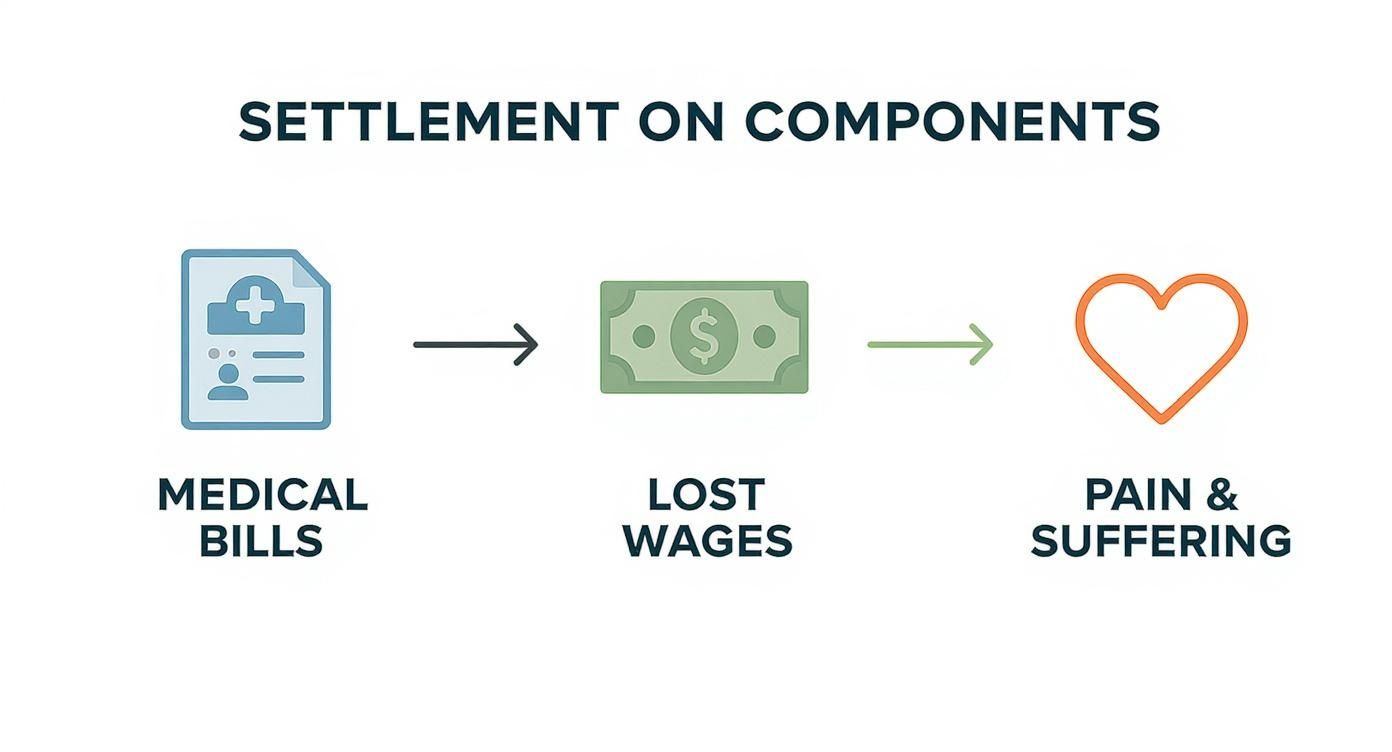
Economic damages are the measurable losses caused by the crash, past and future. Building them well takes documentation: hospital bills, pay stubs, repair receipts, and expert projections of future care.
- Medical Bills: From the ambulance ride to the last physical therapy session, plus any future surgeries or care you’ll need.
- Lost Wages: Income lost while you couldn’t work, including loss of future earning capacity if your injuries force a career change.
- Property Damage: The cost to repair or replace your vehicle and anything else damaged in the crash.
This is the starting point, not the whole claim.
The Structure: Non-Economic Damages
Non-economic damages compensate for the human cost of the crash: pain, emotional distress, and loss of enjoyment of life. It’s the sleepless nights, the anxiety when a truck merges behind you on the highway, the inability to pick up a child without pain. In Colorado, non-economic damages are capped at $1,500,000 for most personal injury claims that accrue on or after January 1, 2025, and actions filed during 2025, and $2,125,000 in wrongful death actions; damages for physical impairment or disfigurement are not subject to that cap, and economic damages are uncapped.
One common shorthand for estimating non-economic damages is a multiplier applied to economic damages, with higher figures for more severe, permanent injuries. It is a rough rule of thumb, not a legal formula. Colorado law doesn’t require any multiplier, and the evidence of how the injury changed your life matters more than any number.
Four Factors That Drive Truck Accident Settlement Value
Truck claims are usually larger and more complex than car accident claims. Four factors tend to matter most.
1. The Severity of Your Injuries
Injury severity is the primary driver of claim value. A collision with a fully loaded commercial truck, which can weigh up to 80,000 pounds, often causes spinal injuries, traumatic brain injuries, internal injuries, and permanent disability.
Traumatic brain injuries (TBIs), paralysis, amputations, and permanent organ damage can require a lifetime of care, and the settlement should reflect that lifetime cost. A TBI case isn’t about one hospital bill; it can mean a lost career, strain on a family, and decades of neurological care. These claims call for detailed economic analysis: attendant care, vocational rehabilitation, adaptive equipment, and psychological treatment.
2. Clear Proof of Liability
The clearer the evidence of fault, the less room there is for dispute. Electronic logging device data, maintenance records, driver histories, and accident reconstruction can show what happened and who was responsible.
- The Truck’s Black Box: Event data can record speed, braking, and other information around the crash.
- Driver Logs: Logs can show whether federal Hours-of-Service rules were followed.
- Witness Testimony: Independent accounts from people who saw the crash carry real weight.
- Police Reports: A citation against the truck driver can be important evidence.
When fault is well documented, claims tend to resolve more readily.
3. Negligence at the Company Level
A tired or distracted driver can be a symptom of problems at the company level. When investigation shows the trucking company itself was negligent, through inadequate training, falsified logs, poor maintenance, or pressure to violate Hours-of-Service rules, the company may be directly responsible, and case value can increase.
In limited cases, Colorado also allows exemplary (punitive) damages for willful and wanton conduct. They cannot be requested at the start of a case; they can only be added later with court permission after a showing of evidence, and they are generally capped at the amount of actual damages (C.R.S. § 13-21-102).
Investigation may look for patterns such as:
- Hiring drivers with known drug or alcohol problems.
- Pressuring drivers to break federal Hours-of-Service rules.
- Skipping critical maintenance on brakes or tires.
- Falsifying safety logs.
Evidence like this shows a jury the difference between a momentary mistake and a business decision that put others at risk.
4. The Insurance Coverage Available
Available coverage often sets the practical limit on a settlement. Federal rules commonly require a $750,000 minimum for many for-hire property carriers, and many carriers carry higher limits, sometimes with umbrella or excess policies. Brokers, shippers, and maintenance contractors may have their own coverage. That is why identifying every insurance layer early matters in catastrophic injury and wrongful death cases.
The scenarios below are general illustrations of how injury severity and the defendant’s conduct can interact. They are not Conduit Law results or a prediction for any case.
| Scenario | Injury Severity | Liability Factor | Illustrative Range |
|---|---|---|---|
| Scenario 1 | Moderate (e.g., broken bones, surgery) | Clear driver error (e.g., speeding) | $250,000 - $750,000 |
| Scenario 2 | Severe (e.g., TBI, amputation) | Clear driver error (e.g., speeding) | $1,000,000 - $3,000,000+ |
| Scenario 3 | Moderate (e.g., broken bones, surgery) | Gross Negligence (e.g., falsified logs) | $750,000 - $1,500,000+ |
| Scenario 4 | Catastrophic (e.g., paralysis) | Gross Negligence (e.g., falsified logs) | $3,000,000 - $10,000,000+ |
As the table illustrates, value tends to be highest when severe harm combines with serious misconduct.
Early Settlement Offers
An adjuster from the trucking company’s insurer may call within days of the crash. They will likely sound kind and concerned, ask about the accident and your injuries, and may ask for a recorded statement. Anything you say can be used later in evaluating fault and damages.
An offer may come quickly, before the medical bills add up, and it can sound substantial when you’re out of work. But early offers are often made before the full extent of an injury is known, and signing a release usually ends the claim for good.
It’s generally wise not to accept a first offer before you understand your injuries and the value of your claim, especially after a serious truck crash.
So, when they call, here’s a simple approach:
- Politely decline to give a recorded statement. Say, “I’m not comfortable being recorded right now.”
- Do not sign or agree to anything.
- If you have an attorney, say so: “Thank you for the call. My attorney will be in touch with you.”
- End the call.
How to Build a Strong Truck Accident Case
Trucking companies and their insurers often begin investigating right after a crash. Evidence fades quickly: skid marks disappear, witnesses become hard to reach, and electronic data can be overwritten. Acting early matters.
Black box data, electronic logging device records, and witness statements should be secured as soon as possible. Photographs of vehicle damage, road conditions, and debris are best captured before cleanup. Medical records and witness contact information should be gathered promptly.
Here’s an immediate action plan:
- Get the Police Report. It is the official first account of the crash.
- Take Photos/Videos of Everything. The scene, the vehicles, your injuries.
- Get Witness Contact Info. Independent witnesses are especially valuable.
- Send a Preservation Letter. A written demand that the trucking company preserve evidence like the truck’s black box and driver logs. It should go out early.
Then, document your recovery. Your medical records tell part of the story, and a pain journal tells the rest. Write down how the injuries affect your daily life. An adjuster sees a bill for "lumbar strain." Your journal translates that into, "I couldn't pick my toddler up out of her crib this morning." One is a line item; the other is a life.
Colorado uses modified comparative negligence (C.R.S. § 13-21-111): you can recover if your share of fault is less than the defendant’s, your award is reduced by your percentage of fault, and you recover nothing if you are 50% or more at fault. Evidence of the driver’s and the company’s conduct, including logbook discrepancies, maintenance records, and driver history, helps establish how fault should be divided.
Real Semi-Truck Accident Settlement Examples
These are actual settlements from Colorado commercial truck collision cases:
Your Questions, Answered Directly

Here are straightforward answers to common questions.
How Long Does a Truck Accident Case Take?
It varies with the complexity of the case. A straightforward claim might resolve within a few months, while a catastrophic injury case often takes a year or more. Medical treatment, expert testimony, insurance layers, and litigation all affect timing. In Colorado, the deadline to file a lawsuit for a motor vehicle injury claim is generally three years from the crash (C.R.S. § 13-80-101(1)(n)).
Settling before Maximum Medical Improvement (MMI) risks leaving future care uncompensated. We generally wait until clients have healed or their doctors can project future medical needs, then negotiate with the full picture in view. It takes patience, but it protects the value of the claim.
Do I Have to Go to Court?
Probably not. Most personal injury cases settle before trial.
Even so, cases are best prepared as if they could go to a jury, with evidence and, where needed, expert witnesses such as accident reconstructionists, medical specialists, and vocational experts. Well-prepared cases backed by solid evidence are valued on their merits.
What if I Was Partially at Fault?
Don’t assume you were. Shared fault is a common argument in truck cases.
Even if partial fault exists, Colorado’s modified comparative fault rule allows recovery as long as your share is below 50%. The award is reduced by your percentage. For example, if you are found 10% responsible on a $1,000,000 claim, the recovery would be $900,000. Investigation, accident reconstruction, and evidence of driver fatigue, mechanical failure, or regulatory violations help establish an accurate allocation of fault.
What Does It Cost to Hire You?
Nothing out of your pocket.
We work on a contingency fee basis, meaning the firm is paid only if money is recovered for you. The fee is a percentage of the recovery. If the case is unsuccessful, you owe nothing. This removes the financial barrier to getting help after a serious crash.
Trucking companies and their insurers have experienced legal teams. Truck cases involve federal regulations, multiple potential defendants, and layered insurance, and they benefit from attorneys who understand both commercial vehicle operations and Colorado personal injury law.
Let’s talk. No charge, no obligation. Just a real conversation about what happened and how we can help.
Elliot A. Singer
Managing Attorney, Conduit Law
Related Settlement Guides
Explore settlement values for related accident and injury types:
- Multi-Vehicle Accident Settlements – Common in truck pile-ups
- Intersection Accident Settlements – Truck turning and T-bone collisions
- Back Injury Settlements – Spinal injuries from truck impacts
- Concussion Settlements – TBI from high-force truck crashes
Disclaimer: This blog post is for informational purposes only and does not constitute legal advice. The information contained herein is not intended to create, and receipt of it does not constitute, an attorney-client relationship. You should not act or refrain from acting based on this information without seeking professional legal counsel. Past results do not guarantee future outcomes.
Call us 24/7 for a free, no-obligation consultation. You can reach Conduit Law at (720) 432-7032 or connect with us online to schedule your free case review.

Written by
Elliot Singer, Esq.
Personal injury attorney at Conduit Law, dedicated to helping Colorado accident victims get the compensation they deserve.
Learn more about our team