![Average Car Accident Settlements Colorado [2026]](/_next/image?url=https%3A%2F%2Fleui45a2n5ivp3hb.public.blob.vercel-storage.com%2Fimages%2Fblog%2Fhero%2Fcar-accident-settlement-1777052866225.jpg&w=1536&q=75)
Table of Contents
Free case qualifier
In a car or vehicle accident?
Answer a few quick questions about the crash and your injuries — we route your details straight to intake.
Start the qualifierAs a rough illustration, many Colorado car accident settlements fall somewhere between $15,000 and $100,000 or more, but an average is the wrong lens; the right number turns on your injuries, your treatment, and the specifics of your case. A car accident settlement isn't a windfall. It's repayment for what was lost: a negotiated agreement to cover medical bills, lost income, and the physical and emotional toll of someone else's carelessness. Colorado requires drivers to carry minimum liability coverage of $25,000 per person and $50,000 per accident for bodily injury, plus $15,000 for property damage. A settlement addresses documented losses: emergency room visits, ongoing treatment, rehabilitation, wages missed during recovery, and pain and suffering. A settlement reflects the actual impact of the accident on your life, health, and finances.
The goal is to restore, as far as money can, what the crash took from you.
It also helps to understand how the other side evaluates a claim.
To an insurance company, a claim is a financial exposure to be evaluated and resolved. This guide explains how that evaluation works, so you can make informed decisions about your own claim. Many injured people aren't familiar with how Colorado law and insurance coverage shape a claim. Knowing the basics puts you on steadier footing.
Want a quick estimate?
Use our free settlement calculator to see what your case might be worth in 60 seconds—no email required.
What Is the Average Car Accident Settlement in Colorado?
There is no reliable published "average" for Colorado car accident settlements. As a rough illustration, claims often fall in a broad $15,000 to $100,000+ range, but that number is only a starting point. A low-speed Denver rear-end crash with short-term soft tissue treatment may resolve near the lower end. A crash involving surgery, permanent impairment, disputed wage loss, or limited BI/UM/UIM insurance can move far above it.
For Denver and other Colorado drivers, the better question is not just "what is the average?" It is: what proof changes the value of this specific claim? Medical bills, future care, lost income, injury duration, comparative fault, policy limits, and treatment gaps all matter. If you want a more case-specific starting point, use the Colorado settlement calculator, then compare the result with our car accident case-worth guide and talk with a lawyer before signing a release.
If your crash happened in Denver, local facts matter too: where the collision occurred, which providers documented your injuries, and whether the insurer is raising city traffic or shared-fault arguments to discount the claim. A Denver car accident lawyer can connect those local details to the settlement value.
This is about more than a crumpled bumper. It's the pain from a herniated disc that makes it hard to pick up your child, the anxiety that comes with getting behind the wheel again, and the wages lost from weeks or months away from work. Medical bills, physical therapy, and ongoing treatment add up, and the effects can reach quality of life, family relationships, and long-term earning capacity.
An insurer's job is to evaluate claims on behalf of its policyholder and its own bottom line, so accurate information about your rights and your claim's value matters. The difference between an early offer and a fully documented claim can determine whether an injured person can truly rebuild. It's about recovering medical expenses, lost wages, and what the injury has taken from daily life.
One point often surprises people: case value and actual recovery can be two different figures, mainly because of insurance limits. Colorado's minimum liability coverage ($25,000 per person and $50,000 per accident for bodily injury, plus $15,000 for property damage) may fall far short of a serious injury. Policy limits, uninsured and underinsured motorist coverage, and available assets all affect the final recovery. Understanding the difference between what a claim is worth and what insurance will pay helps set realistic expectations.
How Insurers Value Your Claim
Think of a car accident claim as two categories of damages. The first is economic damages: medical bills, repair estimates, lost wages, and pharmacy receipts. These are documented, verifiable, and relatively hard to dispute, so adjusters can calculate them precisely. But they are only part of the picture.
This includes every hospital bill, every lost paycheck, every copay for physical therapy: the tangible costs of someone else's negligence. Medical expenses, rehabilitation costs, vehicle repair bills, and documented income loss create a clear paper trail. Insurers review these expenses closely and may question individual charges. They are generally more resistant to the second category, which can't be itemized on a receipt.
The rest of a crash's impact isn't found on a receipt. Medical bills capture the cost of treatment, but not what the injury took from daily life: pain, sleep, relationships, and the ability to do ordinary things.
That is where non-economic damages come in. They cover what you have been through: chronic back pain that disrupts sleep, anxiety when brake lights flash ahead, the frustration of not being able to move without wincing. Insurers use methods such as multipliers and per diem calculations, along with comparative fault reductions, to put a number on these losses. Understanding how that works helps you build a claim that reflects the full scope of the injury.
Some insurers use claims-evaluation software to help value injury claims, and a common rough method applies a multiplier (often described as 1.5 to 5) to medical bills to estimate non-economic damages. There is no fixed formula, and the result depends heavily on how well the injury and its effects are documented.
Insurers generally don't explain how they arrived at an offer. That makes it important to present clear evidence on medical causation and on how the injury has affected your life, rather than relying on the insurer's internal valuation.
Your Damages Are More Than Just Medical Bills
Here are the two main categories of compensation available after a car accident. Understanding them is the first step toward knowing a claim's actual value, not just the first number offered. Economic damages include medical expenses, lost wages, rehabilitation, and property damage. Non-economic damages (pain and suffering, emotional distress, and reduced quality of life) carry real value but require careful documentation.
| Damage Category | What It Covers | How It's Valued |
|---|---|---|
| Economic Damages | Medical Bills (past & future), Lost Wages, Lost Earning Capacity, Property Damage | Receipts, Invoices, Pay Stubs, Expert Projections |
| Non-Economic Damages | Pain and Suffering, Emotional Distress, Loss of Enjoyment of Life, Disfigurement | Multiplier Method, Per Diem Method, Legal Precedent |
Averages mean little when evaluating an individual case. Each accident involves distinct injuries, lost wages, property damage, and long-term medical needs, and damages extend well beyond the initial hospital bills to ongoing treatment, rehabilitation, pain and suffering, and lost earning capacity.
The multiplier is often where the biggest valuation disagreements arise. A minor whiplash case might be valued at a low multiple, while a serious injury requiring surgery may support a much higher one. A higher valuation is supported with medical evidence, expert testimony, and clear documentation of how the injury has changed daily life and future earning capacity.
Early offers often reflect a low multiplier, in part because the full effect of the injury isn't documented yet. Pain and suffering covers physical pain, emotional distress, lost enjoyment of life, and psychological effects, so keeping a record of these losses matters.
How Insurers Evaluate and Respond to Claims
Insurers handle claims through established processes designed to control costs. Adjusters know policy limits well, may question medical necessity, and may take time to respond. Understanding the process helps injured drivers recognize when professional representation is worth considering.

The other driver's insurer represents its policyholder, not you. Claims can involve delays, early offers, and disputes over medical necessity, and injured people are often dealing with financial stress, medical treatment, and exhaustion at the same time. Knowing what to expect is the first step toward protecting yourself in the claims process.
Understanding the process is where a fair car accident settlement begins.
The Quick Early Offer
One common step is a quick settlement offer. An adjuster may call days after the crash, sound sympathetic, and offer a few thousand dollars to sign and close the claim. An offer this early is often made before the full extent of the injuries, and the claim's value, is known.
Accepting an early offer usually means signing a release. Once a settlement release is signed, it usually ends the claim and prevents reopening it for later-discovered symptoms or complications.
A sore neck that later turns out to be two herniated discs requiring long-term care is a very different claim. Waiting for diagnostic imaging and specialist evaluations helps make sure any settlement reflects the actual injury.
The Recorded Statement
The other driver's insurer may ask you for a recorded statement and describe it as routine. Anything said in a recorded statement becomes part of the claim file and can be used later to dispute the injury or fault. It's wise to talk with a lawyer before agreeing to give one.
For example, a polite "I'm okay" in response to "How are you?" can later be cited as evidence the injury wasn't serious. Injured people often downplay their condition out of politeness or shock, and a statement given soon after a crash may not match the medical picture that develops later.
Delay
Claims can also slow down: paperwork requests, changes in adjusters, and weeks without a response while medical bills accumulate. Delays can put financial pressure on injured people to accept less than a claim is worth.
The longer a claim is unresolved, the more that financial pressure can build. Knowing the timeline, the deadlines, and your options helps you avoid settling just to end the process.
Time also affects evidence: witnesses become harder to reach and memories fade. Preserving evidence early protects the claim regardless of how long negotiations take.
The Colorado-Specific Rules That Shape Your Case
Every state has different rules, and assuming Colorado's laws match California's or Texas's can be a costly mistake. These rules shape how a car accident settlement is valued. Colorado requires minimum liability coverage of $25,000 per person and $50,000 per accident for bodily injury, plus $15,000 for property damage. Colorado has its own rules on comparative fault, deadlines, damage caps, and insurance. Applying another state's framework to a Colorado claim can lead to missed deadlines or reduced recoveries.
Insurance adjusters work with these rules every day, including comparative fault, deadlines, and damage caps. Injured people who understand them are in a better position during negotiations.
Here are the two Colorado rules that most affect a recovery.
Modified Comparative Fault
Colorado follows modified comparative fault (C.R.S. § 13-21-111), and it shapes how car accident claims are resolved. Even if an injured person bears partial responsibility, they may still recover damages, but the award is reduced by their percentage of fault.
A jury, or an insurance adjuster in negotiation, assigns a percentage of fault to everyone involved. If a driver is found 10% at fault, perhaps for driving a few miles over the speed limit, that driver recovers 90% of their damages. Small percentages can make a real financial difference, especially when combined with limited insurance coverage.
And there is an important limit: Colorado has a 50% bar.
If you are found 50% or more at fault, you cannot recover damages under Colorado's modified comparative fault rule. That is why fault is often the most contested issue in a claim, and why evidence such as photos, witness statements, and police reports matters.
The Statute of Limitations
The second critical rule is the statute of limitations, the deadline for filing a lawsuit. In Colorado, most car accident injury claims must be filed within three years of the crash (C.R.S. § 13-80-101(1)(n)). Once the deadline passes, the right to sue is generally lost, even if the case has substantial merit.
Three years can pass quickly, especially while treatment is ongoing and negotiations stall. Claims involving multiple parties, uninsured drivers, or disputed liability can take longer to develop, and evidence weakens over time.
Missing the deadline can bar the claim no matter how serious the injuries. Some situations have different deadlines (for example, claims against government entities have short notice requirements), so it is important to have your deadline confirmed early.
Your Settlement Timeline—Mapping the Road from Crash to Check
It's easier to be patient when you know what to expect. A car accident settlement follows a predictable, though often slow, path: claim filing, investigation, treatment and documentation, negotiation, and resolution. Here is what happens at each stage.
Phase 1: The Foundation (Weeks 1-4)
This phase is about investigation. That means securing the police report, identifying and interviewing witnesses, photographing vehicle damage and scene conditions, notifying the at-fault driver's insurer of the claim, and verifying all available insurance coverage. Colorado's minimum liability limits ($25,000 per person and $50,000 per accident for bodily injury, plus $15,000 for property damage) are often less than a serious injury is worth, so identifying every coverage source early matters.
Phase 2: Healing and Documentation (Months 1-?)
This is the most important phase, and it can't be rushed. Every medical decision becomes part of the record supporting the claim. Attend every appointment, follow the treatment plan, and be honest about pain levels, limitations, and symptoms. Consistent treatment documents the seriousness of the injury and the link between the crash and ongoing health problems.
While healing continues, every medical record, diagnosis, treatment note, and bill is collected as evidence of damages. Settling before reaching Maximum Medical Improvement (MMI), the point where a condition has stabilized and future needs are clearer, can leave out ongoing complications, future medical needs, and long-term effects that only become apparent later.
If an adjuster encourages settlement while treatment is ongoing, keep in mind that early offers often underestimate long-term medical expenses, therapy, lost wages, and pain and suffering. Once a release is signed, reopening the claim is usually not possible. Continue documenting medical visits, treatment plans, and expenses before considering any offer.
Phase 3: The Demand and Negotiation
Once treatment is complete, a formal demand letter is sent to the insurer. It is a detailed presentation backed by medical records and a calculation of total damages, covering economic losses (medical expenses, lost wages, property damage) and non-economic damages such as pain and suffering. Depending on coverage, the demand may go to the at-fault driver's liability carrier, your own underinsured or uninsured motorist coverage, or both. The insurer will review the details, may request more documentation, and responds with its own valuation.
Then negotiation begins.
The insurer's first response is often well below the demand, and back-and-forth negotiation can take months depending on the case's complexity. Simpler cases may resolve faster, while claims involving serious injuries or liability disputes take longer. Persistence and documentation matter throughout.
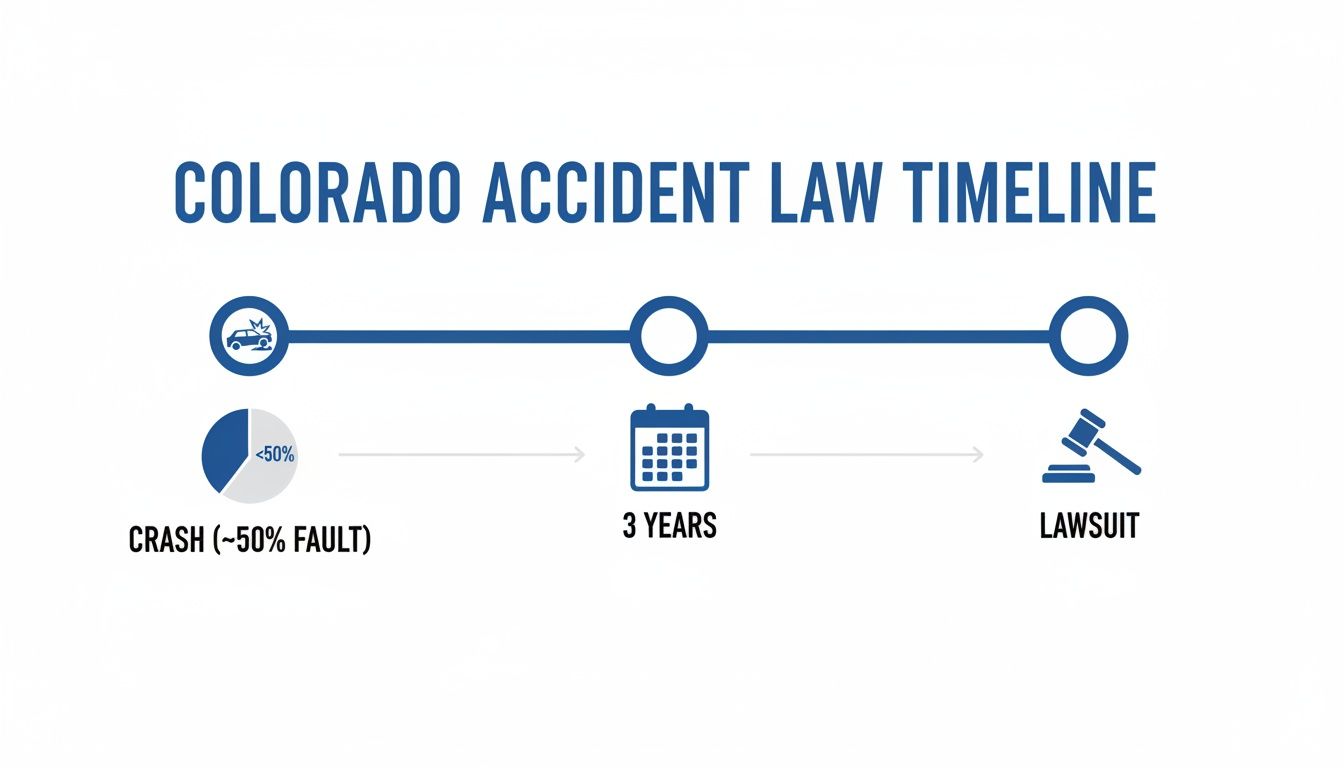
If negotiations don't produce a fair result, the next step is filing a lawsuit. That doesn't mean the case will go to trial; many cases still resolve after filing, through discovery and mediation. Thorough preparation, medical records, and expert analysis strengthen the claim at every stage.
Real Car Accident Settlement Examples
These are actual settlements from Colorado car accident cases:
Real Car Accident Settlements
Settlement Value vs. Available Coverage
Your case value and the amount you can recover may differ. Colorado requires only $25,000/$50,000 minimum liability coverage. If the at-fault driver carries minimum coverage, your recovery may be limited regardless of your actual damages—unless you have underinsured motorist (UIM) coverage or other sources apply.
Past results do not guarantee future outcomes. Each case is unique and results depend on specific facts and circumstances. Settlement amounts shown represent actual recoveries for clients but should not be considered a prediction of results in your case.
An Attorney Who Costs You Nothing Upfront
How are you supposed to afford a lawyer when you're already out of work and facing medical bills? That's what contingency fee arrangements are for. Personal injury attorneys typically handle cases on contingency, meaning they advance costs and are paid only if the case settles or wins at trial. That lets injured people focus on recovery instead of upfront attorney fees.

Under the contingency fee model, the attorney receives no payment unless the client receives compensation. The fee is a percentage of the final settlement or verdict. This matters most in serious cases, where the at-fault driver's coverage may be limited and additional coverage sources need to be identified. Clients pay nothing upfront, so they can focus on recovery while their lawyer handles negotiations and, if needed, litigation.
Contingency fees also align incentives: the attorney is paid only when the client recovers. An attorney working on contingency has every reason to identify all coverage, document the full claim, and hold responsible parties accountable.
The Value of Experienced Counsel
An experienced attorney often adds more value to a case than the fee. Legal representation helps with recorded statements, early offers, and delays, and brings an understanding of claim valuation, how insurers calculate damages, and when an offer falls short. Counsel also manages documentation and deadlines and preserves evidence that people handling claims on their own may overlook.
Negotiating non-economic damages is often where representation makes a meaningful difference, through medical evidence, documentation of daily-life effects, and knowledge of case valuation and insurance law.
An experienced attorney navigates insurance claims, identifies all available coverage sources, including uninsured and underinsured motorist coverage, and pursues fair compensation for medical expenses, lost wages, and vehicle damage.
Liens and Reimbursement Claims
Beyond the main settlement, medical liens and reimbursement claims can affect how much of a recovery you keep. A Colorado hospital lien, a private health-plan reimbursement claim, Medicare conditional payments, Medicaid recovery, and an ERISA plan claim can each follow different rules. Some may be negotiable or reduced for procurement costs, but there's no one-size-fits-all lien reduction.
- Medical Liens: If your health insurance paid for your treatment, it may have a right to reimbursement from your settlement, depending on the plan and the type of coverage. We review each lien and negotiate where the rules allow.
- Subrogation: Your own auto insurer may also assert reimbursement or subrogation rights for some benefits it paid. Those claims depend on the policy and are reviewed before funds are distributed. Colorado MedPay is generally the exception: under C.R.S. § 10-4-635(3), the MedPay carrier cannot recover what it paid from the at-fault driver or from you, except in cases of fraud.
Every lien should be verified by payer type, statute, and plan language before settlement funds are distributed. A personal injury lawyer handles that review alongside investigating the claim and calculating full damages, including future medical costs and lost wages.
Your Questions, Answered—No Legal Jargon Allowed
After a crash, things can feel chaotic, and straight answers help. Here are answers to common questions. One basic point first: Colorado requires drivers to carry at least $25,000 per person and $50,000 per accident for bodily injury, plus $15,000 for property damage. Those are minimums, not a measure of what a claim is worth.
How Much Is My Car Accident Claim Actually Worth?
There's no formula for calculating a car accident claim's value. It reflects your specific losses, which fall into two categories. Economic damages are the measurable costs: medical bills, vehicle repairs, and lost paychecks. Non-economic damages cover the human cost: pain and suffering, emotional distress, and diminished quality of life.
Every case is unique, and recovery depends on medical expenses, lost wages, property damage, and the length of recovery. Colorado's minimum liability limits may be insufficient for serious injuries, which is why uninsured and underinsured motorist coverage can be especially valuable. Settlement value depends on documented medical treatment, lost income, pain and suffering, and the at-fault driver's policy limits. Catastrophic or permanent injuries are valued very differently from short-term ones.
How Long Will This Whole Thing Take?
Patience is important in any car accident claim. A straightforward case with clear liability and minor injuries might wrap up in a few months, while complex claims often take more than a year. Medical records must be gathered, expert opinions obtained, and negotiations conducted, sometimes with multiple insurers. Realistic expectations help you avoid settling prematurely.
The clock is driven by:
- The Severity of Your Injuries: You should never settle until you've reached "maximum medical improvement."
- Disputes Over Fault: If the other driver denies responsibility, it takes time to prove what happened.
- The Insurer's Approach to Negotiation: Some insurers move slowly, which can make an early offer tempting.
Should I Take the Insurance Company’s First Offer?
Usually not. The first offer is often made before the full extent of the injuries and future care needs is known, and it typically reflects only part of the actual damages. Colorado's minimum liability requirements are a legal floor, not a measure of fair compensation. An initial offer may not account for medical expenses, lost wages, pain and suffering, and future care needs.
Accepting an early settlement means signing a release, which usually ends the claim even if injuries worsen later. Waiting for medical clarity and a full valuation of losses protects your ability to pursue fair compensation.
Can I Still Get a Settlement if I Was Partly at Fault?
Yes, as long as you were less than 50% at fault. Colorado uses a modified comparative fault rule (C.R.S. § 13-21-111): an injured driver can recover damages if they were less than 50% responsible, but not at 50% or more. The award is reduced by the driver's percentage of fault. For example, if damages total $50,000 and the driver is found 30% at fault, they would receive $35,000. Because the 50% line is decisive, evidence about how the crash happened matters a great deal.
Related Settlement Guides
Explore settlement values for specific accident and injury types:
- Rear-End Accident Settlements – Colorado's most common crash type
- T-Bone Accident Settlements – Side-impact collision values
- Whiplash Settlements – Soft tissue injury compensation
- Herniated Disc Settlements – Spinal disc injury claims
Disclaimer: This blog post is for informational purposes only and does not constitute legal advice. The information provided herein is not intended to create, and receipt of it does not constitute, an attorney-client relationship. You should consult with an attorney for advice regarding your individual situation.
A car accident claim in Colorado involves insurance requirements, liability questions, and settlement negotiations happening at once, along with medical documentation, police reports, and insurance correspondence. Free consultations are available for injured people who want guidance without financial pressure.

Written by
Elliot Singer, Esq.
Personal injury attorney at Conduit Law, dedicated to helping Colorado accident victims get the compensation they deserve.
Learn more about our team