

Table of Contents
If you slipped and fell at a Colorado grocery store, your claim usually comes down to one question: did the store know — or should it have known — about the hazard and fail to fix it? That's the legal idea of "notice," and it's where most grocery-store cases are won or lost. The single most important thing you can do is move fast to lock down the store's surveillance video before it's recorded over.
That spill on the floor by the dairy case usually isn't bad luck — it's a store that didn't follow its own sweep-and-inspect routine. This guide covers the parts that are specific to grocery-store falls: the store's duty to shoppers, how notice gets proven, what drives value, and the evidence you need to grab before it disappears. For the broader rules on Colorado slip-and-fall law and settlements generally, see our Colorado slip-and-fall settlement guide.
The Store Owes Shoppers a Real Duty
When you walk into a grocery store to shop, you're not just a guest — you're there for the store's business benefit, which generally makes you an "invitee" under Colorado's Premises Liability Act (C.R.S. § 13-21-115), the class of entrant owed the highest duty of care. In practice, that means the store has to take reasonable steps to find and fix dangers it knew about or should have discovered, not just react after someone gets hurt.
This is the foundation of a grocery-store case, and it matters because it reframes the whole thing. It's not about a shopper being clumsy. It's about a business that took your money and didn't hold up its end on basic safety. A momentary misstep doesn't erase that obligation.

It Comes Down to One Word: Notice
The store's insurer will spend most of its energy attacking notice, because if there's no notice, there's usually no case. There are two flavors of it.
Actual notice
Someone at the store actually knew. An employee saw the puddle from a leaking freezer, walked past it, and did nothing. It's the strongest version — but it's also the rarest, because you usually need a witness or a paper trail to prove a specific person knew.
Constructive notice — the one that matters
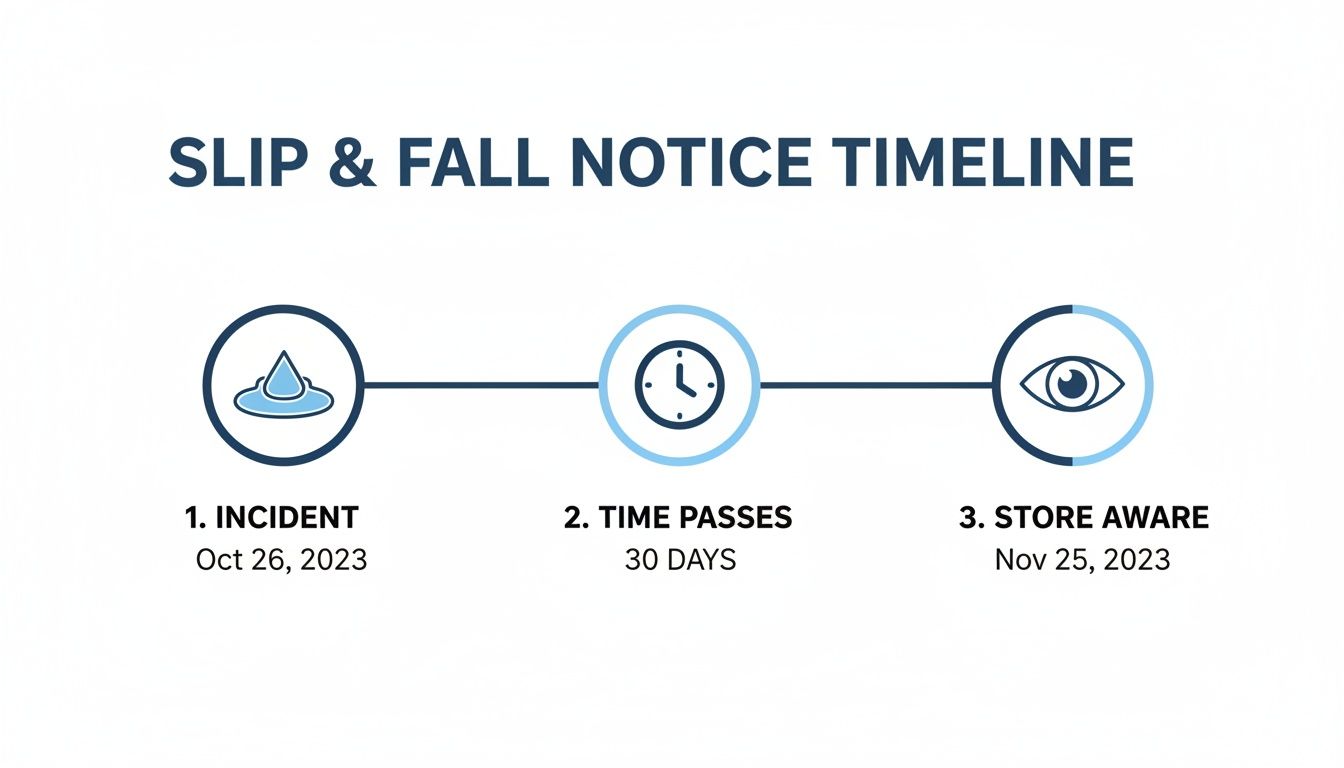
This is where most grocery cases live. Constructive notice means the hazard — the spill, the dropped grapes, the ice tracked in from the parking lot — sat there long enough that a store doing its job should have found and cleaned it. You don't have to prove anyone actually saw it. You prove the store's own routine failed: sweep logs that go blank for hours, inspection schedules nobody followed, video showing the spill sitting untouched. It's not about what they knew — it's about what their own safety rules say they should have known.
The "open and obvious" dodge
When the insurer can't deny the hazard was there, it pivots to blaming you: the danger was "open and obvious," so you should have seen it and stepped around it. It's an infuriating argument — retailers spend millions getting your eyes on products at eye level, then act shocked you weren't staring at the floor. Whether and how far this defense applies is a fact-specific legal question under the Premises Liability Act (C.R.S. § 13-21-115), so don't assume it sinks your claim.
What Drives the Value of a Grocery-Store Claim
A settlement isn't a number someone picks out of the air — it's built from your specific, documented losses. Amounts are highly case-dependent. The factors below move the value up or down:
- Strength of the notice evidence — surveillance video, sweep/inspection logs, witnesses, prior incidents in the same spot.
- Medical expenses — the ambulance, ER, imaging, surgery, physical therapy, and the future care your doctors say you'll need.
- Lost income — wages you missed, plus reduced earning capacity if the injury permanently limits the work you can do.
- Severity and permanence of the injury — a sprain and a shattered wrist that needs hardware are not the same case.
- Pain, limitation, and lost enjoyment — the chronic pain, the hobbies you can't do, the sleep you don't get. Colorado caps these non-economic damages; for claims that accrue on or after January 1, 2025, and actions filed during 2025, the general cap is $1.5 million (with the first inflation adjustment in 2028). Economic losses like medical bills and lost wages aren't subject to that cap, so confirm how the limit applies to your case.
- Comparative fault — if you're assigned a share of the blame, it can reduce or, past a threshold, bar recovery. The insurer will push this hard, which is another reason solid evidence matters.
Reported grocery-store fall settlements run a wide range — modest for a minor injury that fully heals, into six figures and beyond where surgery or permanent impairment is involved. Treat any range as illustrative, not a promise; your case is its own thing.
Grab the Evidence Before the Store Deletes It
Here's the part that's genuinely urgent. One piece of evidence can carry a grocery-store case: the store's surveillance video. And it's on a timer. Many chains overwrite footage in a matter of days — sometimes as little as 48 hours — and once it's gone, it's gone. The video that would have proven the spill sat there for 40 minutes disappears before a lot of injured shoppers even realize they have a claim.
That's why the first real move is a spoliation letter — a formal, documented demand that the store preserve the video and everything else tied to your fall. If a store destroys evidence after getting one, a court can hit it with sanctions, including telling the jury to assume the missing footage would have helped your side. Big chains also run on paperwork, and that paperwork cuts against them when it's incomplete: a training manual that says inspect the produce aisle every 15 minutes, next to an inspection log that's blank for two hours before your fall, is the kind of contradiction juries notice.
What to Do in the First Hours
It's chaos right after a fall, but the first few hours shape the whole claim.
- Report it and get a name. Find a manager, insist on a written incident report, and get that manager's full name.
- Document the scene. Photograph the hazard, the area, your shoes, and any visible injury. Get names and numbers from witnesses before they leave.
- Get medical care the same day. Go to urgent care or the ER. A delay hands the insurer its favorite argument — that you weren't really hurt.
- Call a lawyer fast. The sooner a preservation letter goes out, the better the odds that surveillance video still exists.
This isn't a game — it's a fight with a company that sees you as a line item. Don't let the video disappear before someone's working your side of it.
Hurt in a grocery-store fall in Colorado? Call Conduit Law at (720) 432-7032 for a free, no-obligation consultation. For the broader rules that apply to every Colorado slip-and-fall claim, read our Colorado slip-and-fall settlement guide.
Disclaimer: This post is general information, not legal advice. Every case is different — talk to a qualified attorney about your specific situation. Past results don't guarantee future outcomes.

Written by
Elliot Singer, Esq.
Personal injury attorney at Conduit Law, dedicated to helping Colorado accident victims get the compensation they deserve.
Learn more about our team

